Description
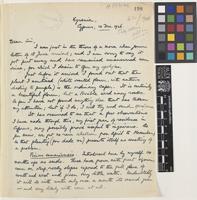
Campbell apologises for not replying to Hill's letter of 18 June sooner: it arrived when he was in the midst of moving and got misplaced. The white scented flower he mentioned is, in fact, the ordinary caper. It is a beautiful flower, but a terrible weed among rocks. Campbell goes on to list some of the observations he has made during his first year in Cyprus, as they may be useful 'to inquirers'. They get no rain from April to November, which can make planting a problem. He introduced Pinus canariensis from seed 14 months ago. It has grown with great vigour, even on dry rocky slopes. Lycium horridum was already introduced in a few gardens but Campbell has extended it further from seeds. It grows vigorously without being watered providing it can throw its roots well down. He introduced Phlomis fruticosa as seed 14 months ago; this is probably native in parts and also does well without water. Cupressus macrocarpa does as well as, if not better than, the native cypress. He planted young trees of Quercus ilex into deep holes at the end of January. Three out of five survived and continued to grow over the summer with no watering at all. As a general observation, he concludes that any deep-rooting plant will survive its first year without water providing it can throw its roots down quickly. In August the soil is quite cool further down and he is confident that a three foot hole, with some organic matter at the bottom, will remain slightly moist and be suitable for planting. Campbell discusses the root growth of some Quercus infectoria he planted in pots from seed last Christmas. Planting seedlings from pots is, he concludes, more successful that uprooting and replanting them. Fraxinus ornus and Caragana arborescens also seem to do well, but he expects they will need water over the first summer. Spartium junceum is also alright, but is devoured by cicadas. He has had no success with any Abies, even those from hot countries: this might be due to a lack of humus in the soil. Page 1 of 3.