

Compilation
Zygophlebia devoluta
1 Images see all
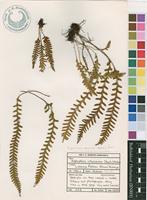
Name
Identification
Zygophlebia devoluta (Baker) Parris [family GRAMMITIDACEAE ] (stored under name); Verified by Burrows, J.E., 2006
Related name
- Zygophlebia devoluta
Flora
Entry for Zygophlebia devoluta (Baker) Parris [family GRAMMITIDACEAE]
Herbarium
Royal Botanic Gardens, Kew (K)
Collection
Flora of Tropical East Africa
Resource Type
Reference Sources
Entry From
Flora of Tropical East Africa, page 1, (2005) Author: B. S. Parris
Names
Zygophlebia devoluta (Baker) Parris [family GRAMMITIDACEAE], in K.B. 57, 2: 432 (2002). Type: Madagascar, Pool s.n. (K!, holo.)
Polypodium devolutum Baker [family POLYPODIACEAE], in J.L.S. 15: 419 (1876)
Ctenopteris devoluta (Baker) Tardieu [family ], in Notul. Syst. (Paris) 15(4): 445 (1959)
Xiphopteris villosissima [family GRAMMITIDACEAE], [sensu Schelpe in Contr. Bolus Herb. 1: 8 (1969) pro parte, non (Hook.) Alston]
Xiphopteris flabelliformis [family GRAMMITIDACEAE], [sensu Schippers in Fern Gaz. 14(5): 192 (1993), non (Poir) Schelpe]
Information
Rhizome short-creeping, not branched. Stipes 0.1– 1.1 mm apart in each row; scales narrowly lanceolate to linear-lanceolate, 2.2– 6.7 mm long, 0.3– 0.5 mm wide. Stipe 12– 93 mm long, with simple eglandular hairs 0.9– 3.4 mm long. Lamina narrowly elliptic to narrowly lanceolate in outline, 62– 169 mm long, 15– 27 mm wide, apex bluntly acute, ± truncate to attenuate at base, pinnate or deeply pinnately divided to a distance 0.1– 0.6 mm from the midrib, pinnae 14– 47 pairs and 1– 4 pairs of apical lobes, lowest pair of pinnae sometimes reduced to auricles, usually 2 mm or more long, longest pinnae 6– 15 mm long, 2– 5 mm wide, narrowly oblong to narrowly oblanceolate, bluntly acute to obtuse at apex; with simple eglandular hairs 0.8– 3.7 mm on both surfaces of lamina and on margin, and translucent 1– 2-forked catenate glandular hairs 0.1– 0.2 mm as receptacular paraphyses; lateral vein branchlets free, or branchlets of the same vein branch sometimes anastomosing at apex near margin. Sori on 12– 37 pairs of pinnae, in apical 1/3 to ± throughout lamina including basal pair of pinnae, 1– 9 in each row on longest pinnae, apical 1/5 to ± throughout pinnae, midway between pinna mid– vein and margin. Fig. 5/5– 5/9.
Range
T 3, 6, 7
Altitude range
1600– 1900 m
Distribution
Tanzania Lushoto District W Usambaras, Shagayu Forest Reserve, 20 Oct. 1986, Schippers T 1583!;Tanzania Morogoro District Uluguru Mts, road from Morningside to Bondwa summit, 3 April 1974, Faden 74/392!;Tanzania Rungwe District Kyimbila, Lukeke, 23 Sept. 1911, Stolz 883!
Distribution (external)
; Madagascar
Notes
A small sterile plant from the West Usambaras (NW on crest of Kisimba above Mazumbai, April 1926, Peter 16491 (B)) probably belongs here. It has identical rhizome scales, but rather sparse laminar indumentum which may reflect the aged nature of the fronds. Zygophlebia devoluta is the East African and Madagascan vicariant of Z. villosissima, which differs in broader rachis wing and shorter proportionately broader pinnae. Stolz 883 is more densely hairy than the other two Tanzanian collections, while the type from Madagascar has slightly shorter lamina hairs than Tanzanian material. The spores of Faden 74/392 (K) are very sparse and largely aborted; the young sporangia appear to be empty in K and MO collections. Likewise the spores of Stolz 883 (B, K) are largely misshapen.