JSTOR Global Plants Home
  • Home
  • Browse
  • About
  • Access
  • Account
    • Saved Items
    • Profile
  • Log in

Global Plants

Skip to Main Content
  • JSTOR Global Plants Home
  • Global Plants

    • Browse
    • About
    • Access
    • Account
      • Saved Items
      • Profile
Log in
  • Browse
  • About
  • Access
  • Account
    • Saved Items
    • Profile
Advanced Search

Compilation
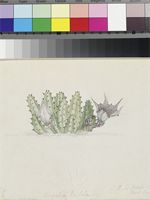
Stapelia barbata

2 Images see all

Stapelia barbata Masson original illustration by Francis Masson
Huernia barbata (Masson) Haw. [family ASCLEPIADACEAE]
Previous
Next

Name

Identification
Stapelia barbata Masson [family APOCYNACEAE ]
Related name
  • Stapelia barbata

Flora

Entry for HUERNIA barbata Haw. [family ASCLEPIADACEAE]
Herbarium
Royal Botanic Gardens, Kew (K)
Collection
Flora Capensis
Resource Type
Reference Sources
Entry From
Flora Capensis, Vol 4, page 518, (1909) Author: By N. E. BROWN.
Names
HUERNIA barbata Haw. [family ASCLEPIADACEAE], Syn. Pl. Succ. 31;—Schultes, Syst. Veg. vi. 8; Loud. Hort. Brit. 97, and Encycl. Pl. 202; G. Don, Gen. Syst. iv. 113; Decne in DC. Prodr. viii. 651; Schlechter in Journ. Bot. 1898, 485.
HUERNIA crispa Haw. [family ASCLEPIADACEAE], Syn. Pl. Succ. 31; Schultes, l.c. 8; G. Don, l.c. 113; Decne, l.c. 651; Schlechter in Journ. Bot. 1898, 485.
HUERNIA barbata Loud. var. crispa [family ASCLEPIADACEAE], Encycl. Pl. 202.
Heurnia barbata Spreng. [family ], Syst. Veg. i. 841; Dietr. Syn. Pl. ii. 887 (excl. syn. S. humilis, Masson).
Stapelia barbata Masson [family ASCLEPIADACEAE], Stap. 11, t. 7; Willd. Sp. Pl. i. 1293; Pers. Syn. Pl. i. 280; Jacq. Stap. t. 2; Poir. Encycl. vii. 389, and in Dict. Sc. Nat. l. 395; Ait. Hort. Kew. ed. 2, ii. 95; Lodd. Bot. Cab. t. 225; Bot. Mag. t. 2401.
Information
stems erect, 1 1/2–2 1/2 in. long, 1/2– 3/4 in. thick, acutely 4–5-angled, glabrous, glaucous-green; angles with spreading deltoid acute teeth 1 1/2 lin. long; flowers 2 or more, successively developed near the base of the young stems; pedicels 1/4– 1/3 in. long, rather slender, glabrous; sepals about 1/4 in. long, lanceolate-subulate, glabrous; corolla acutely pointed and pentagonal in bud, when expanded 1 1/4–2 in. in diam., campanulate, with ascending-spreading or gradually recurving lobes, glabrous and without spots outside, clear or dirty sulphur-yellow to pale buff on the inside, marked on the lobes and upper part of the tube with blood-red dots, which pass into transverse interrupted lines on the lower part of the tube, covered from the middle of the tube to the base or to 2/3 of the way up the lobes with long stiff clavate purple hairs, which become minute upon the lobes, each seated on a purple-brown papilla, with the tips and margins of the lobes papillate; tube 2/3–1 in. long; lobes 1/2– 2/3 in. long and nearly as broad, deltoid, acuminate; outer-corona 5-lobed, blackish or blackish-crimson; lobes subquadrate, emarginate or shortly and obtusely bifid; inner corona-lobes 1 1/2–2 lin. long, subulate, slightly gibbous at the base, connivent over the style-apex at the basal part, then divergent-ascending, with suberect tips, purple. null
Distribution
CENTRAL REGION Somerset Div.; near Sheldon, Mrs. Hutton in Herb. Pillans, 162! cultivated specimens, MacOwan! Colesberg Div.? cultivated specimens from a plant collected “in the Karoo towards Colesberg,” Shaw!KALAHARI REGION Var. γ: Griqualand West; Diamond Fields, Tuck in Herb. MacOwan, 2245!SOUTH AFRICA without locality, Masson, and cultivated specimens! VAR. β, cultivated specimens!
Notes
Described (except var. γ) from living plants. The ground colour of the corolla varies, as upon one plant sent to me by Dr. Shaw in 1874 I had open at the same time flowers with a clear sulphur-yellow ground and spreading limb and others with a dirty sulphur-yellow ground and recurved limb. Occasionally 6-lobed flowers are produced, and a plant of the variety tubata, with 6-lobed flowers was figured with a distinct name by Jacquin, but in my experience this is not a constant character, the plant always reverts to the normal 5-lobed flowers.

Related Materials

  • Terms and Conditions
  • Privacy Policy
  • Cookie Policy
  • Cookie Settings
  • Accessibility
  • Help
  • Contact Us
  • Facebook
  • Twitter
ITHAKA

JSTOR is part of ITHAKA, a not-for-profit organization helping the academic community use digital technologies to preserve the scholarly record and to advance research and teaching in sustainable ways.

©2000-2026 ITHAKA. All Rights Reserved. JSTOR®, the JSTOR logo, JPASS®, Aluka®, and ITHAKA® are registered trademarks of ITHAKA.

╳