

Compilation
Saintpaulia brevipilosa
1 Images see all
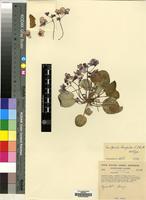
Name
Identification
Saintpaulia brevipilosa B.L.Burtt [family GESNERIACEAE ] Verified by B. L. Burtt, 1963 Saintpaulia ionantha H. Wendl. [family GESNERIACEAE ] (stored under name); Verified by Darbyshire, I., 2006
Related name
- Saintpaulia ionantha
- Saintpaulia brevipilosa
Flora
Entry for Saintpaulia ionantha (B.L.Burtt) I.Darbysh. subsp. velutina [family GESNERIACEAE]
Herbarium
Royal Botanic Gardens, Kew (K)
Collection
Flora of Tropical East Africa
Resource Type
Reference Sources
Entry From
Flora of Tropical East Africa, page 1, (2006) Author: IAIN DARBYSHIRE
Names
Saintpaulia ionantha (B.L.Burtt) I.Darbysh. subsp. velutina [family GESNERIACEAE], stat. nov. Type: Tanzania, Lushoto District, W Usambara Mts, Balangai, 8 km from Sakarre, comm. Punter ref. D, cult. in R.B.G. Edinb., C.1579 (E!, holo.)
Saintpaulia velutina B.L.Burtt [family GESNERIACEAE], in Notes Roy. Bot. Gard. Edinb. 22: 563 (1958) & in Notes Roy. Bot. Gard. Edinb. 25: 194 (1964); Iversen in Symb. Bot. Upsal. 28: 242 (1988); Watkins et al., Wild Afr. Violet: 47 (2002)
Saintpaulia brevipilosa B.L.Burtt [family GESNERIACEAE], in Notes Roy. Bot. Gard. Edinb. 25: 193 (1964); Watkins et al., Wild Afr. Violet: 47 (2002). Type: Tanzania, Morogoro District, Nguru Mts, Lulaga, comm. Punter ref. 59/4350, cult in R.B.G. Edinb., C.3827 (E!, holo.), syn. nov.
Information
Plants rosulate. Leaves strongly purple or more rarely green beneath; blade broadly ovate to orbicular, 2–8.5 cm long, margin subentire, crenate or crenate-serrate, apex rounded to broadly obtuse, upper surface densely erect puberulent, with or without interspersed long erect to arced hairs. Petioles, peduncles and pedicels with spreading, ascending or suberect hairs of variable length. Inflorescences 2–6-flowered. Corolla deep blue-purple throughout or with the lobes paler towards the margins, rarely paler throughout, margin variously with predominantly glandular or predominantly eglandular hairs or with a mixture of both. Capsule 11–20 mm long, 2–3 mm diameter.
Range
DISTR. T 3, 6 restricted to the W Usambara, Nguru and Uluguru Mts
Altitude range
(350–)700–1500 m
Distribution
TANZANIA Lushoto District Balangai, Jan. 1953, Faulkner 1126!TANZANIA Morogoro District Kanga Mt, July 1983, Polhill & Lovett 4956! & ibid., Dec. 1987, Lovett & D.W. Thomas 2787!
Notes
USES. None recorded on herbarium specimens. CONSERVATION This taxon is currently known from less than 10 sites over a rather broad distribution in the Tanzanian highlands. Populations at Kanga in the Nguru Mts appear healthy and largely unthreatened. However, forest at the type locality, Balangai in the W Usambaras, has been seriously degraded in recent decades through timber extraction and agricultural encroachment. It is therefore assessed as Vulnerable (VU B2ab(iii)) The type collections of S. velutina and S. brevipilosa (and the resultant cultivated stock) appear very different and it is with reluctance that S. brevipilosa is here reduced to synonymy. However, a review of the material from Kanga Mt (T 6), clearly demonstrates the variability possible within this taxon. Plants from the lowest altitudes (Polhill & Lovett 4956!, 750 m alt.) have large, subentire leaves with a puberulent indumentum (although close examination reveals the presence of somewhat longer hairs); such plants are close to the type of S. brevipilosa. A specimen from 1000–1100 m alt. (Pócs 6137/C!) has a more variable indumentum, with some of the younger leaves clearly having some longer hairs. At higher elevations (1200–1500 m alt., e.g. Lovett & D.W. Thomas 2787!), the leaves are smaller and clearly crenate and have conspicuous long hairs interspersed within the puberulent indumentum. Such specimens are practically inseparable from plants from Balangai in the Usambara Mts, the type location of subsp. velutina. Slight differences do occur, notably that in the Kanga material the marginal hairs of the corolla are predominantly eglandular (glandular in Balangai), the petioles, peduncles and pedicels have subappressed to ascending hairs (spreading in Balangai) and the leaf margin is subentire to crenate (crenate-serrate in Balangai). However, such differences are inconsistent; for example, in the type specimen of S. brevipilosa the hairs on the petioles, peduncles and pedicels are spreading and the marginal hairs of the corolla are mixed glandular and eglandular. The fruits of the Usambara populations are currently known only from a single, immature specimen (Iversen et al. 84263!); and appear somewhat shorter than the Nguru plants, though some are cylindric. It is the narrower cylindric fruits that principally separate this taxon from subsp. ionantha var. diplotricha, although the more dense minute hairs in subsp. velutina give the leaves a more velvety texture. The habitat also differs significantly between the two taxa. A collection from 720 m alt. in the Mkungwe Catchment Forest Reserve in the northeast Uluguru Mts (Jannerup & Mhoro 271!) with diplotrichous leaves which are subentire when mature is placed within this taxon. This represents the only collection of the S. ionantha complex known from the Uluguru Range. It is interesting in having scattered long glandular hairs on some of the pedicels. However, some plants lack this character, thus it is not considered sufficiently consistent to be of taxonomic significance. Further analysis of this population, including collection of fruits, is desirable to confirm its placement. The taxon recorded as S. cf. velutina B.L.Burtt by Lindqvist & Albert (in K.B. 54: 367 (1999); = S. sp. nov. Mhonda sensu Schulman & Kolehmainen in Scripta Bot. Belg. 29: 168 (2004)) possibly refers to this subspecies. The voucher (not seen in the current study) is recorded as having been collected from the Dibohelo River near Mhonda Mission in the Nguru Mts. The genetic data suggests that the Nguru material (both S. brevipilosa and S. cf. velutina) is genetically distinct from the Usambara group (which includes the type locality of S. velutina) which disagrees with the current circumscription of subsp. velutina .