

Compilation
Rhabdotosperma keniensis
1 Images see all
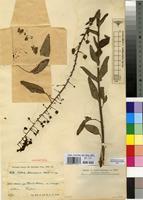
Name
Identification
Celsia keniensis Murb. [family SCROPHULARIACEAE ] Verified by Not on sheet, Rhabdotosperma keniensis (Murb.) Hartl [family SCROPHULARIACEAE ] (stored under name); Verified by Not on sheet,
Related name
- Celsia keniensis
- Rhabdotosperma keniensis
Flora
Entry for Verbascum brevipedicellatum (Engl.) Huber-Morath [family SCROPHULARIACEAE]
Herbarium
Royal Botanic Gardens, Kew (K)
Collection
Flora of Tropical East Africa
Resource Type
Reference Sources
Entry From
Flora of Tropical East Africa, page 1, (2008) Author: S.A. GHAZANFAR, F.N. HEPPER & D. PHILCOX
Names
Verbascum brevipedicellatum (Engl.) Huber-Morath [family SCROPHULARIACEAE], in Bauhinia 5: 11 (1973); Blundell, Wild Fl. East Afr.: 378, pl. 393 (1987); U.K.W.F.: 254 (1994). Type: Tanzania, Kilimanjaro [Kilimandscharo], Meyer 286 (B†, holo.). Neotype: Tanzania, Kilimanjaro, SE of Bismark hut, Bigger 2012 (K!, chosen here)
Celsia brevipedicellata Engl. [family SCROPHULARIACEAE], in Abhandl. Akad. Wissensch. Berlin 1891(2): 376 (1892); Skan in F.T.A.: 4(2): 285 (1906); Murb. in Lunds Univ. Arsskr. 22, 1: 65 (1925); A.V.P.: 164 (1957); F.P.U. ed. 2: 133 (1971)
Celsia brevipedicellata Murb. var. homostemon [family SCROPHULARIACEAE], in Lunds Univ. Arsskr. 22, 1: 67 (1925). Type: Kenya, Aberdare Mts, 13 March 1922, R.E. & T.C.E. Fries 2262 (UPS!, holo.)
Celsia brevipedicellata Murb. var. heterostemon [family SCROPHULARIACEAE], in Lunds Univ. Arsskr. 22, 1: 68 (1925). Type: East Africa, unspecified
Celsia keniensis Murb. [family SCROPHULARIACEAE], in Lunds Univ. Arsskr. 22, 1: 70, t. 2 (1925); Glover, Prov. Check-List Brit. & It. Somal.: 244 (1947). Type: Kenya, Mt Kenya, R.E. & T.C.E. Fries 458 (K!, UPS, syn.), 1869 (UPS!, syn.)
Celsia floccosa [family SCROPHULARIACEAE], [sensu Agnew UKWF: 550 (1974), non Benth.]
Rhabdotosperma brevipedicellata (Engl.) D.Hartl [family SCROPHULARIACEAE], in Beitr. Biol. Pfl. 53(1): 58 (1977); Fischer, F. A.C. Scrophulariaceae: 12, pl. 2 (1999) & in Fl. Ethiop. & Eritr. 5: 252 (2006)
Rhabdotosperma keniensis (Murb.) D.Hartl [family SCROPHULARIACEAE], in Beitr. Biol. Pfl., 53 (1): 58 (1977); Fischer in Thulin (ed.), Fl. Somal.: 3: 266 (2006)
Information
Biennial herb, somewhat woody at the base, 0.6–2.5 m high; stems almost glabrous to densely floccose, often tinged deep red. Lower leaves petiolate, petiole 1–2.5 cm long; blade simple or occasionally with small pinnate lobes on the petiole, oblong-lanceolate, 3–12 cm long, 1.5–4 cm wide, obtuse to acute, truncate at the base, ± glabrous or pubescent above, pubescent or floccose beneath, margins biserrate; upper leaves ± sessile, sometimes with base clasping. Inflorescence simple or sparingly branched; bracts lanceolate, 3–5(–12) mm long, sessile, serrate; pedicels in fruit 1.3–2.5 cm long, ± glandular-pubescent. Calyx deeply divided, 5–6 mm long in fruit, 2/3 as long as the mature capsule. Corolla yellow with purple streaks at centre, about 2 cm diameter. Stamens reddish-purple bearded; anthers orange; style purplish. Capsule ovoid, 6–8 mm, glabrous. Seeds striate. Fig. 3, p. 15.
Range
DISTR. U 1–3; K 1–6; T 2, 3, 6
Altitude range
1200–3600(–4100) m
Distribution
KENYA Mt Kenya, April 1975, Hepper, Field & Townsend 4879!KENYA Kericho District Sotik, 15 June 1953, Verdcourt 974!KENYA Masai District Enesambulai valley, 12 Sept. 1970, Greenway & Kanuri 14572!TANZANIA Mt Kilimanjaro, 21 July 1968, Bigger 2012!TANZANIA Masai District Ngorogoro Crater, 5 Sept. 1964, Richards 19130!TANZANIA Lushoto District Mkuzi, 1 Sept. 1971, Greenway 8697!UGANDA Karamoja District Moroto Mt, June 1963, J. Wilson 1487!UGANDA Kigezi District Kigezi, April 1949, Purseglove 2721!UGANDA Mt Elgon, April 1930, Liebenberg 1668!
Distribution (external)
Congo-Kinshasa
Sudan
Ethiopia
Somalia
Notes
USES. An important medicinal herb whose dried leaves mixed with water are used to prevent (cure) kwashiorkor and fresh leaves used to help with afterbirth.. CONSERVATION Least Concern (LC); common and widespread This is an extremely variable species; field studies would be necessary to study the morphological variations (if constant) amongst populations. With the material that I (S.A.G.) have studied, it is difficult to recognise the species (and even less the infraspecific ranks) that have been described around this species.