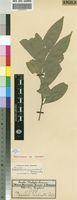
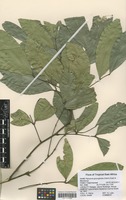
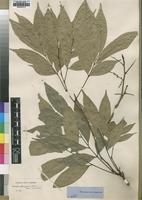
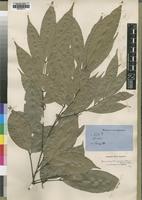
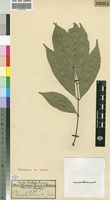
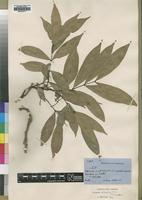
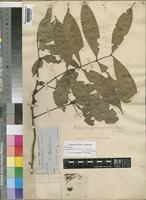
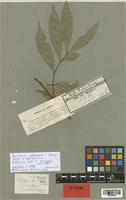
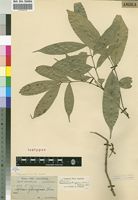
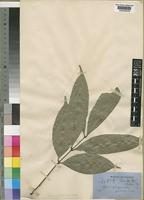
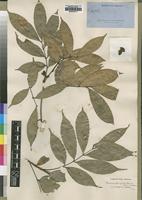
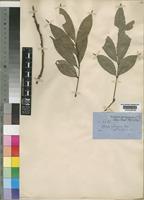
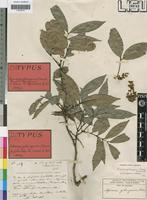
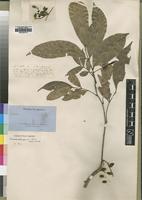
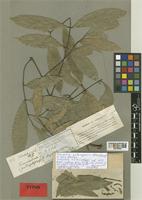
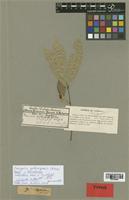
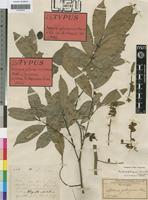
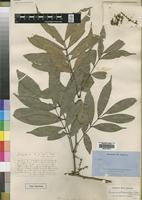
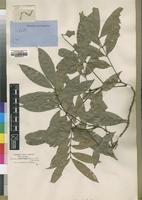
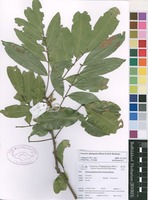
Shrub or small tree 1.8–18 m. tall with glabrous branches; bark pale grey-brown, described as rough or smooth; twigs densely lenticellate. Leaves often drying grey-green; petiole slender, 2.5–15 cm. long, thickened at base, glabrous; rhachis 6–12 cm. long; petiolules 5–7 mm. long; leaflets in (2–)3–5 pairs, rarely 2 but probably always some with more (see note), oblanceolate to broadly elliptic-oblong, obovate or elliptic, 5.5–27+ cm. long, 1.7–7(–12) cm. wide, rounded to subacute or distinctly acuminate or rarely emarginate at the apex, cuneate at the base, glabrous. Inflorescences axillary and on the older wood, narrowly thyrsoid with single flowers or subsessile ± 3-flowered cymules spaced at intervals, ferruginous pubescent; male 2–20.5 cm. long, pedicels 0–2.5 mm. long; female mostly shorter, 2.5–5(–7) cm. long, pedicels 2–2.5 mm. long (in Flora area – 5–7 mm. in Natal). Male flowers: calyx-tube 1–2 mm. long, lobes triangular, 2–3 mm. long, velvety brown-pubescent outside; petals white or cream, obovate, the limb 2 mm. long and wide, scale bilobed, with a pair of simple or forked ligulate appendages; disk semicircular; stamens 8 with pilose filaments 7 mm. long. Female flowers: ovary 1.8 mm. long, ferruginous pubescent; style and stigma 3 mm. long. Fruit orange-yellow, with 1–3 mericarps developing, joined for up to 2/3 their length, each ellipsoid, compressed, 1.5–2 cm. long, 1.1–1.5 cm. wide, up to 1.1 cm. thick, sometimes only one developing then other 2 remaining at its base, ± 6 mm. long; pedicels ± 3 mm. long. Seeds pale brown or dark, compressed ellipsoid, 1.2–1.8 cm. long, 0.8–1.3 cm. wide, up to 8 mm. thick.