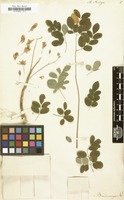
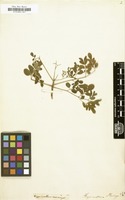
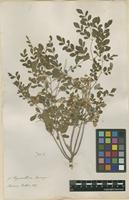
Plants 1–10 m, to 40 cm diam. Roots tuberous when young, woody with age. Bark pale gray or tan, smooth or finely rugose. Stems often canelike, becoming pendent with age, glabrous or finely puberulent. Leaves with pungent odor of horseradish; 30–60 cm, leaflets distributed on 4–8 pairs of pinnae; pinnae largest near base of leaf, 2 or 3 pinnate; leaflets 75–150, distalmost pairs represented by pairs of single leaflets along main rachis; blades bright to dark green, (0.5–)1–2(–3) × (0.3–)0.5–1.5(–2) mm, base rounded to cuneate, apex rounded to emarginate, glands 3–5 mm (smaller at blade apex). Panicles (5–)10–25(–35) cm, each flower subtended by glandular bract. Pedicels 5–10(–20) mm; bracteoles 2. Flowers sweet-scented, 2–3 cm; sepals 10–20 × 3–4 mm, proximal ones usually reflexed, usually puberulent, distalmost pair usually largest, ± erect, enclosing banner petal, or ± reflexed; petals cream, 1–2 cm, distalmost banner petal ± erect, others usually ± reflexed; filaments and staminodes 7–10 mm, basally pubescent, adherent distally proximal to banner petal and anthers in a 3-tiered presentation; receptacle cup-shaped, 3–4 mm; gynophore 2–3 mm, appressed to banner petal; ovary 3–5 mm, with 3 ridges. Capsules tan, 10–30(–55) × 1.5–3 cm, apex beaked, 3 (or 4)-angled; valves silvery inside. Seeds pale to dark brown, globular, 3-winged; cotyledons exuding oil when compressed.