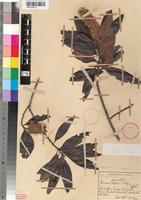
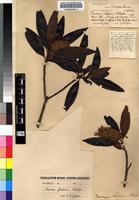
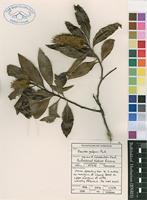
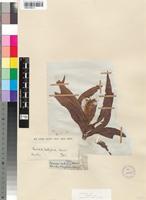
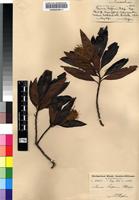
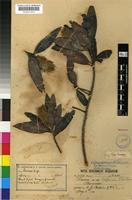
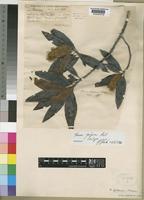
a tree or shrub, 8 ft. high; branchlets glabrous or minutely pubescent when young, with a dark brown or blackish bark; leaves shortly petioled, lanceolate, acute at both ends, 2–4 in. long, 3/4–1 in. broad, coriaceous, drying blackish or dark brown on the upper and reddish-brown on the under surface, glabrous or minutely pubescent when quite young; lateral nerves numerous, very oblique, not joining into a submarginal nerve, like the veins raised, particularly above; petiole rarely over 2 lin. long, glabrous or obscurely pubescent; inflorescence racemose, shortly peduncled, cylindrical, usually 2 (rarely up to 3 1/2) in. long; rhachis greyish- or whitish-tomentose; bracts broad-ovate, 1/2 lin. long, tomentose; pedicels up to 1 1/2 lin. long; adult flower-bud slightly curved, with a slender tube gradually tapering upwards and an oblong subacute or obtuse limb, minutely and adpressedly pubescent, 4 1/2–5 1/2 lin. long; perianth-sheath flattened out, spreading, recurved in the upper part; limbs oblong, subacuminate, 1 1/2 lin. long, those of the sheath separating only at the tips; anthers subsessile, linear-oblong, 1–1 1/4 lin. long; apical glands ovoid, subacute; hypogynous scales subulate from a triangular base; ovary ovoid, 1/2– 3/4 lin. long, covered with whitish or (when dry) fulvous hairs up to 3 lin. long; style 4 lin. long, curved upwards, particularly in the mature state; stigma cylindric, slightly wider than the style and gradually or with a slight bend passing into it, 1 lin. long; fruit subglobose, up to 1 1/2 lin. in diam. null