JSTOR Global Plants Home
  • Home
  • Browse
  • About
  • Access
  • Account
    • Saved Items
    • Profile
  • Log in

Global Plants

Skip to Main Content
  • JSTOR Global Plants Home
  • Global Plants

    • Browse
    • About
    • Access
    • Account
      • Saved Items
      • Profile
Log in
  • Browse
  • About
  • Access
  • Account
    • Saved Items
    • Profile
Advanced Search

Compilation
Euphorbia memoralis

3 Images see all

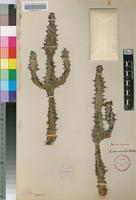
Isotype of Euphorbia memoralis R.A.Dyer [family EUPHORBIACEAE]
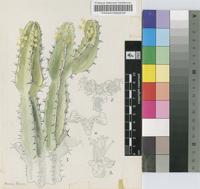
Euphorbia memoralis R.A.Dyer
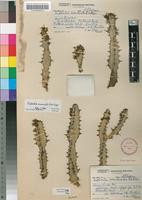
Holotype of Euphorbia memoralis R.A.Dyer [family EUPHORBIACEAE]
Previous
Next

Name

Identification
Euphorbia memoralis R.A.Dyer [family EUPHORBIACEAE ]
Related name
  • Euphorbia memoralis

Flora

Entry for Euphorbia memoralis R.A. Dyer [family EUPHORBIACEAE]
Herbarium
Royal Botanic Gardens, Kew (K)
Collection
Flora Zambesiaca
Resource Type
Reference Sources
Entry From
FZ, Vol 9, Part 5, (2001) Author: S. Carter & L.C. Leach
Names
Euphorbia memoralis R.A. Dyer [family EUPHORBIACEAE], in Fl. Pl. Africa 29: t. 1129 (1952). —Drummond in Kirkia 10: 253 (1975). —Court, Succ. Fl. South. Africa: 26 (1981). Type: Zimbabwe, Mvurwi Range (Umvukwe Hills), 1945, Christian 379 cult. in Nat. Herb. Pretoria 28439 (PRE, holotype).
Information
Succulent spiny shrubs or tree-like shrubs to 1.5(3) m high, with a short stout ± cylindric trunk, to c. 10 cm in diameter.Branches crowded, spreading-ascending, rebranching, dark grey-green, (4)5–7(8)-angled, constricted into segments, eventually falling with age; segments subconical to ± circular, 5–15 cm long, 3–4 cm in diameter; angles ± winged, shallowly sinuate, with tubercles 6–10 mm apart along the margins.Spine shields forming a ± continuous horny margin along the angles, 2–3 mm wide, sometimes interrupted at the flowering eyes; spines to 6 mm long, spreading, much reduced at the constrictions; prickles minute or absent.Leaves to 20 × 6–7 mm on young growth, oblong-lanceolate, reduced to 1.5–2 mm long on older growth, triangular, scale-like, caducous.Cymes solitary, 1–2-forked; peduncle and cyme branches c. 2 mm long; bracts 1.5 × 2 mm.Cyathia with involucres 2.5–3 × 6–7 mm, campanulate; glands c. 3 mm wide, transversely oblong, touching, greenish-yellow; lobes c. 2 mm wide, fimbriate.Male flowers: bracteoles c. 2.5 mm long, laciniate; stamens far exserted, pedicels c. 4 mm long, filaments c. 4 mm long.Female flower: styles 2–4 mm long, free to below the middle, with bifid tips.Capsule obtusely lobed, c. 4 × 7 mm, exserted on a recurved pedicel 7–8 mm long.Seed c. 2 mm in diameter, subglobose, smooth.
Habitat
Exposed stony slopes of chrome-rich soils
Range
Restricted to the northern parts of the Great Dyke
Altitude range
1450 m.
1450
1450
Distribution
Zimbabwe N Mutorashangu (Mtoroshanga) Pass, st. 15.ix.1963, Leach & Müller 11718 (K; SRGH).

Related Materials

  • Terms and Conditions
  • Privacy Policy
  • Cookie Policy
  • Cookie Settings
  • Accessibility
  • Help
  • Contact Us
  • Facebook
  • Twitter
ITHAKA

JSTOR is part of ITHAKA, a not-for-profit organization helping the academic community use digital technologies to preserve the scholarly record and to advance research and teaching in sustainable ways.

©2000-2026 ITHAKA. All Rights Reserved. JSTOR®, the JSTOR logo, JPASS®, Aluka®, and ITHAKA® are registered trademarks of ITHAKA.

╳