JSTOR Global Plants Home
  • Home
  • Browse
  • About
  • Access
  • Account
    • Saved Items
    • Profile
  • Log in

Global Plants

Skip to Main Content
  • JSTOR Global Plants Home
  • Global Plants

    • Browse
    • About
    • Access
    • Account
      • Saved Items
      • Profile
Log in
  • Browse
  • About
  • Access
  • Account
    • Saved Items
    • Profile
Advanced Search

Compilation
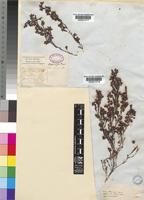
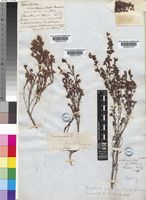
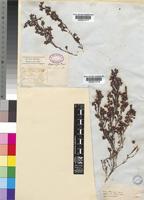
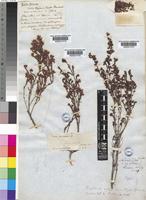
Erica adunca

13 Images see all

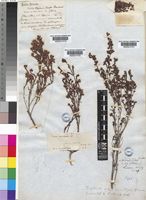
Erica adunca Benth. [family ERICACEAE]
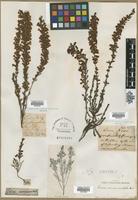
Type of Erica adunca Benth. [family ERICACEAE]
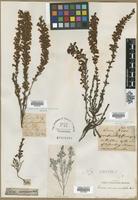
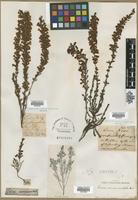
Erica adunca Benth. [family ERICACEAE]
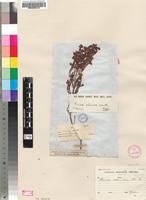
Isotype of Erica adunca Benth. [family ERICACEAE]
Syntype of Erica adunca Benth. [family ERICACEAE]
Erica adunca Benth.
Erica adunca Benth. [family ERICACEAE]
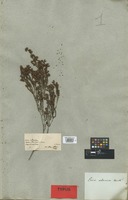
Isotype of Erica adunca Benth. [family ERICACEAE]
Type? of Erica adunca Benth. [family ERICACEAE]
Isotype of Erica adunca Benth. [family ERICACEAE]
Previous
Next

Name

Identification
Erica adunca Benth. [family ERICACEAE ]
Related name
  • Erica adunca

Flora

Entry for ERICA adunca Benth. [family ERICACEAE]
Herbarium
Royal Botanic Gardens, Kew (K)
Collection
Flora Capensis
Resource Type
Reference Sources
Entry From
Flora Capensis, Vol 4, page 2, (1909) Author: By H. BOLUS, F. GUTHRIE, and N. E. BROWN.
Names
ERICA adunca Benth. [family ERICACEAE], in DC. Prodr. vii. 618
Information
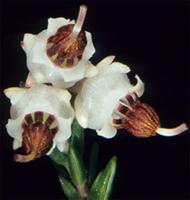
branches 8 in. or more long; leaves from erect to squarrose, linear, subulate or lanceolate-oblong, subtrigonous, the younger ciliolate, 1–2 1/2 lin. long; pedicels 1 1/2 lin. long; bracts subremote, sepal-like but smaller; sepals somewhat lax and spreading, narrow-ovate, acute or acuminate, keel-tipped, subviscid, glabrous, white, 1 1/2 lin. long; corolla urceolate or globose-urceolate, longer or sometimes shorter than its width, glabrous, viscid (or viscid-puberulous, acc. to Bentham), 1 1/2–1 3/4 lin. long, usually somewhat exceeding the sepals, occasionally shorter; limb spreading; filaments dilated just below the anther, slightly curved; anther subterminal, longitudinally semiovate, the dorsal margin curved, acute, ciliolate, more or less hispidulous, 2/3– 3/4 lin. long; pore 3/5 the length of the cell; style generally deflexed or hooked; ovary on a conspicuous black disk, glabrous or hispidulous. null
Distribution
COAST REGION Swellendam Div.; mountains near Swellendam, Bolus, 7304! Riversdale Div.; Garcias Pass, 1000 ft., Galpin, 3546! 3547! Schlechter, 1731! George Div.; Montagu Pass, 2500 ft., Schlechter, 5802!SOUTH AFRICA without locality, Niven, 100!
Notes
Variable as to the length and position of the leaves, length of corolla and hairiness of the anther; it may generally be recognized by its loose sepals, deflexed style (in well-matured flowers), and the prominent dark disk below the ovary.

Related Materials

  • Terms and Conditions
  • Privacy Policy
  • Cookie Policy
  • Cookie Settings
  • Accessibility
  • Help
  • Contact Us
  • Facebook
  • Twitter
ITHAKA

JSTOR is part of ITHAKA, a not-for-profit organization helping the academic community use digital technologies to preserve the scholarly record and to advance research and teaching in sustainable ways.

©2000-2026 ITHAKA. All Rights Reserved. JSTOR®, the JSTOR logo, JPASS®, Aluka®, and ITHAKA® are registered trademarks of ITHAKA.

╳