JSTOR Global Plants Home
  • Home
  • Browse
  • About
  • Access
  • Account
    • Saved Items
    • Profile
  • Log in

Global Plants

Skip to Main Content
  • JSTOR Global Plants Home
  • Global Plants

    • Browse
    • About
    • Access
    • Account
      • Saved Items
      • Profile
Log in
  • Browse
  • About
  • Access
  • Account
    • Saved Items
    • Profile
Advanced Search

Compilation
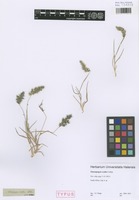
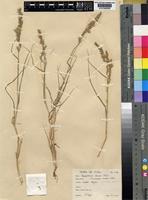
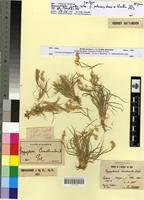
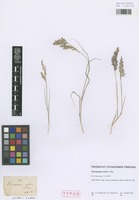
Enneapogon scaber

12 Images see all

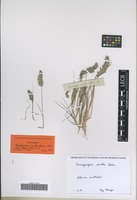
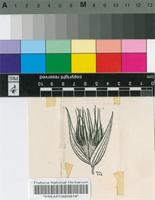
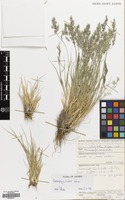
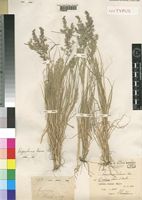
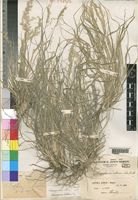
Type? of Enneapogon scaber Lehm. [family POACEAE]
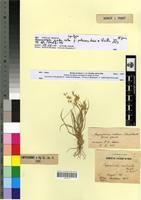
Syntype of enneapogon scaber Lehm. f. pallescens Maire & Weiller [family POACEAE]
Type of Enneapogon scaber Lehm. [family GRAMINEAE]
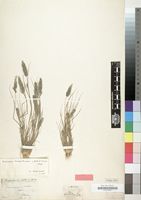
Isotype of Enneapogon scaber Lehm. [family POACEAE]
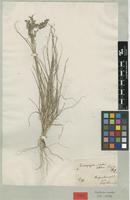
Type of Enneapogon scaber Lehm. [family POACEAE]
Enneapogon scaber Lehm. [family POACEAE]
Syntype of enneapogon scaber Lehm. f. pallescens Maire & Weiller [family POACEAE]
Type of Enneapogon scaber Lehm. [family POACEAE]
Enneapogon scaber Lehm.
Filed as Enneapogon scaber Lehm. [family GRAMINEAE]
Syntype of Pappophorum laxum Chiov. [family GRAMINEAE]
Previous
Next

Name

Identification
Enneapogon scaber Lehm. [family POACEAE ]
Related name
  • Enneapogon scaber

Flora

Entry for ENNEAPOGON scaber Lehm. [family POACEAE]
Herbarium
Royal Botanic Gardens, Kew (K)
Collection
Flora Capensis
Resource Type
Reference Sources
Entry From
Flora Capensis, Vol 7, page 310, (1900) Author: (By O. STAPF.)
Names
ENNEAPOGON scaber Lehm. [family POACEAE], Pug. iii. 41;—Nees in Linnæa, vii. 304; Fl. Afr. Austr. 234.
Pappophorum scabrum Kunth [family POACEAE], Enum. i. 255; Steud. Syn. Pl. Glum. i. 199; Durand & Schinz, Consp. Fl. Afr. v. 870; Hack. in Bull. Herb. Boiss. iv. App. iii. 22.
Information
perennial, glandular-pubescent all over and often scabrid besides; culms tufted, erect or geniculately-ascending, often zigzag, 1/2–1 ft. long, rather slender, branched below, 3–5-noded, internodes usually enclosed except the uppermost; sheaths rather loose, the lower whitish, usually scabrid, nodes villous; blades linear, tapering to a fine point, 2–4 1/2 in. by 1–2 lin., flat or more often convolute, rather rigid, scabrid on both sides; panicle spike-like, cylindric, sometimes interrupted, or oblong to ovate and rather lax, 1 1/2–3 in. by 1/2– 3/4 in., light to dark grey; lowest branches up to 1 1/2 in. long, branched from the base or simple in the lowest 1/2 in.; spikelets 2–2 1/2 lin. long, crowded or rather lax; glumes subequal, ovate, subacute or minutely truncate, scantily hairy, 7–9-nerved, nerves prominent, 2 of the side ones sometimes percurrent in the upper glume; lower valve 3/4–1 lin. long, densely villous; awns 1–1 1/2 lin. long, rather broad at the base, scaberulous; pale 1 1/2 lin. long, keels ciliolate; anthers 3/4–1 lin. long; grain not quite 1/2 lin. by 1/4 lin. null
Range
Also in tropical South-west Africa, Morocco, and Algiers.
Distribution
CENTRAL REGION Calvinia Div.; between Lospers Plaats and Springbok Kuil River, 2000–3000 ft., Zeyher, 1820! Beaufort West Div.; on stony heights and by the Gamka River at Zwartbulletje, 2500–3000 ft., Drège! Graaff Reinet Div.; stony hills near Graaff Reinet, 2700 ft., Bolus, 556! Sutherland Div.; at Yuk River, near Yuk River Hoogte, Burchell, 1270! 1271! Fraserburg Div.; Dwaal River, Burchell, 1471! Carnarvon Div.; at the northern exit of Karree Bergen Poort, near Carnarvon, Burchell, 1557! Richmond Div.; Zeekoe River, 5000 ft., Drège.COAST REGION Knysna Div.; Plettenberg Bay, Mund. Queenstown Div.; between Kat Berg and Klipplaat River, 3000–4000 ft., Drège.KALAHARI REGION Griqualand West, Hay Div.; on the Asbestos Mountains, Burchell, 2052! Herbert Div.; St. Clair, Orpen!WESTERN REGION Great Namaqualand; Kukaus, near Aus, Schenck, 117! Aus, Schinz, 634! Steingrover, 40. Little Namaqualand; Silver Fontein, near Ookiep, 2000–3000 ft., Drège!

Related Materials

  • Terms and Conditions
  • Privacy Policy
  • Cookie Policy
  • Cookie Settings
  • Accessibility
  • Help
  • Contact Us
  • Facebook
  • Twitter
ITHAKA

JSTOR is part of ITHAKA, a not-for-profit organization helping the academic community use digital technologies to preserve the scholarly record and to advance research and teaching in sustainable ways.

©2000-2026 ITHAKA. All Rights Reserved. JSTOR®, the JSTOR logo, JPASS®, Aluka®, and ITHAKA® are registered trademarks of ITHAKA.

╳