JSTOR Global Plants Home
  • Home
  • Browse
  • About
  • Access
  • Account
    • Saved Items
    • Profile
  • Log in

Global Plants

Skip to Main Content
  • JSTOR Global Plants Home
  • Global Plants

    • Browse
    • About
    • Access
    • Account
      • Saved Items
      • Profile
Log in
  • Browse
  • About
  • Access
  • Account
    • Saved Items
    • Profile
Advanced Search

Compilation
Encephalartos ngoyanus

4 Images see all

Encephalartos ngoyanus I.Verd.
Previous
Next

Name

Identification
Encephalartos ngoyanus I.Verd. [family ZAMIACEAE ]
Related name
  • Encephalartos ngoyanus

Flora

Entry for Encephalartos ngoyanus [family ZAMIACEAE]
Herbarium
South African National Biodiversity Institute, Compton Herbarium, Cape Town (SAM)
Collection
Flora of Southern Africa
Resource Type
Reference Sources
Entry From
Flora of South Africa, (2003) Author: Dr J.P. Roux
Names
Encephalartos ngoyanus [family ZAMIACEAE]
Common names
E. caffer sensu Hutch. & Rattr. in F.C. 5, 2 (Suppl.) : 30 (1933), partly, as to Rattray 1278. E. sp. aff. E. caffer Lehm., M. R. Henderson in Journ. S. Afr. Bot. 11 : 16 (1945).
Information
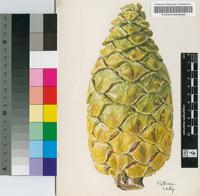
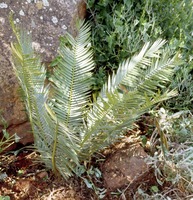
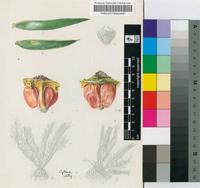
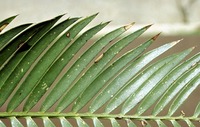
Stem subterranean or with crown ex­posed, usually unbranched, up to about 30 cm long and 20 cm diam., with woolly bracts. Leaves 3-7 in a whorl, 60-120 cm long in­cluding slender petiole 10-30 cm long; rha-chis erect or slightly recurving with silky and woolly off-white tomentum, glabrescent ex­cept for pulvinus; leaflets thinly pubescent at first, glabrescent, reduced in size abruptly near apex of leaf and gradually towards base but rarely to a prickle; median leaflets linear-lanceolate, pungent, 7-8 cm long, 9-11 mm broad, occasionally in shade up to 12 cm long and 1*5 cm broad, usually with 1-3 teeth on lower margin, rarely entire. Cones solitary on short stout peduncle, pale olive-green turning yellow. Male cones more or less cylindric, 20-25 cm long, 4 • 5-6 cm diam.; median scales 2 • 5-2 • 8 cm long, 2 • 2-2 • 5 cm broad, 1-4-1-5 cm thick vertically, laterally angled; bulla face projecting in a subcylindric beak 7-8 mm long with the terminal facet only faintly indicated except for lower margin which is acute, decurved and sometimes slight­ly overlapping scale below. Female cones ovate-oblong in outline about 23 cm long, 10 cm diam.; median scales about 5 cm long, 4-5 cm broad and 3 cm thick vertically, laterally ridged and extended into incurved lobes about 5 mm long; bulla face only slightly projecting with upper facet humped, terminal facet faintly defined on upper mar- gin, lower margin acute decurved and some­times slightly overlapping scale below. Seed scarlet, 2*7-3 cm long, 2 cm diam.
Habitat
This species seems to be distinguishable from E. caffer in a number of inconspicuous ways. Firstly the root-system is less tuberous, the stem less con­sistently subterranean, the leaflets less crowded, not twisted and the lower margin often toothed, and the female cone scales have a less pronounced terminal facet
Use
25. Encephalartos ngoyanus Verdoorn in Flow. PI. Afr. 27: PI. 1053, 1054 (1949); R. A. Dyer in Bothalia 8 : 508 (1965). Syntypes: Zululand, Verdoorn & Christian 716; 716b (female and male respectively (PRE).
Range
In grassveld and forest margins, often near boulders, in northern Zululand and over the Trans­vaal and Swaziland border. Map 5. Natal.—Mtunzini: Ngoye, Verdoom & Christian 715; 715a; 716; 716a, b, c; Rattray 1278; Ward 3469. Lower Umfolozi: Mkuzi, Galpin 13310. Ubombo: Ward AQ11. Ingwavuma: Verdoom & Christian 720; 720a, b, c, d; Conyngham la, b, c. Transvaal.—Piet Retief: Pongola Poort, Wil­liams in PRE 29821. Swaziland.—Ubombo Mt., Galpin 11818.

Related Materials

  • Terms and Conditions
  • Privacy Policy
  • Cookie Policy
  • Cookie Settings
  • Accessibility
  • Help
  • Contact Us
  • Facebook
  • Twitter
ITHAKA

JSTOR is part of ITHAKA, a not-for-profit organization helping the academic community use digital technologies to preserve the scholarly record and to advance research and teaching in sustainable ways.

©2000-2026 ITHAKA. All Rights Reserved. JSTOR®, the JSTOR logo, JPASS®, Aluka®, and ITHAKA® are registered trademarks of ITHAKA.

╳