JSTOR Global Plants Home
  • Home
  • Browse
  • About
  • Access
  • Account
    • Saved Items
    • Profile
  • Log in

Global Plants

Skip to Main Content
  • JSTOR Global Plants Home
  • Global Plants

    • Browse
    • About
    • Access
    • Account
      • Saved Items
      • Profile
Log in
  • Browse
  • About
  • Access
  • Account
    • Saved Items
    • Profile
Advanced Search

Compilation
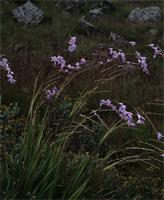
Dierama formosum

3 Images see all

Dierama formosum Hilliard
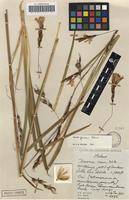
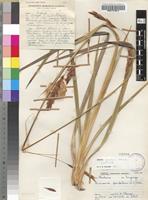
Filed as Dierama formosum Hilliard [family IRIDACEAE]
Isotype of Dierama formosum Hilliard [family IRIDACEAE]
Previous
Next

Name

Identification
Dierama formosum Hilliard [family IRIDACEAE ]
Related name
  • Dierama formosum

Flora

Entry for Dierama formosum Hilliard [family IRIDACEAE]
Herbarium
Royal Botanic Gardens, Kew (K)
Collection
Flora Zambesiaca
Resource Type
Reference Sources
Entry From
FZ, Vol 12, Part 4, (1993) Author: P. Goldblatt
Names
Dierama formosum Hilliard [family IRIDACEAE], in Notes Roy. Bot. Card. Edinburgh 45: 80 (1988). — Milliard, Burtt & Batten, Dierama: Hairbells of Africa: 58 (1991). Type: Zimbabwe, summit of lnyangani Mt., c. 2600 m, 7.x.1962, Plowes 2268 (K, holotype; PRE).
Information
Plants forming large tufts with many stems. Corms 30–35 mm in diameter. Leaves several, the basal ones 300–750 × (4)6–10 mm, sheathing cauline leaves 5. Stems 75–165 mm long, 3–5-branched. Spikes pendulous, the terminal spike 6–10-flowered, lateral spikes 3–9-flowered; flowers moderately crowded (bracts often 2 internodes long or longer); floral bracts 20–25 mm long, lanceolate to oblanceolate-obovate, acute to acuminate, solid red-brown or densely flecked, thus appearing solidly coloured, often slightly lighter towards the shoulders and margins where flecks are more dispersed, rarely entire bract merely flecked and then appearing lighter; main veins 5 on each side of the midvein, intermediate veins often well developed and then the veins very close and the base sometimes semi-solid, but veins always distinct, fading out in the middle or upper third of the bract. Flowers pale-lilac to bright cerise-pink, 26–37 mm long; perianth tube (6.5)8–12 mm long, tepals (17)19–26 × 6–11 mm. Anthers 7–9 mm long. Stigmas reaching 2.5–14 mm below the tepal apices.
Habitat
Relatively common in montane grassland
Altitude range
at 1370 to 2590 m.
2590
1370
Distribution
Zimbabwe E Stapleford Forest Reserve, 8.x.1959, Chase 7173 (K; MO; PRE; SRGH).Malawi S Mt. Mulanje, Lichenya Plateau, 17.x.1941, Greenway 6317 (BR; K; PRE).Mozambique MS Gorongosa Mt., Gogogo summit, x.1971, Tinley 2208 (BR; K; PRE; SRGH).
Distribution (external)
eastern Transvaal (South Africa).
Notes
Flowering in all months.Allied to D. cupuliflorum Klatt, but more robust and often taller, and with larger corms and broader leaves. The more crowded terminal spikes of 6–10 flowers (3–9 in the lateral spikes) and distinctly elliptic tepals readily distinguish D. formosum from D. cupuliflorum which usually has 2–6 flowers per terminal spike (2–4 per lateral spike) and usually oblong tepals.

Related Materials

  • Terms and Conditions
  • Privacy Policy
  • Cookie Policy
  • Cookie Settings
  • Accessibility
  • Help
  • Contact Us
  • Facebook
  • Twitter
ITHAKA

JSTOR is part of ITHAKA, a not-for-profit organization helping the academic community use digital technologies to preserve the scholarly record and to advance research and teaching in sustainable ways.

©2000-2026 ITHAKA. All Rights Reserved. JSTOR®, the JSTOR logo, JPASS®, Aluka®, and ITHAKA® are registered trademarks of ITHAKA.

╳