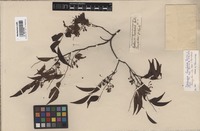
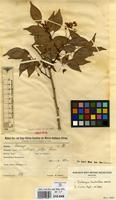
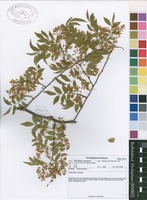
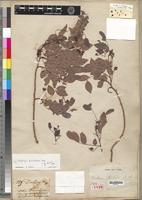
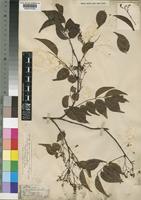
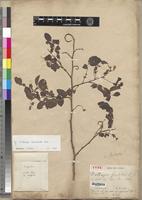
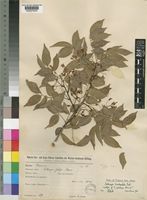
Small tree or shrub, often scandent with aid of modified coiled branchlets from the older nodes, 3–7.5 m. tall; bark turning grey, striate, apparently not becoming very rough. Branchlets subglabrous to crisped-pubescent. Leaves 6–15 cm. long; stipules oblong or oblanceolate, sometimes slightly curved, bluntly pointed, 4–10 mm. long, often subpersistent; lateral leaflets 3–5 on either side of rhachis, ovate-lanceolate, ovate or elliptic, 2.5–6 cm. long, 1.2–3 cm. wide, acuminate, rounded at base, subglabrous or appressed pubescent particularly beneath; primary lateral nerves ± 7–10(–12) on either side of midrib. Panicles on leafy shoots, lax, 4–10 cm. long, many-flowered; axes subglabrous to pubescent; bracts oblong-elliptic to spathulate, 1–3 mm. long, often somewhat persistent; bracteoles at top of slender 1.5–3 mm. long pedicel, rather smaller and narrower. Calyx with the lateral lobes not or scarcely developed, thus 2-lipped, 4–5 mm. long, glabrous to thinly pubescent (particularly in Madagascar). Corolla 6.5–8 mm. long, white or cream, fragrant; standard elliptic-oblong to oblong-obovate, ± abruptly contracted to the well-developed claw, glabrous; wings practically as long as standard and shortly exceeding keel. Stamens 9–10, all united or the vexillary stamen free. Fruit oblong-elliptic or oblong, narrowed at either end, with the short stipe 4.2–6.8 cm. long, 1.3–1.8 cm. wide, chartaceous, not much thickened over the seed-cavity but outer layer in this region darker coloured, becoming peripherally cracked and partially detached, dull brown, glabrous, very obscurely veined, 1–2-seeded. Fig. 20/2, 6, p. 97.