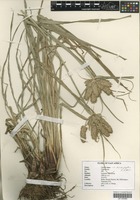
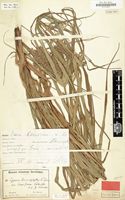
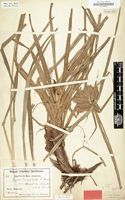
Cyperus tomaiophyllusNot on sheet. [family CYPERACEAE ] (stored under name); Verified by Not on sheet.,
Related name
Cyperus tomaiophyllus
Flora
Entry for Mariscus tomaiophyllus C. B. Clarke [family CYPERACEAE]
Herbarium
Royal Botanic Gardens, Kew (K)
Collection
Flora of Tropical Africa
Resource Type
Reference Sources
Entry From
Flora of Tropical Africa, Vol 8, page 264, (1902) Author: (By C. B. Clarke.)
Names
Mariscus tomaiophyllusC. B. Clarke [family CYPERACEAE], in Durand & Schinz, Conspect. Fl. Afr. v. 594.
Cyperus tomaiophyllusK. Schum. [family CYPERACEAE], in Engl. Pfl. Ost-Afr. C. 122.
Information
Stem 1–3 ft. long, stouter, at the top 1/8– 1/6 in. in diam., trigonous and smooth. Leaves 3/4 the length of the stem, 1/4– 1/3 in. broad; margins cutting the hand. Umbel simple; rays 7, up to 1/2 in. long; bracts 6, similar to the leaves, lowest up to 7 in. long. Spikes 1 1/4 by 1/2 in., exceedingly dense with very numerous spikelets. Spikelets a greenish straw-colour, perfecting 3 nuts, almost comose from the long-exserted cinnamon-coloured styles. Nut 1/2 the length of the glume, oblong.
Distribution
German East Africa Mozamb. Dist. Kilimanjaro, 5000–9000 ft., Meyer 272! Volkens, 854! 1010!
Distribution (external)
Madagascar
Notes
This resembles M. hemisphæricus; and, according to K. Schumann, differs chiefly by the cutting edges of the leaves. The spikelets have fewer nuts than those of M. hemisphæricus .