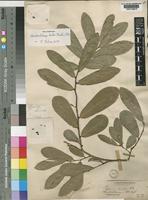
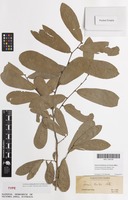
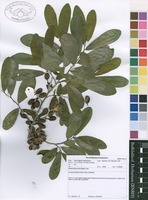
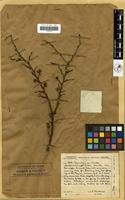
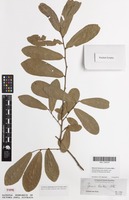
Shrub or small weak-stemmed tree 2.4–7(–10) m. tall, usually much branched and straggling; bark ± smooth, grey-brown with buff-coloured lenticels, peeling in untidy flakes; branchlets glabrous, at first pale but soon dark brown and lenticellate. Leaf-blades elliptic-oblong, oblanceolate-elliptic, or obovate, (1–)6–11(–14) cm. long, (0.8–)2–5(–6.5) cm. wide, obtuse, rounded or emarginate at the apex, cuneate to rounded at the base, rather thin, bright green, sometimes rather paler beneath and glaucous, glabrous above, very sparsely and inconspicuously pubescent beneath and apparently glabrous to the naked eye; venation fine, reticulate, slightly prominent on both surfaces; petiole 2–5 mm. long, glabrous. Flowers solitary, axillary, sessile, with a heavy sweet scent; buds spherical, ± 3 mm. in diameter, persisting through the dry season when the tree is deciduous and probably opening just before the rains; bracteoles 4–5, biseriate, imbricate, cucullate, increasing in size towards the flowers, reddish-brown, up to 3 mm. long and 3 mm. wide, persistent, glabrous or ciliate. Calyx yellow, reddish-brown or red-bordered, shining scarious-coriaceous, completely covering the petals in bud, dividing at anthesis into (2–)3 subequal cucullate broadly triangular lobes, these 3–3.5 mm. long, 2.5–4.5 mm. wide, finely rugose, glabrous. Petals cream or white, obovate or oblong, 4.5–6 mm. long, 2.5–3.5 mm. wide, the inner rather shorter, thick, densely white silky pilose outside and inside near the apex, glabrous inside at the base. Stamens 0.75 mm. long, just over 1 mm. wide, glabrous. Monocarps (1–)3–10, purplish-red or black, 1.3–2.3 cm. long, 0.7–1 cm. wide, often apiculate, glabrous, finely rugose, edible; stipes 4–5.5 mm. long. Seeds pale, cyhndric-ellipsoid, 1.6–2 cm. long, 8–9 mm. wide and thick; hilum terminal, more or less round. Fig. 25.