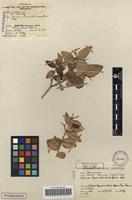
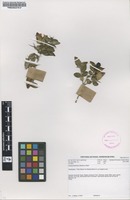
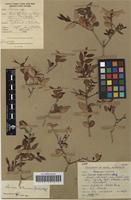
Shrub, spiny, much branched, up to 3 m high; branches divaricate, often puberu-lous, rarely pubescent when young, becoming glabrous; sap milky; spines bifurcate, rarely simple, 2-5 cm long, arising usually in pairs at the apex of a shoot and decussate to the apical leaves, persistent, often bearing in the angle of the fork a reduced or abortive inflorescence. Leaves coriaceous, ovate to ovate-oblong or oblong-lanceolate, 2-4-5 cm long and 1-5-2-4 cm broad, truncate to rounded at the base, apex acute to obtuse, usually mucronulate, glabrous or, rarely, puberulous, shiny above, paler below; secondary nerves 5-12, usually distinct; petiole short, up to 2 mm long, channelled above; axillary glands present; stipules 0. Inflorescence cymose, contracted, sessile at the ends of the branchlets or in the spine-forks, puberulous; bracts lanceolate, acuminate or spine tipped, 3 mm long. Flowers relatively small, white, tinged with red, scented, subsessile. Calyx 2 mm long, puberulous; sepals 4, the inner 2 shorter, ovate, acute to acuminate. Corolla salver-shaped; tube cylindric 9-14 mm long, glabrous or puberulous without, hairy within; lobes 4, rarely 5, ovate to rotund, 3-5 mm long, overlapping to the left, pubescent above. Stamens 4, very rarely 5, inserted at the middle; anthers subsessile, 1-5 mm long. Disc 0. Ovary entire, 2-chambered with up to 8 ovules in each cell; style 3-4 mm long; stigma some distance below the anthers, ellipsoid, apex bifid, hairy. Fruit a berry, subglobose, 7-10 mm in diameter, purple to black, edible. Seeds 4-8, flat, irregularly ovoid in outline; testa rough, hard. Fig. 37: 4.