JSTOR Global Plants Home
  • Home
  • Browse
  • About
  • Access
  • Account
    • Saved Items
    • Profile
  • Log in

Global Plants

Skip to Main Content
  • JSTOR Global Plants Home
  • Global Plants

    • Browse
    • About
    • Access
    • Account
      • Saved Items
      • Profile
Log in
  • Browse
  • About
  • Access
  • Account
    • Saved Items
    • Profile
Advanced Search

Compilation
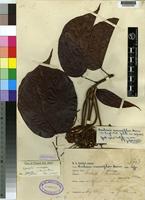
Bauhinia macrosiphon

2 Images see all

Isosyntype of Bauhinia macrosiphon Harms [family LEGUMINOSAE]
Gigasiphon macrosiphon (Harms) Brenan from Kenya
Previous
Next

Name

Identification
Gigasiphon macrosiphon (Harms) Brenan [family LEGUMINOSAE ] (stored under name); Verified by Brenan JPM, 1963 Bauhinia macrosiphon Harms [family LEGUMINOSAE ] Verified by Brenan JPM, 1963
Related name
  • Bauhinia macrosiphon
  • Gigasiphon macrosiphon

Flora

Entry for GIGASIPHON macrosiphon (Harms) Brenan [family LEGUMINOSAE-CAESALPINIOIDEAE]
Herbarium
Royal Botanic Gardens, Kew (K)
Collection
Flora of Tropical East Africa
Resource Type
Reference Sources
Entry From
Flora of Tropical East Africa, page 1, (1967) Author: J. P. M. Brenan
Names
GIGASIPHON macrosiphon (Harms) Brenan [family LEGUMINOSAE-CAESALPINIOIDEAE], in K.B. 17: 214 (1963). Types: Tanganyika, Usambara Mts., near Amani, Braun 1033 & Zimmermann 3088 (B, syn. †) & near Kihuhwi [Kiuhui], Grote 3763 (B, syn. †, EA, isosyn., BM, drawing!)
Bauhinia macrosiphon Harms [family LEGUMINOSAE-CAESALPINIOIDEAE], in E. J. 53:467 (1915); L.T.A.: 658 (1930); T.T.C.L.: 88 (1949)
Gigasiphon humblotianum [family LEGUMINOSAE-CAESALPINIOIDEAE], [sensu K.T.S.: 105 (1961), non (Baill.) Drake]
Information
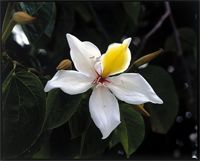
Tree 6–20 m. high. Bark whitish- or pinkish-grey. Branchlets rusty -puberulous, soon glabrescent. Leaves papery, broadly ovate to suborbicular-ovate or ± obovate, 8–17 cm. long, 6–15.5 cm. wide, ± cordate or subcordate at base, subglabrous. Racemes erect (Gardner 1), short, terminal, 4–10 cm. long (fide Harms). Hypanthium 8–13 cm. long, rusty-pubescent outside. Sepals ± 5–8 cm. long. Petals “ magnolia-like, pure white except for yellow splash within on one petal ” (Eggeling 6408) or “ white flushed creamy-pink ” (Greenway 4915), obovate-elliptic, 9–13 cm. long, 4–6 cm. wide. Stamens all fertile; filaments slightly pubescent. Pods up to ± 6-seeded, flattened, indehiscent, breaking irregularly, ± 30 cm. long and 6–6.8 cm. wide. Seeds suborbicular-compressed, ± 1.8–3 cm. in diameter, 1–1.6 cm. thick, dull purplish-brown. Fig. 45.
Range
DISTR. K7; T3, 8 not known elsewhere
Altitude range
120–910 m.
Distribution
KENYA Kwale District Mrima Hill, 16 July 1960, T. A. M. Gardner 1 ! & 31 Aug. 1959, Verdcourt 2404! & about halfway Msambweni—Lungalunga, 15 Jan. 1964, Verdcourt 3935!TANGANYIKA Lushoto District Amani, cultivated, 23 Feb. 1937, Greenway 4915!TANGANYIKA Lindi District Rondo Plateau, Mchinjiri, Nov. 1951, Eggeling 6408 !
Notes
The large and beautiful flowers of this tree would make it a worthwhile introduction for ornament in other parts of the tropics.The suggested identity of Bauhinia macrosiphon and Gigasiphon humblotianum (Baill.) Drake, from Madagascar (see T.T.C.L.: 88 (1949)) has not been confirmed. G. humblotianum is, according to Drake and Baillon, a scrambling shrub with leaves 20 cm. long, racemes more than 50 cm. long, a hypanthium 22–25 cm. long, and partly sterile stamens. Examination of the type-material shows no difference in the length of the raceme from G. macrosiphon, the 50 cm. mentioned above apparently including a length of the branch supporting the raceme; the leaves are about 18 cm. long. The hypanthium is, however, 20–25 cm. long, and the indumentum on the outside of the sepals is only a short sparse puberulence. The leaves are also glabrous beneath.

Related Materials

  • Terms and Conditions
  • Privacy Policy
  • Cookie Policy
  • Cookie Settings
  • Accessibility
  • Help
  • Contact Us
  • Facebook
  • Twitter
ITHAKA

JSTOR is part of ITHAKA, a not-for-profit organization helping the academic community use digital technologies to preserve the scholarly record and to advance research and teaching in sustainable ways.

©2000-2026 ITHAKA. All Rights Reserved. JSTOR®, the JSTOR logo, JPASS®, Aluka®, and ITHAKA® are registered trademarks of ITHAKA.

╳