JSTOR Global Plants Home
  • Home
  • Browse
  • About
  • Access
  • Account
    • Saved Items
    • Profile
  • Log in

Global Plants

Skip to Main Content
  • JSTOR Global Plants Home
  • Global Plants

    • Browse
    • About
    • Access
    • Account
      • Saved Items
      • Profile
Log in
  • Browse
  • About
  • Access
  • Account
    • Saved Items
    • Profile
Advanced Search

Compilation
Anthospermum zimbabwense

2 Images see all

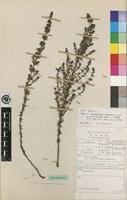
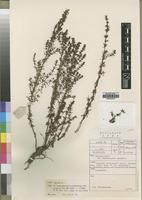
Isotype of Anthospermum zimbabwense Puff [family RUBIACEAE]
Previous
Next

Name

Identification
Isotype of Anthospermum zimbabwense Puff [family RUBIACEAE ] (stored under name);
Related name
  • Anthospermum zimbabwense

Flora

Entry for Anthospermum zimbabwense Puff [family RUBIACEAE]
Herbarium
Royal Botanic Gardens, Kew (K)
Collection
Flora Zambesiaca
Resource Type
Reference Sources
Entry From
FZ, Vol 5, Part 1, (1989) Author: B. Verdcourt
Names
Anthospermum zimbabwense Puff [family RUBIACEAE], in Pl. Syst. Evol., Suppl. 3: 201 (1986). TAB. 34, fig. A. Type: Zimbabwe, Rhodes Inyanga National Park, Mt. Inyangani, Puff 790125–3/1 (BM; SRGH; WU, holotype;).
Information
Dioecious subshrub or dwarf shrub, several- to many-stemmed, erect, 0.2–0.6(1) m. tall, often with a quite thick, ± disk-like woody base. Stems ± unbranched to much-branched, branches often more numerous in male than female, ascending to ± erect, papillate to very shortly hairy. Leaves in whorls of 3, pseudo-verticillate; blades (3)4–8(12) x 0.5–1.5(3) mm., linear to linear-lanceolate or narrowly oblanceolate, glabrous; margins mostly revolute; petioles subobsolete; stipular sheath with a small, narrow seta, often flanked by a smaller seta on either side. Flowers subsessile, in clusters of several (male) to many (female) at nodes, female inflorescences often more conspicuous than male, ± compact and cylindrical; corolla 4-merous, greenish-yellow to yellow, in male usually a little hairy outside. Male: tube 0.5–1 mm. long, (± broadly) funnel-shaped, lobes 1.3–2 x 6.5–0.8 mm.; anthers (0.8)1–1.3 mm. long; rudimentary ovary minute, hardly discernible. Female: tube 0.2–0.4 mm. long, lobes 0.3–0.5 x 0.1–0.2 mm.; style ± 0, stigmas 3.4–9.1 mm. long; ovary 0.7–0.8 x 0.6 mm., with 4 indistinct calyx lobes or calyx lobes lacking. Fruit reddish-brown; mericarps 1.4–1.7 x 0.7–0.9 mm., ± obovate, ± glabrous or with a few whitish hairs, with 2 indistinct, ± triangular calyx lobes hardly longer than 0.1 mm. or calyx lobes ± lacking.
Habitat
Mostly in fire-prone grassland
Range
Known only from Zimbabwe and Mozambique
Altitude range
1650–2150(2500) m.
2150
1650
Distribution
Mozambique MS Tsetserra, fl. 8.ii.1955, Exell, Mendonça & Wild 293 (BM; LISC; SRGH).Zimbabwe E Mutare Distr., Banti Forest, fl. 4.ii.1955, Exell, Mendonça & Wild 174 (BM; LISC; SRGH).
Notes
See also 5., A. vallicola and 6., A. whyteanum for comments and details on occasional hybrids with these species.

Related Materials

  • Terms and Conditions
  • Privacy Policy
  • Cookie Policy
  • Cookie Settings
  • Accessibility
  • Help
  • Contact Us
  • Facebook
  • Twitter
ITHAKA

JSTOR is part of ITHAKA, a not-for-profit organization helping the academic community use digital technologies to preserve the scholarly record and to advance research and teaching in sustainable ways.

©2000-2026 ITHAKA. All Rights Reserved. JSTOR®, the JSTOR logo, JPASS®, Aluka®, and ITHAKA® are registered trademarks of ITHAKA.

╳