JSTOR Global Plants Home
  • Home
  • Browse
  • About
  • Access
  • Account
    • Saved Items
    • Profile
  • Log in

Global Plants

Skip to Main Content
  • JSTOR Global Plants Home
  • Global Plants

    • Browse
    • About
    • Access
    • Account
      • Saved Items
      • Profile
Log in
  • Browse
  • About
  • Access
  • Account
    • Saved Items
    • Profile
Advanced Search

Compilation
Anthospermum welwitschii

11 Images see all

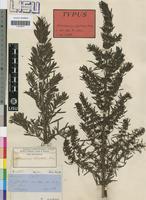
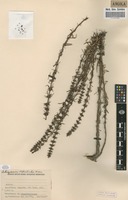
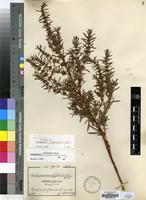
Isotype of Anthospermum welwitschii Hiern [family RUBIACEAE]
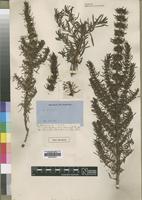
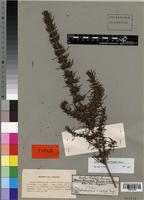
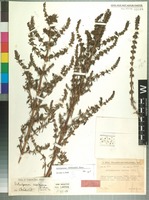
Type of Anthospermum welwitschii Hiern [family RUBIACEAE]
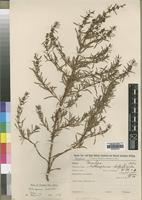
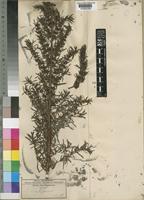
Type of Anthospermum cliffortioides K.Schum. [family RUBIACEAE]
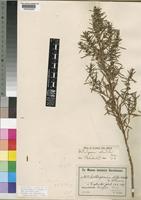
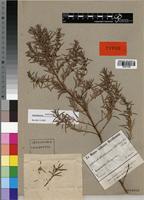
Anthospermum welwitschii Hiern [family RUBIACEAE]
Filed as Anthospermum welwitschii Hiern [family RUBIACEAE]
Type of Anthospermum welwitschii Hiern [family RUBIACEAE]
Anthospermum welwitschii Hiern [family RUBIACEAE]
Type of Anthospermum welwitschii Hiern [family RUBIACEAE]
Isotype of Anthospermum cliffortioides K.Schum. [family RUBIACEAE]
Holotype of Anthospermum uwembae Gilli [family RUBIACEAE]
Previous
Next

Name

Identification
Anthospermum welwitschii Hiern [family RUBIACEAE ] (stored under name);
Related name
  • Anthospermum uwembae
  • Anthospermum cliffortioides
  • Anthospermum welwitschii

Flora

Entry for Anthospermum welwitschii [family ACANTHACEAE]
Herbarium
South African National Biodiversity Institute, Compton Herbarium, Cape Town (SAM)
Collection
Flora of Southern Africa
Resource Type
Reference Sources
Entry From
Flora of South Africa, (2003) Author: Dr J.P. Roux
Names
Anthospermum welwitschii [family ACANTHACEAE]
Common names
A. cliffortioides K. Schum. in Bot. Jb. 30: 416 (1901). Type: Tanzania, Usafua, Beya-Berg (=Mbeya Mt.), Goetze 1082(B, holo.t; BM;BR;E;G; K, iso.!). A. ammannioides sensu auctt. Afr. austr., non S. Moore.
Information
Dioecious shrub, single- or (seldom) seve­ral-stemmed, ± erect, c. 1-3 m tall. Stems mostly much branched above, branches usually ± regular, paired, often ascending. Leaves de­cussate, mostly pseudoverticillate; blades (7-) 10-35 X (1-) 1,5-3,5 mm, (narrowly) ob-lanceolate, elliptic to ± linear-lanceolate, mostly glabrous; petioles ± 0-1 mm long; sti­pular sheath with 3-5 (-7,8) setae, the longest c. (0,5-)0,7-4,5(-5,6) mm. Flowers subsessile to shortly pedicellate (pedicels to 0,7 mm in ("male").), in clusters of many (very many: ("female")) at nodes, inflorescences dimorphic, in ("female") often quite contracted, dense, ± cylindrical inflores­cence zones; corolla 4-merous, greenish yellow to pale yellow, occasionally purplish tinged outside, mostly glabrous. ("male"): tube (0,5-)0,7-l,2 mm long, funnel-shaped, lobes (l,2-)l,5-2,2(-2,7) X (0,4-)0,6-0,9(-l,l) mm; anthers 1-2 mm long; small rudimentary ovary with 4 minute calyx lobes. ("female"): tube 0,2-0,5 mm long, lobes 0,2-0,7 x 0,1-0,2 mm; style ± 0-1 mm long, stigmas 2, 3-7,5(-10) mm long; ovary c. 0,6-1 x 0.3-0,6 mm, with 4 sometimes unequal calyx lobes. Fruit mostly reddish brown, shiny; mericarps 1,5-2,7 x 0,7-1,2 mm, oblong, elliptic to ± obovate, glabrous or (seldom) ± sparsely shortly hairy, with 2 ± triangular calyx lobes c. (0,3-)0,5-l(-l,2) X 0,2-0,5 mm, one occasio­nally longer than the other. Chromosome number. 2n=22. Reference: 1 The holotype, according to Verdcourt (op. cit.) in LISU, was not amongst LISU material sent to me on loan.
Habitat
A record from Mafikeng (Cape, 2525-DC: Kassner 1541, E!) appears highly doubtful (not mapped). In the Flora area A. welwitschii is rather uniform in its characters. A. ammannioides, with which it has consistently been con­fused, occurs in the eastern highlands of Zimbabwe and on Gorongosa Mt. and is distinguished by its leaves in whorls of three.
Use
1. Anthospermum welwitschii Hiern, Cat. Afr. PI. Welw. 2: 500 (1898); Brenan in Mem. N.Y. bot. Gdn 8: 455 (1954); Verde, in F.T.E.A. Rubiaceae 1: 330 (1976). Type: An­gola, Huila, Panda forests, near Erne, Wel-witsch 5335 (BM; G; K, iso.!).'
Range
Known from Transvaal; extending to tropical East Africa and Angola. Typically growing at the edge of afro-montane forest or scrub, sometimes in disturbed sites. Map 4. Occurring from northern Natal to eastern Cape. Mostly growing on rocky outcrops or at the edge of gorges or kloofs, often in grassland-forest/scrub borders; mainly on (confined to ?) TMS. Map 6.

Related Materials

  • Terms and Conditions
  • Privacy Policy
  • Cookie Policy
  • Cookie Settings
  • Accessibility
  • Help
  • Contact Us
  • Facebook
  • Twitter
ITHAKA

JSTOR is part of ITHAKA, a not-for-profit organization helping the academic community use digital technologies to preserve the scholarly record and to advance research and teaching in sustainable ways.

©2000-2026 ITHAKA. All Rights Reserved. JSTOR®, the JSTOR logo, JPASS®, Aluka®, and ITHAKA® are registered trademarks of ITHAKA.

╳