South African National Biodiversity Institute, Compton Herbarium, Cape Town (SAM)
Collection
Flora of Southern Africa
Resource Type
Reference Sources
Entry From
Flora of South Africa, (2003) Author: Dr J.P. Roux
Names
Aloe mudenensis [family ALOACEAE]
Information
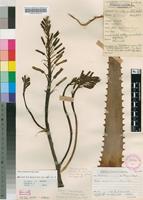
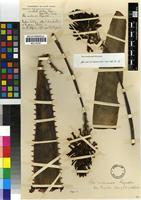
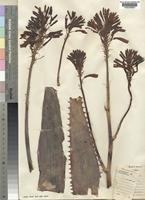
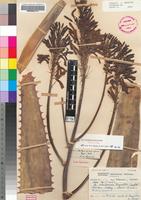
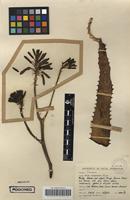
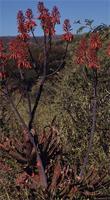
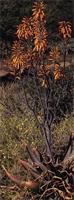
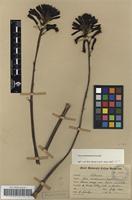
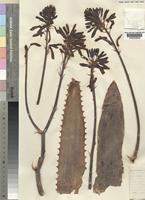
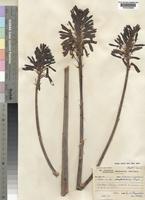
Plants usually solitary, short-stemmed, 250-500 mm tall excluding inflorescence. Leaves + 20, spreading, 175-350 x 50-90 mm, blue-green in summer, blue-purple in winter, upper surface flat to slightly channelled, with many irregular pale spots, lower surface convex, lin-eate, with or without irregular spots. InfloresÂcence with ± 8 ultimate branches, up to 1 m tall; racemes cylindric-conical, dense, up to 175 mm long; bracts deltoid-acuminate, 14-20 x 2-4 mm, 5-9-nerved; pedicels 15-30 mm long, lengthening in fruit. Flowers 19-35 mm long, brilliant orange or sometimes varying from yelÂlow to red, subclavate above basal constriction; outer segments free for 5-9 mm, inner segments adnate to outer. Anthers exserted 1^4 mm. Ovary 7-8 x 2-3 mm; style exserted 2-5 mm. Fruit ±16x8 mm. Flowering time June to July.
Habitat
Plants of this species are more often caulescent than any other member of this section except A. angolensis (no. 57). One very old plant was seen near Muden with a prostrate stem 2 m long. Other distinguishing characters are the bluish green leaves, which go an attracÂtive shade of lilac in cold weather, and the striÂate lower surfaces of the leaves.
Use
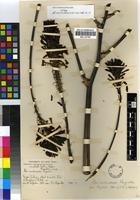
48. Aloe mudenensis Reynolds in Journal of South African Botany 3: 39 (1937a); ReyÂnolds: 244 (1950); Jeppe: 70 (1969); Bornman & D.S.Hardy: 107 (1972); B.-E. van Wyk & G.F.Sm.: 210 (1996). Type: KwaZulu-Natal, Muden Valley, Reynolds 2029 (PRE, holo.!; BOL!).
Range
Found in Swaziland and KwaZulu-Natal, with one record on the Mpumalanga border. A. mudenensis occurs in valley bushveld on sandy loam. It is one of the few species to survive close to human habitation and in heavily overÂgrazed areas. Map 37.