JSTOR Global Plants Home
  • Home
  • Browse
  • About
  • Access
  • Account
    • Saved Items
    • Profile
  • Log in

Global Plants

Skip to Main Content
  • JSTOR Global Plants Home
  • Global Plants

    • Browse
    • About
    • Access
    • Account
      • Saved Items
      • Profile
Log in
  • Browse
  • About
  • Access
  • Account
    • Saved Items
    • Profile
Advanced Search

Compilation
Aloe dinteri

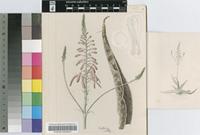
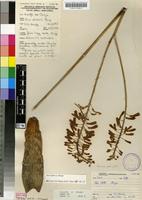
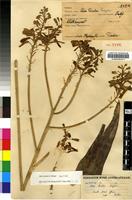
3 Images see all

Aloe dinteri A.Berger
Filed as Aloe dinteri A.Berger [family ASPHODELACEAE]
Holotype of Aloe dinteri A.Berger [family ASPHODELACEAE]
Previous
Next

Name

Identification
Aloe dinteri A.Berger [family ASPHODELACEAE ]
Related name
  • Aloe dinteri

Flora

Entry for Aloe dinteri [family ALOACEAE]
Herbarium
South African National Biodiversity Institute, Compton Herbarium, Cape Town (SAM)
Collection
Flora of Southern Africa
Resource Type
Reference Sources
Entry From
Flora of South Africa, (2003) Author: Dr J.P. Roux
Names
Aloe dinteri [family ALOACEAE]
Information
Plants solitary, 150-200 mm tall excluding inflorescence. Leaves 9-12, spreading, held al­most horizontal, narrowly lanceolate to narrowly deltoid, 200-400 x 40-80 mm, V-shaped in section, deep grey-green or brownish green with white spots. Inflorescence 3-8-branched, 0.5-1.0 m high; bracts narrowly deltoid-acuminate, very thin, scarious, ± 7-12 x 2 mm, 3-nerved (1 distinct, 2 obscure). Flowers pale pink with bluish bloom, 18-30 mm long, constricted above ovary; outer segments free for 5-10 mm, inner segments free but adnate to outer; pedicels 10-15 mm long, lengthening to 21 mm in fruit, Anthers not or hardly exserted. Ovary 5.0-6.0 x 1.5-2.5 mm, olive-green to brownish green; style not or hardly exserted. Fruit ± 26 x 12 mm, pale beige. Flowering time January to March.
Habitat
In this species the roots form far more of the total mass of the plant than the stem, leaves and inflorescence. This disproportion is unique in the genus. Bracts of A. dinteri are 3-nerved, not 1- nerved as in A. variegata (no. 40) and A. sladeniana (no. 41). Other differences between A. dinteri on the one hand and these two species on the other are discussed under the relevant species.
Use
42. Aloe dinteri A.Berger, in Dinter, Neue und wenig bekannte Pflanzen Deutsch-Sudwest-Afrikas: 14 (1914); Reynolds: t. 637 (1936d); Reynolds: 210 (1950); Jeppe: 17 (1969); Solch, Roessler & Merxm.: 16 (1970); Bornman & D.S.Hardy: 77 (1972); Jankowitz: 50 (1975). Type: Namibia, Outjo, Dinter 2791a (SAM!).
Range
Aloe dinteri occurs in Namibia in areas of low summer rainfall, usually wedged firmly in cracks in limestone rocks. Sometimes it also occurs on granite, in bushveld near the edge of the Namib Desert. Map 32.

Related Materials

  • Terms and Conditions
  • Privacy Policy
  • Cookie Policy
  • Cookie Settings
  • Accessibility
  • Help
  • Contact Us
  • Facebook
  • Twitter
ITHAKA

JSTOR is part of ITHAKA, a not-for-profit organization helping the academic community use digital technologies to preserve the scholarly record and to advance research and teaching in sustainable ways.

©2000-2026 ITHAKA. All Rights Reserved. JSTOR®, the JSTOR logo, JPASS®, Aluka®, and ITHAKA® are registered trademarks of ITHAKA.

╳