JSTOR Global Plants Home
  • Home
  • Browse
  • About
  • Access
  • Account
    • Saved Items
    • Profile
  • Log in

Global Plants

Skip to Main Content
  • JSTOR Global Plants Home
  • Global Plants

    • Browse
    • About
    • Access
    • Account
      • Saved Items
      • Profile
Log in
  • Browse
  • About
  • Access
  • Account
    • Saved Items
    • Profile
Advanced Search

Compilation
Acacia nigrescens

30 Images see all

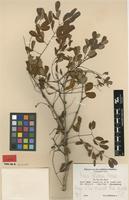
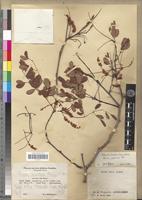
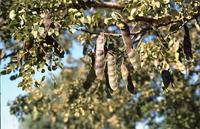
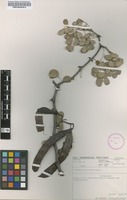
Acacia nigrescens Oliv.
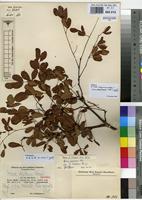
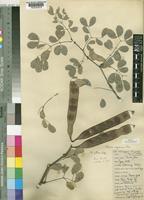
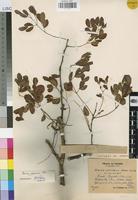
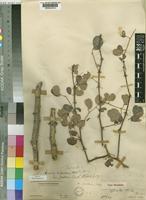
Isotype of Acacia schliebenii Harms [family FABACEAE]
Acacia nigrescens Oliv.
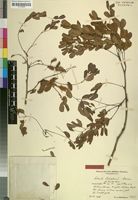
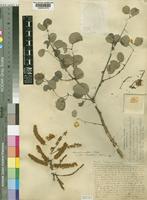
Acacia nigrescens Oliv. [family LEGUMINOSAE-MIMOSOIDEAE]
Acacia nigrescens Oliv.
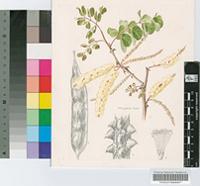
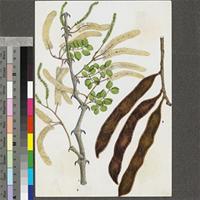
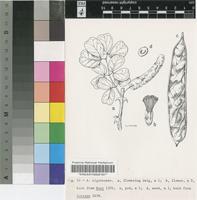
Acacia nigrescens Oliv. original illustration from the 'Trees of Central Africa'
Acacia nigrescens Oliv.
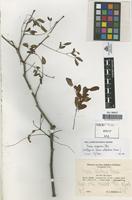
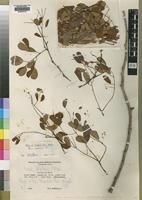
Isotype of Acacia schliebenii Harms [family LEGUMINOSAE-MIM]
Acacia nigrescens Oliv.
Acacia nigrescens Oliv. [family LEGUMINOSAE-MIMOSOIDEAE]
Acacia nigrescens Oliv.
Isotype of Acacia schliebenii Harms [family FABACEAE]
Type of Acacia schliebenii Harms [family FABACEAE-MIMOSOIDEAE]
Acacia nigrescens Oliv.
Acacia nigrescens Oliv. [family LEGUMINOSAE-MIMOSOIDEAE]
Isotype of Acacia schliebenii Harms [family LEGUMINOSAE-MIMOSOIDEAE]
Acacia nigrescens Oliv.
Isotype of Acacia schliebenii Harms [family LEGUMINOSAE-MIMOSOIDEAE]
Acacia nigrescens Oliv.
Acacia nigrescens Oliv. [family LEGUMINOSAE-MIMOSOIDEAE]
Type of Acacia schliebenii Harms [family LEGUMINOSAE]
Acacia nigrescens Oliv.
Filed as Acacia nigrescens Oliv. [family FABACEAE]
Acacia nigrescens Oliv.
Previous
Next

Name

Identification
Acacia nigrescens Oliv. [family LEGUMINOSAE ]
Related name
  • Acacia nigrescens

Flora

Entry for Acacia nigrescens [family FABACEAE]
Herbarium
South African National Biodiversity Institute, Compton Herbarium, Cape Town (SAM)
Collection
Flora of Southern Africa
Resource Type
Reference Sources
Entry From
Flora of South Africa, (2003) Author: Dr J.P. Roux
Names
Acacia nigrescens [family FABACEAE]
Common names
A. caffra sensu Oliv. in F.T.A. 2 : 345 (1871) pro parte, tantum quoad specim. McCabe pro parte; Bak.f., Leg. Trop. Afr. 3 : 833 (1930) etiam pro parte ut praec. A. nigrescens var. pallens Benth. in Trans. Linn. Soc. Lond. 30 : 517 (1875); Young in Candollea 15 : 119, 1.19/14 (1955). Type: Mozambique, near Sena, Kirk 201 (K, holo.!). A. passargei Harms in Passarge, Kalahari : 789 (1904); in Engl., Pflanzenw. Afr. 3,1 : 384 (1915). Type: Presumably from Botswana, Passarge 22 (B, holo. f; BM drawing!). A. pallens (Benth.) Rolfe in Kew Bull. 1907 : 361 (1907); Burtt Davy in Kew Bull. 1908 : 159 (1908); Glover in Ann. Bolus Herb. 1 : 145 (1915); Sim, Native Timbers S. Afr. 35, t.35 & 36 (1921); Bak.f., Leg. Trop. Afr. 3 : 829 (1930); Burtt Davy, Fl. Transv. 2 : 339, fig.57 (1932); Stapleton, Common Transvaal Trees 6 (1937). Type as for A. nigrescens var. pallens. A. mellifera sensu Henkel, Woody PI. Natal 232 (1934), non (Vahl) Benth. < Albizia lugardii N.E. Br. in Kew Bull. 1909 : 109 (1909). Type: Botswana, Ngamiland, Okavango valley, Lugard 246 (K, holo.!).
Information
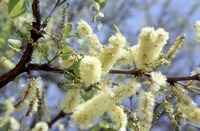
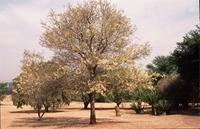
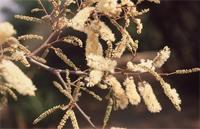
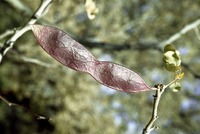
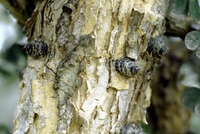
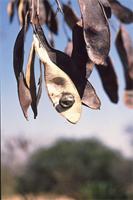
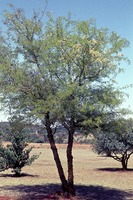
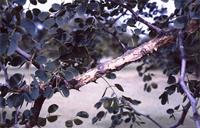
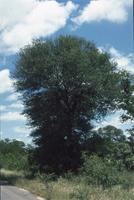
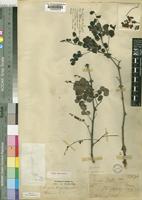
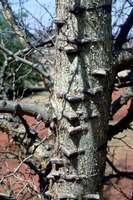
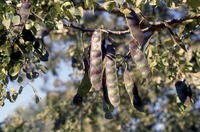
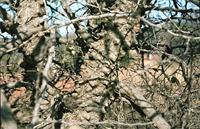
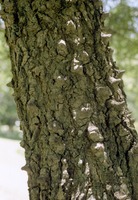
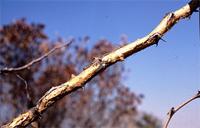
Tree to 30 m high; crown rounded or branches ascending and spreading slightly, often cylindrical in young plants; trunk to 0,75 m in diam., typically beset with persis­tent prickles arising from swollen knobs up to 6,3 cm long. Bark yellowish-, grey- or reddish-brown, sometimes almost black, rough, fissured; young branchlets yellowish-, grey- or reddish-brown to blackish, flaking minutely, glabrous to pubescent. Stipules not spinescent, in pairs, ± linear, 1-3 x 0,2-0,6 mm, soon deciduous. Prickles in pairs below the nodes, strongly recurved, often broad-based, grey- to reddish-brown or black, up to 7 mm long. Leaves: petiole 0,5-4,3 cm long, glabrous to pubescent, adaxial gland often absent, variable in position, 0,3-0,7 X 0,2-0,5 mm; rhachis 0,8-10,2 cm long, glabrous to pubescent, usually without a gland at the junction of each pinna pair; pinnae 2-4 pairs; rhachillae 0,3-3,7 cm long; leaflets 1-2(4) pairs per pinna, (6,5)10-30(50) X (5,3)7-30(49,8) mm, very variable in shape, obliquely obo-vate-orbicular to broadly obovate-elliptic, apex rounded and often emarginate, sub-coriaceous, venose, glabrous above and below or sparingly to densely appressed-pubescent above and/or below. Inflorescences spicate, fascicled, on short lateral branchlets, or occasionally solitary, sometimes crowded into a terminal raceme. Flowers yellowish-white, sessile; spikes 1-10,2 cm long; peduncles 0,3-2,4 cm long, glabrous or sub-glabrous, occasionally pubescent. Calyx often tinged with pink or distinctly pinkish-red, glabrous, tube 0,7-1,75 mm long, lobes 0,3-0,8 mm long. Corolla glabrous, tube 1,5-2 mm long, lobes up to 0,75 mm long. Stamen-filaments free, up to 6 mm long; anthers 0,1 mm across, with a deciduous apical gland. Ovary glabrous, 0,6-1,5 mm long, very shortly stipitate. Pods olive- or dark-brown to blackish, 6,1-17,8 X 1,4-2,4(2,7) cm, oblong, straight or nearly so, acuminate apically, longitudinally dehiscent, glabrous, coriaceous, brittle, scarcely venose. Seeds olive to olive-brown, 10-13 X 10-13 mm, subcircular-lenticular, compressed; areole 6-8 X 6-8 mm, horse-shoe shaped.
Habitat
A. nigrescens is usually an easily recognized species on account of its 1-2 (rarely 3-4) pairs of large leaflets and glabrous calyces. However, plants are found with leaflets intermediate in size, shape and number between those of A. nigrescens and those of A. burkei Benth. As these plants have pubescent calyces, their relationship appears to be with A. burkei rather than with A, nigrescens and they are discussed in more detail under A. burkei.
Use
8. Acacia nigrescens Oliv. in F.T.A. 2 : 340 (1871); Benth. in Trans. Linn. Soc. Lond. 30 : 517 (1875); Sim, For. Fl. P.E. Afr. 54, t.33B (1909); Harms in Engl., Pflanzenw. Afr. 3,1 : 384 (1915); Marloth, Fl. S. Afr. 2 : fig. 31 (1925); Bak.f., Leg. Trop. Afr. 3 : 829 (1930); Milne-Redhead in Kew Bull. 1937 : 417 (1937); Hutch., Botanist in S. Afr. 370, 375, 538, 549 (1946); Codd, Trees & Shrubs Kruger Nat. Park 47, figs. 40, 41, 42, 43c, d, e (1951); O. B. Miller in J.S. Afr. Bot. 18 : 23 (1952); Young in Candollea 15 : 119 (1955); Palgrave, Trees Cent. Afr. 250 (1956); Torre in C.F.A. 2 : 274 (1956): Schreiber in Mitt. Bot. Staatssamml. Munchen 2 : 284 (1957); Brenan in F.T.E.A. Legum.-Mimos. : 85, fig. 14/9 (1959); Palmer & Pitman, Trees S. Afr. 161, t.viii, 40, 41, 42 (1961); Letty, Wild Flow. Transv. 153, t.77 fig. 1 & la (1962); F. White, For. Fl. N. Rhod. 82, fig. 17E (1962); Von Breitenbach, Indig. Trees S. Afr. 2 : 274 (1965) pro parte excl. syn. A. goetzei Harms pro parte; De Winter et al, 66 Transv. Trees 52 (1966); Schreiber in F.S.W.A. 58 : 11 (1967); Ross in Bol. Soc. Brot, Sir. 2, 42 : 181 (1968); Brenan in F.Z. 3,1 : 69, t.15/3 (1970); Ross, Acacia Spp. Natal 35, fig. 1/5 (1971); Van Wyk, Trees Kruger Nat. Park 1 : 147 (1972); Ross, Fl. Natal 193 (1973); Palmer & Pitman, Trees S. Afr. 2 : 748 (1973). Type: Malawi, near Mitonda, Shire River, Kirk s.n. (K, holo.!).
Range
Found from Tanzania southwards to South West Africa, Botswana, the Transvaal, Swaziland and Natal (Zululand). Occurs on a variety of soil types in woodland, wooded grassland and bushveld, some­times near rivers and pans.

Related Materials

  • Terms and Conditions
  • Privacy Policy
  • Cookie Policy
  • Cookie Settings
  • Accessibility
  • Help
  • Contact Us
  • Facebook
  • Twitter
ITHAKA

JSTOR is part of ITHAKA, a not-for-profit organization helping the academic community use digital technologies to preserve the scholarly record and to advance research and teaching in sustainable ways.

©2000-2026 ITHAKA. All Rights Reserved. JSTOR®, the JSTOR logo, JPASS®, Aluka®, and ITHAKA® are registered trademarks of ITHAKA.

╳