JSTOR Global Plants Home
  • Home
  • Browse
  • About
  • Access
  • Account
    • Saved Items
    • Profile
  • Log in

Global Plants

Skip to Main Content
  • JSTOR Global Plants Home
  • Global Plants

    • Browse
    • About
    • Access
    • Account
      • Saved Items
      • Profile
Log in
  • Browse
  • About
  • Access
  • Account
    • Saved Items
    • Profile
Advanced Search

Compilation
Acacia burttii

7 Images see all

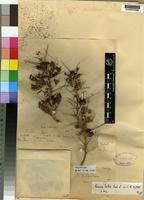
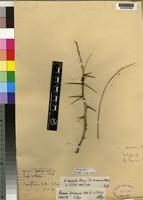
Isotype of Acacia burttii Baker f. [family LEGUMINOSAE]
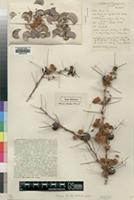
Type of Acacia burttii Baker.f. [family LEGUMINOSAE-MIMOSOIDEAE]
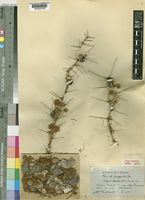
Type of Acacia burttii Baker f. [family LEGUMINOSAE]
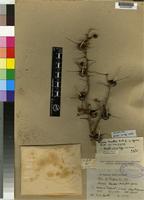
Isotype of Acacia arenaria Schinz [family LEGUMINOSAE]
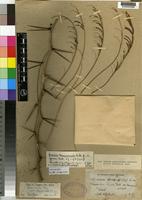
Type of Acacia burttii Baker,f. [family LEGUMINOSAE]
Acacia burttii Baker f.
Previous
Next

Name

Identification
Acacia burttii Baker f. [family FABACEAE ]
Related name
  • Acacia burttii

Flora

Entry for ACACIA burttii Bak. f. [family LEGUMINOSAE-MIMOSOIDEAE]
Herbarium
Royal Botanic Gardens, Kew (K)
Collection
Flora of Tropical East Africa
Resource Type
Reference Sources
Entry From
Flora of Tropical East Africa, page 1, (1959) Author: J. P. M. Brenan
Names
ACACIA burttii Bak. f. [family LEGUMINOSAE-MIMOSOIDEAE], in J.B. 71: 342 (1933); B. D. Burtt in Journ. Ecol. 30: 98, 143, t. 9, photo. 13 (1942); T.T.C.L. 335 (1949). Type: Tanganyika, Kahama District, 9 km. along Shinyanga road, B. D. Burtt 4501 (BM, holo.!, EA, FHO, K, iso.!)
Information
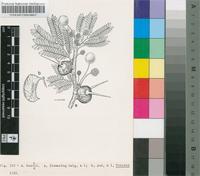
Altogether glabrous shrub or small tree 2–3 m. high with pole-like stem and short lateral branches giving plant a columnar appearance; bark buff or fawn. Young branchlets pale grey, sometimes going brown; epidermis flaking away later to expose a powdery rusty-brown inner layer. Stipules spinescent, mostly 1.5–3.5(–5.5) cm. long, straight, mostly grey or whitish, some fused at base into round or ovoid “ant-galls” 1–2.5 cm. in diameter, which are purplish going black and characteristically spotted or flecked. Leaves: petiole 3–13 mm. long, frequently glandular at apex; rhachis 0–3.2 cm. long; pinnae 1–4 pairs, 2–4.5 cm. long; leaflets 7–16 pairs, acute or subacute and mucronate at apex, (4–)5–13(–17) mm. long, 1.5–4 (–6) mm. wide. Flowers creamy-white, in heads; involucel at base of peduncle. Calyx 1.75–3 mm. long. Corolla 4.5–5 mm. long. Pods (Fig. 17/54, p. 68) short, half-moon-shaped or reniform, flattened, thin, glabrous, finely net-veined, grey-brown, 1.5–4 cm. long, 1–1.7 cm. wide, one-seeded. Seeds grey, mottled with dark brown, smooth, subcircular or broadly elliptic, compressed, 9–11 mm. long, 8.5–9 mm. wide; areole 5–7 mm. long, 4–6 mm. wide.
Range
DISTR. T1, 4 not known elsewhere
Altitude range
1130–1220 m.
Distribution
TANGANYIKA Mwanza District 40 km. E. of Geita Gold Mine, 11 Apr. 1937, B. D. Burtt 6454!;TANGANYIKA Kahama District 24 km. along Kahama-Ushirombo road, 9 Jan. 1933, B. D. Burtt 4502!TANGANYIKA SW. Tabora District , 10 Oct. 1934, C. H. N. Jackson 45!
Notes
No other species of “gall-acacia” in our area combines creamy-white flowers with such large leaflets and constantly so few pinnae. As the pod-shape is also unique among East African acacias, A. burttii is one of the most distinct and easily recognized of our species.

Related Materials

  • Terms and Conditions
  • Privacy Policy
  • Cookie Policy
  • Cookie Settings
  • Accessibility
  • Help
  • Contact Us
  • Facebook
  • Twitter
ITHAKA

JSTOR is part of ITHAKA, a not-for-profit organization helping the academic community use digital technologies to preserve the scholarly record and to advance research and teaching in sustainable ways.

©2000-2026 ITHAKA. All Rights Reserved. JSTOR®, the JSTOR logo, JPASS®, Aluka®, and ITHAKA® are registered trademarks of ITHAKA.

╳