JSTOR Global Plants Home
  • Home
  • Browse
  • About
  • Access
  • Account
    • Saved Items
    • Profile
  • Log in

Global Plants

Skip to Main Content
  • JSTOR Global Plants Home
  • Global Plants

    • Browse
    • About
    • Access
    • Account
      • Saved Items
      • Profile
Log in
  • Browse
  • About
  • Access
  • Account
    • Saved Items
    • Profile
Advanced Search

Compilation
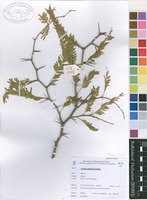
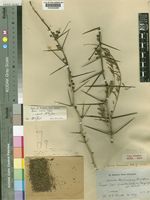
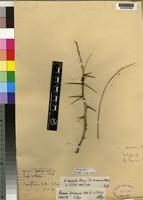
Acacia arenaria

7 Images see all

Filed as Acacia arenaria Schinz [family MIMOSACEAE]
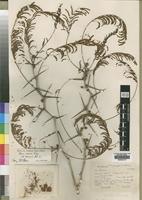
Type of Acacia hermannii Baker,f. [family LEGUMINOSAE]
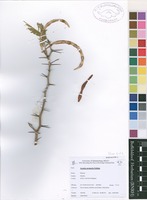
Type of Acacia rufobrunnea N.E.Br. [family LEGUMINOSAE-MIMOSOIDEAE]
Acacia arenaria Schinz [family LEGUMINOSAE-MIMOSOIDEAE]
Acacia arenaria Schinz
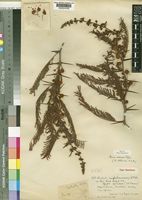
Isotype of Acacia arenaria Schinz [family LEGUMINOSAE]
Filed as Acacia arenaria Schinz [family MIMOSACEAE]
Previous
Next

Name

Identification
Acacia arenaria Schinz [family FABACEAE ]
Related name
  • Acacia arenaria

Flora

Entry for Acacia arenaria [family FABACEAE]
Herbarium
South African National Biodiversity Institute, Compton Herbarium, Cape Town (SAM)
Collection
Flora of Southern Africa
Resource Type
Reference Sources
Entry From
Flora of South Africa, (2003) Author: Dr J.P. Roux
Names
Acacia arenaria [family FABACEAE]
Common names
A. hermannii Bak.f. in J. Bot., Lond. 67 : 198(1929); Bak.f., Leg. Trop. Afr. 3 : 847 (1930); Brenan, Checklist Tang. Terr. 337 (1949); Wild, S. Rhod. Bot. Diet. 47 (1953). Type: Tanzania, Singida District, near Manyugi [? Manyigi], B.D. Burtt 1379 (BM, holo.!; FHO!, K!, Z!). A. rufobrunnea N.E. Br. in Kew Bull. 1909 : 107 (1909). Type: Botswana, Ngamiland, Botletle valley, E.J. Lugard 245 (K, holo.!). A. seyalDel. var. multijugasensu O.B. Miller in J. S. Afr. Bot. 18 : 24 (1952) quoad specim. Pole Evans 3251, non Schweinf.
Information
Shrub or small tree 1,5-9 m high, branching from near the base. Bark pale to dark grey- or reddish-brown to black, rough; young branchlets pale to dark grey- or reddish-brown, often as though whitewashed over a purplish background, sparingly to densely puberulous. Stipules spinescent, in pairs, up to 6 cm long, straight, slender, usually the same colour as the young branch-lets and sparingly to densely puberulous; other prickles absent. Leaves: petiole 0,3-1,4 cm long, adaxial gland often absent, when present usually just below the lowest pinna pair, slightly raised, round to oval, 0,6-1,4 x 0,5—1,2 mm; rhachis 5-21,5 cm long, sparingly to densely pubescent, with a gland at the junction of eacli of the top 1-3 pairs of pinnae; well-developed leaves with 15-36 pairs of pinnae (reduced leaves with as few as 9 pairs of pinnae sometimes also present); rhachillae 1,2-4,1 cm long; leaflets (11)18-26(32) pairs per pinna, 1,5-5 x 0,5-1,1 mm, linear to linear-oblong, apex rounded to subacute, margins glabrous or ciliate, glabrous abaxially. Inflorescences capi­tate, solitary or more usually fascicled, often crowded into an irregular terminal "raceme". Flowers white or pale pink, sessile; peduncles (0,6)1,1-2,2(2,9) cm long, sparingly to densely pubescent, usually glandular; invo-lucel at or above the middle or at the apex of the peduncle. Calyx cupular, white or pink, sparingly to densely pubescent, espe­cially at apices of lobes, tube 0,3-0,9 mm long, lobes up to 0,6 mm long. Corolla tubular, glabrous, tube up to 2,5 mm long, lobes up to 0,7 mm long, usually 2-4 times as long as the calyx. Stamen-filaments free, up to 5 mm long; anthers 0,2-0,25 mm across, with a deciduous apical gland. Ovary up to 1 mm long, glabrous. Pods pale to dark reddish-brown, 8-22 x 0,5-0,8 cm, arcuate, sometimes slightly constricted between the seeds, flat, longitudinally dehiscent; valves thin, glabrous to sparingly pubescent and glandular. Seeds olive-grey, 7-9 X 3-4,5 mm, oblong or quadrate, smooth, compressed; areole 3,5-4,5 x 1,5-2,25 mm.
Habitat
A. davyi bears a superficial resemblance to A. arenaria. For the differences between the two species see the notes under A. davyi.
Use
39. Acacia arenaria Schinz in Mem. Herb. Boiss. 1 : 105 (1900); Harms in Engl., Pflanzenw. Afr. 3,1 : 376 (1915); Dinter in Feddes Repert. 15 : 78 (1917): Bak.f., Leg. Trop. Afr. 3 : 839 (1930); Hutch., Botanist in S. Afr. 523 (1946); O.B. Miller in J. S. Afr. Bot. 18 : 18 (1952); Torre in C.F.A. 2 : 282 (1956); Brenan in F.T.E.A. Legum.-Mimos. : 126, fig. 17/55 (1959); Schreiber in F.S.W.A. 58 : 7 (1967); Brenan in F.Z. 3,1 : 106 (1970); Palmer & Pitman, Trees S. Afr. 2 : 805 (1973). Syntypes: South West Africa, Ovamboland, Olukonda-Oshiheke, Schinz 2071 (Z!); Amboland. "Omatope", Schinz 2072 (Z!)
Range
Occurs in Tanzania, Angola, South West Africa, Botswana and Rhodesia. Found usually in drier types of mixed woodland, grassland or scrub, sometimes with Colophospermum mopane.

Related Materials

  • Terms and Conditions
  • Privacy Policy
  • Cookie Policy
  • Cookie Settings
  • Accessibility
  • Help
  • Contact Us
  • Facebook
  • Twitter
ITHAKA

JSTOR is part of ITHAKA, a not-for-profit organization helping the academic community use digital technologies to preserve the scholarly record and to advance research and teaching in sustainable ways.

©2000-2026 ITHAKA. All Rights Reserved. JSTOR®, the JSTOR logo, JPASS®, Aluka®, and ITHAKA® are registered trademarks of ITHAKA.

╳