JSTOR Global Plants Home
  • Home
  • Browse
  • About
  • Access
  • Account
    • Saved Items
    • Profile
  • Log in

Global Plants

Skip to Main Content
  • JSTOR Global Plants Home
  • Global Plants

    • Browse
    • About
    • Access
    • Account
      • Saved Items
      • Profile
Log in
  • Browse
  • About
  • Access
  • Account
    • Saved Items
    • Profile
Advanced Search

Compilation
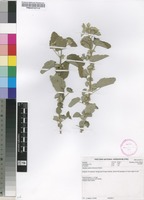
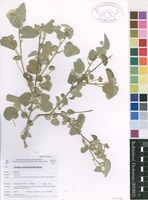
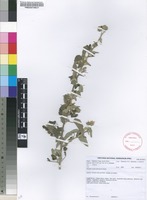
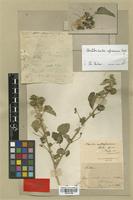
Abutilon austro-africanum

4 Images see all

Filed as Abutilon austro-africanum [family MALVACEAE]
Filed as Abutilon austro-africanum Hochr. [family MALVACEAE]
Filed as Abutilon austro-africanum (Hiern) F.White [family MALVACEAE]
Type of Abutilon austro-africanum Hochr. [family MALVACEAE]
Previous
Next

Name

Identification
Abutilon austro-africanum Hochr. [family MALVACEAE ] (stored under name); Verified by Data not digitized, Abutilon austro-africanum Hochr. [family MALVACEAE ] Verified by Data not digitized,
Related name
  • Abutilon austro-africanum

Flora

Entry for Abutilon austro-africanum Hochr. [family MALVACEAE]
Herbarium
Royal Botanic Gardens, Kew (K)
Collection
Flora Zambesiaca
Resource Type
Reference Sources
Entry From
FZ, Vol 1, Part 2, page 420, (1961) Author: A. W. Exell
Names
Abutilon austro-africanum Hochr. [family MALVACEAE], in Ann. Conserv. Jard. Bot. Genève, 7: 25 (1902). — Ulbr. in Engl., Bot. Jahrb. 51: 14 (1913). — Burtt Davy, F.P.F.T. 2: 275 (1932). TAB. 93 fig. 6. Syntypes from Griqualand-W. and SW. Africa.
Information
Shrublet 0·5–0·75 m. tall, often spreading, canescent to glaucous with a short greyish velvety indumentum and additional long soft patent white hairs (rarely very sparse or almost lacking); stems greyish- or yellowish-green when young, soon glabrescent and becoming pale-purplish-brown, ultimately woody with an ash-grey smooth or finely longitudinally fissured bark. Leaf-lamina 2–5 (8) × 1–3 (5) cm., cordate-triangular to ovate-cordate, apex acute or somewhat acuminate or rounded, margin crenate to crenate-serrate often with minutely callous-mucronate serrations, dark-greyish-green and velvety above, much paler, glaucous-grey and finely velvety beneath, venation of lower surface somewhat prominent and conspicuous owing to its whitish or pale yellow colour; petiole usually shorter than the lamina, terete. Flowers yellow, solitary, axillary on main branches (not on condensed short axillary shoots); pedicels (10) 25–50 mm. long, slender, terete, articulated near the apex. Calyx 9–12 mm. long, widely campanulate, incised beyond the middle; lobes 6–8 mm. long, triangular-ovate to ovate-lanceolate, acuminate-apiculate, with a prominent median vein and usually in addition with a faint longitudinal vein on either side. Petals 11–14 × 8 mm., conspicuously ciliate in basal narrowed portion, often marked with reddish spots at the base and reddish-veined in lower portion. Staminal tube rather shortly conical, sparsely stellate-hairy to glabrous except at the very base. Fruit c. 14 × 5 mm., discoid-subglobose, truncate at the apex and widely umbilicate in the centre, stellate-hairy. Mericarps 20–30, c. 7 × 5 mm., ultimately black, 1-seeded, the upper edge slanting upwards into the usually sharply pointed to shortly apiculate dorsal apical angle. Seeds c. 2·5 mm. long, punctate-verruculose.
Habitat
Usually found in open vegetation on sandy to gravelly, often brackish soils, often in pans, generally in areas with a low rainfall.
Distribution
Mozambique M Sabiè, Moamba, Pedrógão 212 (LMJ; PRE).Zimbabwe W Bulawayo, Orpen 80/50 (BM; SRGH).Botswana SE Mochudi, fl. & fr. 1.iv.1914, Harbor in Rogers 6444 (BM; BOL; GRA; K; PRE).
Distribution (external)
SW. Africa
Cape Prov. (Griqualand-W.)
Transvaal
Notes
This species is an example of a plant with an E-W distribution pattern found in a relatively small group of species in southern Africa. They occur from SW. Africa (and sometimes Angola) through Bechuanaland, S. Rhodesia and/or the Transvaal (sometimes also Griqualand-W.) to Mozambique. The explanation of this distribution pattern is most probably an ecological one; these species are either more or less confined to dry sandy or gravelly, sometimes alkaline or brackish soils occurring throughout the area (Barleria senensis Klotzsch and Abutilon austro-africanum. are good examples) or they are distributed by water in an E-W or W-E direction (the general directions of the rivers in this area). An example of the latter group is Abutilon engleranum, the only other species of the genus with this distribution pattern.

Related Materials

  • Terms and Conditions
  • Privacy Policy
  • Cookie Policy
  • Cookie Settings
  • Accessibility
  • Help
  • Contact Us
  • Facebook
  • Twitter
ITHAKA

JSTOR is part of ITHAKA, a not-for-profit organization helping the academic community use digital technologies to preserve the scholarly record and to advance research and teaching in sustainable ways.

©2000-2026 ITHAKA. All Rights Reserved. JSTOR®, the JSTOR logo, JPASS®, Aluka®, and ITHAKA® are registered trademarks of ITHAKA.

╳