JSTOR Global Plants Home
  • Home
  • Browse
  • About
  • Access
  • Account
    • Saved Items
    • Profile
  • Log in

Global Plants

Skip to Main Content
  • JSTOR Global Plants Home
  • Global Plants

    • Browse
    • About
    • Access
    • Account
      • Saved Items
      • Profile
Log in
  • Browse
  • About
  • Access
  • Account
    • Saved Items
    • Profile
Advanced Search

Compilation
Abies procera

4 Images see all

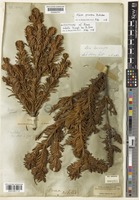
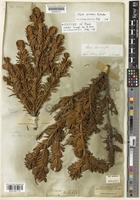
Isotype of Pinus nobilis Douglas ex D.Don [family PINACEAE]
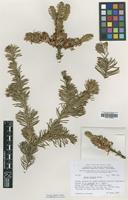
Abies procera Rehder [family PINACEAE]
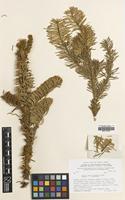
Type? of Abies procera Rehder [family PINACEAE]
Previous
Next

Name

Identification
Abies procera Rehder [family PINACEAE ] (stored under name);
Related name
  • Abies procera
Common name
  • Noble fir, Flora of North America Vol. 2

Flora

Entry for Abies procera Rehder [family PINACEAE]
Herbarium
Flora of North America (FNA)
Collection
Flora of North America
Resource Type
Reference Sources
Entry From
Flora of North America, Vol 2,
Names
Abies procera Rehder [family PINACEAE], Rhodora, 42: 522. 1940
Abies nobilis (Douglas ex D. Don) Lindley [family PINACEAE], 1833,. not A.Dietrich 1824
Treatment Author(s)
Richard S. Hunt
Information
Trees to 80m; trunk to 2.2m diam.; crown spirelike. Bark grayish brown, in age becoming thick and deeply furrowed (furrows and ridges about same width) and reddish brown (especially reddish when plates flake off). Branches diverging from trunk at right angles, stiff; twigs reddish brown, finely pubescent for several years. Buds hidden by leaves, tan, ovoid, small, not resinous, apex rounded; basal scales short, broad, equilaterally triangular, pubescent centrally, not resinous, margins entire to crenate, apex sharp-pointed. Leaves 1--3(--3.5)cm ´ 1.5--2mm, 1-ranked, flexible, proximal portion often appressed to twig for 2--3mm (best seen on abaxial surface of twig), distal portion divergent; cross section flat, with prominent raised midrib abaxially, with or without groove adaxially, or cross section 4-sided on fertile branches; odor pungent, faintly turpentinelike; abaxial surface with 2--4 glaucous bands, each band with (4--)6--7 stomatal rows; adaxial surface bluish green, with 0--2 glaucous bands, each band with 0--7 stomatal rows at midleaf; apex rounded to notched; leaves on fertile branches 4-sided with 4 bands of stomates below; resin canals small, near margins and abaxial epidermal layer. Pollen cones at pollination ± purple, ± red, or reddish brown. Seed cones oblong-cylindric, 10--15 ´ 5--6.5cm, green, red, or purple, overlaid with green bracts, at maturity brown (bracts light-colored and scales dark), sessile, apex rounded; scales ca. 2.5 ´ 3cm, pubescent; bracts exserted and reflexed over scales. Seeds 12 ´ 6mm, body reddish brown; wing slightly longer than body, light brown to straw; cotyledons (4--)5--6(--7). 2 n =24.
Altitude range
60--2700m
Distribution
USA Calif.USA Oreg.USA Wash.
Discussion
See discussion under Abies magnifica.

Related Materials

  • Terms and Conditions
  • Privacy Policy
  • Cookie Policy
  • Cookie Settings
  • Accessibility
  • Help
  • Contact Us
  • Facebook
  • Twitter
ITHAKA

JSTOR is part of ITHAKA, a not-for-profit organization helping the academic community use digital technologies to preserve the scholarly record and to advance research and teaching in sustainable ways.

©2000-2026 ITHAKA. All Rights Reserved. JSTOR®, the JSTOR logo, JPASS®, Aluka®, and ITHAKA® are registered trademarks of ITHAKA.

╳