JSTOR Global Plants Home
  • Home
  • Browse
  • About
  • Access
  • Account
    • Saved Items
    • Profile
  • Log in

Global Plants

Skip to Main Content
  • JSTOR Global Plants Home
  • Global Plants

    • Browse
    • About
    • Access
    • Account
      • Saved Items
      • Profile
Log in
  • Browse
  • About
  • Access
  • Account
    • Saved Items
    • Profile
Advanced Search

Compilation
Abies lasiocarpa

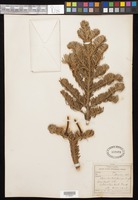
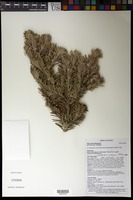
14 Images see all

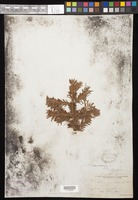
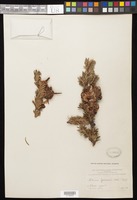
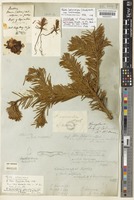
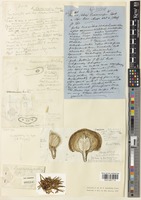
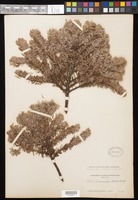
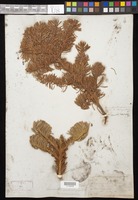
Abies lasiocarpa (Hook.) Nutt. [family PINACEAE]
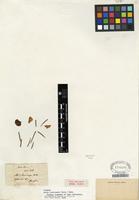
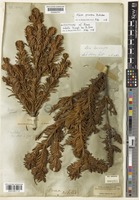
Isotype of Pinus nobilis Douglas ex D.Don [family PINACEAE]
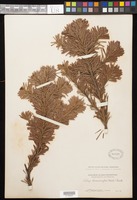
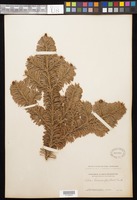
Abies lasiocarpa (Hook.) Nutt. [family PINACEAE]
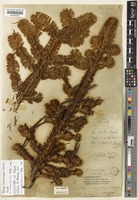
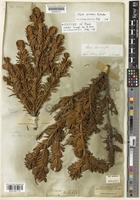
Type of Pinus lasiocarpa Hook. [family PINACEAE]
Type of Abies lasiocarpa (Hook.) Nutt. [family PINACEAE]
Abies lasiocarpa (Hook.) Nutt. [family PINACEAE]
Holotype of Abies bifolia A.Murray bis [family PINACEAE]
Abies procera Rehder [family PINACEAE]
Abies lasiocarpa (Hook.) Nutt. [family PINACEAE]
Abies lasiocarpa (Hook.) Nutt. variety lasiocarpa [family PINACEAE]
Abies lasiocarpa (Hook.) Nutt. [family PINACEAE]
Holotype of Pinus lasiocarpa Hook. [family PINACEAE]
Previous
Next

Name

Identification
Abies lasiocarpa (Hook.) Nutt. [family PINACEAE ] (stored under name); Verified by Elbert L. Little, Jr.,, Pinus lasiocarpa Hook. [family PINACEAE ] Verified by Not on sheet, Pinus lasiocarpa Hook. [family PINACEAE ] Verified by Not on sheet,
Related name
  • Abies lasiocarpa
  • Pinus lasiocarpa
Common name
  • Subalpine fir, Flora of North America Vol. 2
  • alpine fir, Flora of North America Vol. 2
  • sapin concolore, Flora of North America Vol. 2

Flora

Entry for Abies lasiocarpa (Hooker) Nuttall [family PINACEAE]
Herbarium
Flora of North America (FNA)
Collection
Flora of North America
Resource Type
Reference Sources
Entry From
Flora of North America, Vol 2,
Names
Abies lasiocarpa (Hooker) Nuttall [family PINACEAE], N. Amer. Sylv., 3: 138. 1849
Pinus lasiocarpa Hooker [family PINACEAE], Fl. Bor.-Amer., 2: 163. 1838
Treatment Author(s)
Richard S. Hunt
Information
Trees to 20m; trunk to 0.8m diam.; crown spirelike. Bark gray, thin, smooth, furrowed in age. Branches stiff, straight; twigs opposite to whorled, greenish gray to light brown, bark splitting as early as 2 years to reveal red-brown layer, somewhat pubescent; fresh leaf scars with red periderm. Buds hidden by leaves or exposed, tan to dark brown, nearly globose, small, resinous, apex rounded; basal scales short, broad, equilaterally triangular, glabrous or with a few trichomes at base, not resinous, margins crenate to dentate, apex sharp-pointed. Leaves 1.8--3.1cm ´ 1.5--2mm, spiraled, turned upward, flexible; cross section flat, prominently grooved adaxially; odor sharp (ß-phellandrene); abaxial surface with 4--5 stomatal rows on each side of midrib; adaxial surface bluish green, very glaucous, with 4--6 stomatal rows at midleaf, rows usually continuous to leaf base; apex prominently or weakly notched to rounded; resin canals large, ± median, away from margins and midway between abaxial and adaxial epidermal layers. Pollen cones at pollination ± purple to purplish green. Seed cones cylindric, 6--12 ´ 2--4cm, dark purple, sessile, apex rounded; scales ca. 1.5 ´ 1.7cm, densely pubescent; bracts included (specimens with exserted, reflexed bracts are insect infested). Seeds 6 ´ 2mm, body brown; wing about 1.5 times as long as body, light brown; cotyledon number 4--5. 2 n =24.
Altitude range
1100--2300 m
Distribution
USA AlaskaUSA Calif.USA Oreg.USA Wash.Canada B.C.Canada Yukon
Discussion
The only unique populations in this species come from coastal Alaska (A. S. Harris 1965; C. J. Heusser 1954). They are found at lower elevations (0--900 m) and appear to be isolated with no reported introgression between them and the coastal mountain populations. The population on the Prince of Wales Island has distinct terpene patterns and needs morphological and developmental studies to see if these patterns contrast with neighboring populations.
Through central British Columbia and northern Washington, Abies lasiocarpa introgresses with A . bifolia . These trees may have morphologic features resembling either species and may have intermediate terpene patterns; they are best classified as interior subalpine fir ( A . bifolia ´ lasiocarpa ). At the southern end of its range, A . lasiocarpa possibly hybridizes with A . procera (R.S. Hunt and E.von Rudloff 1979). Abies lasiocarpa shares with A . procera a red periderm, crystals in the ray parenchyma (R.W. Kennedy et al. 1968), and reflexed tips of the bracts, features not shared with A . bifolia .
Abies lasiocarpa usually exists in small stands at high elevations and is not often observed. Its differences in comparison to A . bifolia have prompted studies (W.H. Parker et al. 1979) to see if it is A . bifolia introgressed with the sympatric A . amabilis . Abies lasiocarpa and A . amabilis , however, are separated by many morphologic features, and no hybrids have been found (W.H. Parker et al. 1979).

Related Materials

  • Terms and Conditions
  • Privacy Policy
  • Cookie Policy
  • Cookie Settings
  • Accessibility
  • Help
  • Contact Us
  • Facebook
  • Twitter
ITHAKA

JSTOR is part of ITHAKA, a not-for-profit organization helping the academic community use digital technologies to preserve the scholarly record and to advance research and teaching in sustainable ways.

©2000-2026 ITHAKA. All Rights Reserved. JSTOR®, the JSTOR logo, JPASS®, Aluka®, and ITHAKA® are registered trademarks of ITHAKA.

╳