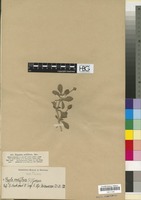
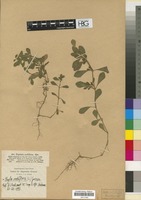
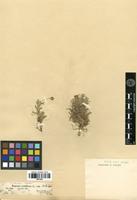
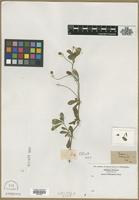
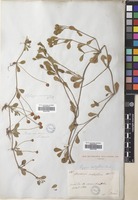
a creeping perennial herb rooting at the nodes, obscurely pubescent, with closely adpressed silvery-white canoe-shaped unicellular hairs attached by the middle, acuminate and serrulate at both ends; stem ridged, with internodes 1 1/2–3 in. long; leaves opposite, sessile or petiolate, obovate, cuneate and entire in the basal half, sharply and coarsely dentate towards the rounded or subacute apex, with the midrib and ascending primary lateral nerves obscure or slightly prominent, 1 1/4–1 1/2 in. long, 1/3– 2/3 in. broad; spike subglobose, solitary, up to 3/4 in. long, 2–2 1/2 lin. in diam.; peduncle 1–2 1/4 in. long; bracts not exceeding the flowers, obovate or subrhomboid, cuneate at the base, truncate, more or less rounded, apiculate or shortly mucronate at the apex, with a narrow membranous sinuate entire or obscurely serrate margin, glabrous above, 1 1/4–1 3/4 lin. long, 1 1/8–1 1/4 lin. broad; calyx deeply 2-lobed, compressed, mitre-shaped, puberulous on the prominent keels with simple adpressed hairs attached by their bases, elsewhere thinly membranous and glabrous, 1–1 1/2 lin. long; lobes acuminate, ciliate; corolla white, minutely and obscurely puberulous without beneath the lower (anterior) lobe, otherwise glabrous, 1 1/2–2 lin. long, later raised as a calyptra by the ripening fruit; upper lip erect, bifid; lower larger than the upper, obscurely 3-lobed with the middle lobe oblong, about 1/2 lin. long; pyrene very shortly oblong, plano-convex, flattened at the commissure, acute, obtuse or rounded at the apex, glabrous, minutely rugose, 1/2 lin. long. null