JSTOR Global Plants Home
  • Home
  • Browse
  • About
  • Access
  • Account
    • Saved Items
    • Profile
  • Log in

Global Plants

Skip to Main Content
  • JSTOR Global Plants Home
  • Global Plants

    • Browse
    • About
    • Access
    • Account
      • Saved Items
      • Profile
Log in
  • Browse
  • About
  • Access
  • Account
    • Saved Items
    • Profile
Advanced Search

Compilation
Xyris decipiens

8 Images see all

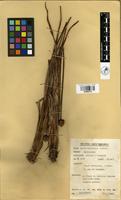
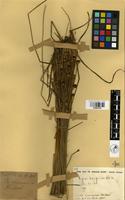
Filed as Xyris decipiens N.E.Br. [family XYRIDACEAE]
Xyris decipiens N.E.Br. [family XYRIDACEAE]
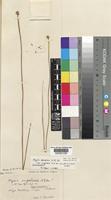
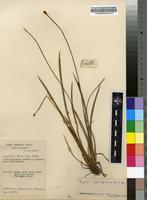
Filed as Xyris decipiens N.E.Br. [family XYRIDACEAE]
Type of Xyris decipiens N.E.Brown [family XYRIDACEAE]
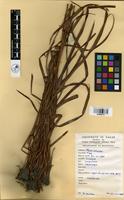
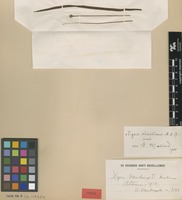
Filed as Xyris decipiens N.E.Br. [family XYRIDACEAE]
Syntype of Xyris vanderystii Malme [family XYRIDACEAE]
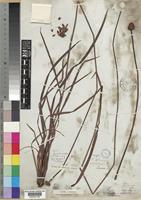
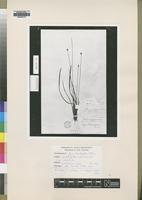
Lectotype of Xyris vanderystii Malme [family XYRIDACEAE]
Previous
Next

Name

Identification
Xyris vanderystii Malme [family XYRIDACEAE ] Xyris decipiens (Malme) Malme [family XYRIDACEAE ] (stored under name);
Related name
  • Xyris angularis
  • Xyris vanderystii
  • Xyris decipiens

Flora

Entry for XYRIS decipiens N. E. Br. [family XYRIDACEAE]
Herbarium
Royal Botanic Gardens, Kew (K)
Collection
Flora of Tropical Africa
Resource Type
Reference Sources
Entry From
Flora of Tropical Africa, Vol 8, page 6, (1902) Author: (By N. E. Brown.)
Names
XYRIS decipiens N. E. Br. [family XYRIDACEAE], in Dyer, Fl. Cap. vii. 3.
XYRIS laxifolia Benth. [family XYRIDACEAE], in Hook. Niger Fl., 548, not of Mart.
Information
Leaves 5–16 in. long, 1 1/2–2 1/2 lin. broad, with concolorous sheaths 1 1/4–3 in. long, linear, acuminate, glabrous. Peduncular-sheath 5 1/2–7 1/2 in. long, acute and leafless, or (abnormally?) with a distinct blade like the other leaves. Peduncle 2–2 1/2 ft. long, 1–1 1/3 lin. thick, terete, sulcate-striate, glabrous; pith rather loose, not hollow at the centre. Spike 6–9 lin. long, 5–6 lin. thick, ovoid, acute or subacute, 30–40-flowered. Bracts 3–3 1/2 lin. long, 2 1/2–2 3/4 lin. broad, oblong-obovate, very obtuse, minutely subdenticulate, concave, 7–9-nerved, light chestnut-brown, slightly shining, with a distinct oblong-lanceolate greyish dorsal area about 1–1 1/4 lin. long and 1/2 lin. broad; nerves reticulate at their apex. Lateral sepals 2 1/2 lin. long, 1/2 lin. broad, pale brown, linear-falcate or linear-lanceolate, acute, keeled; keel winged, serrulate along the upper part. Corolla only seen in bud. Arms of the staminodes very short ending in dense brush-like tufts of long hairs. Anthers linear-oblong. Capsule 2 1/2 lin. long, oblong-lanceolate, subacute, trigonous.
Distribution
Sierra Leone Upper Guinea Samu Country, Scott-Elliot, 4220! and without precise locality, Smeathman!Angola Lower Guinea Curror!
Notes
This is the stoutest of all the African species, and the dorsal area on the bracts is more conspicuous than in any other. The pubescence on the keel of the lateral sepals, mentioned in my original description, seems to be due to some accidental disintegration of the superficial cells in the specimens first examined, and does not occur in the Sierra Leone example. Since this species was described it has been discovered that the plants collected by Curror and labelled “W. Africa, S. of the Tropic,” were all collected in Angola.

Related Materials

  • Terms and Conditions
  • Privacy Policy
  • Cookie Policy
  • Cookie Settings
  • Accessibility
  • Help
  • Contact Us
  • Facebook
  • Twitter
ITHAKA

JSTOR is part of ITHAKA, a not-for-profit organization helping the academic community use digital technologies to preserve the scholarly record and to advance research and teaching in sustainable ways.

©2000-2026 ITHAKA. All Rights Reserved. JSTOR®, the JSTOR logo, JPASS®, Aluka®, and ITHAKA® are registered trademarks of ITHAKA.

╳