JSTOR Global Plants Home
  • Home
  • Browse
  • About
  • Access
  • Account
    • Saved Items
    • Profile
  • Log in

Global Plants

Skip to Main Content
  • JSTOR Global Plants Home
  • Global Plants

    • Browse
    • About
    • Access
    • Account
      • Saved Items
      • Profile
Log in
  • Browse
  • About
  • Access
  • Account
    • Saved Items
    • Profile
Advanced Search

Compilation
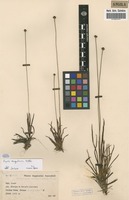
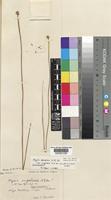
Xyris angularis

2 Images see all

Filed as Xyris angularis N.E.Br. [family XYRIDACEAE]
Xyris decipiens N.E.Br. [family XYRIDACEAE]
Previous
Next

Name

Identification
Xyris decipiens N.E.Br. [family XYRIDACEAE ] (stored under name); Verified by Hepper, Xyris angularis N.E.Br. [family XYRIDACEAE ] Verified by Hepper,
Related name
  • Xyris angularis
  • Xyris decipiens

Flora

Entry for XYRIS angularis N. E. Brown. [family XYRIDACEAE]
Herbarium
Royal Botanic Gardens, Kew (K)
Collection
Flora of Tropical Africa
Resource Type
Reference Sources
Entry From
Flora of Tropical Africa, Vol 8, page 6, (1902) Author: (By N. E. Brown.)
Names
XYRIS angularis N. E. Brown. [family XYRIDACEAE]
Information
Leaves and peduncular-sheath not seen. Peduncle 14–18 in. high, about 1/2 lin. thick, distinctly 4–6-angled, hollow, glabrous. Spike 3–4 lin. long, 2 1/2–3 lin. thick, ellipsoid, about 10-flowered. Bracts 2–2 1/2 lin. long, 1 1/2 lin. broad, elliptic, very obtuse, not keeled, concave, glabrous, rather light brown with a distinct greyish lanceolate or lanceolate-oblong dorsal area; nerves numerous, much reticulated. Lateral sepals 2 1/2 lin. long, 1/4– 1/3 lin. broad, falcate-linear, acute, keeled, brown, paler towards the margins; keel not produced at the apex, serrulate along the apical half, with the teeth often ending in a fine hair. Corolla not seen.
Distribution
Niger Upper Guinea Nupe, Barter!
Notes
This species is easily recognised by its sharply angular peduncles, combined with the distinct dorsal area of the bracts.

Related Materials

  • Terms and Conditions
  • Privacy Policy
  • Cookie Policy
  • Cookie Settings
  • Accessibility
  • Help
  • Contact Us
  • Facebook
  • Twitter
ITHAKA

JSTOR is part of ITHAKA, a not-for-profit organization helping the academic community use digital technologies to preserve the scholarly record and to advance research and teaching in sustainable ways.

©2000-2026 ITHAKA. All Rights Reserved. JSTOR®, the JSTOR logo, JPASS®, Aluka®, and ITHAKA® are registered trademarks of ITHAKA.

╳