JSTOR Global Plants Home
  • Home
  • Browse
  • About
  • Access
  • Account
    • Saved Items
    • Profile
  • Log in

Global Plants

Skip to Main Content
  • JSTOR Global Plants Home
  • Global Plants

    • Browse
    • About
    • Access
    • Account
      • Saved Items
      • Profile
Log in
  • Browse
  • About
  • Access
  • Account
    • Saved Items
    • Profile
Advanced Search

Compilation
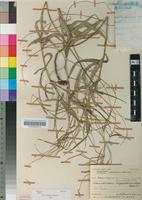
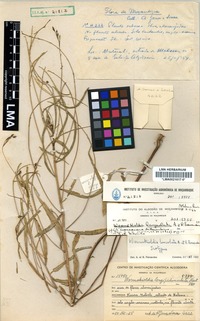
Wormskioldia lanceolata

2 Images see all

Isotype of Wormskioldia lanceolata A.& R.Fern. [family TURNERACEAE]
Isotype of Wormskioldia lanceolata A. Fern. & R.Fern. [family TURNERACEAE]
Previous
Next

Name

Identification
Isotype of Wormskioldia lanceolata A. Fern. & R.Fern. [family TURNERACEAE ] (stored under name); Verified by R. Fern. & A. Fern.,
Related name
  • Wormskioldia lanceolata
  • Tricliceras lanceolatum

Flora

Entry for Tricliceras lanceolatum A. & R. Fernandes R. Fernandes [family TURNERACEAE]
Herbarium
Royal Botanic Gardens, Kew (K)
Collection
Flora Zambesiaca
Resource Type
Reference Sources
Entry From
FZ, Vol 4, Part 0, page 348, (1978) Author: R. Fernandes
Names
Tricliceras lanceolatum A. & R. Fernandes R. Fernandes [family TURNERACEAE], in Bol. Soc. Brot., Sér. 2, 49: 20 (1975). Type: Mozambique, Mutuáli, Malema road, Gomes e Sousa 4222 (COI, holotype; LMA).
Wormskioldia lanceolata A. & R. Fernandes [family TURNERACEAE], op. cit. 35: 156, t. 3 (1961); in Mem. Junta Invest. Ultramar, Sér. 2, 34: 15 (1962). Type as above.
Information
Annual herb. Stem up to 60 cm. high, erect, simple or branched from the base, puberulous (hairs very short and thin, arcuate, antrorse, subappressed) and sparsely setose (setae c. 0·5 mm. long, yellowish towards the apex, brownish at the swollen base). Leaves all similar, up to 15 × 1·6 cm., oblong-lanceolate to linear-lanceolate, unlobed, tapering towards the base and the very acute apex, shallowly undulate and with minute teeth at the margin, sometimes with some triangular teeth near the base and a pair of sessile glands just at the base, thinly membranous, glabrous everywhere or sparsely puberulous towards the base; petiole 1–2 mm. long to absent. Flowers (4)5–9 per raceme; peduncles up to 25 cm. long, sparsely hairy at the base, glabrous upwards; pedicels c. 2 mm. long in flower, up to 4 mm. long in fruit. Flower-buds acute. Calyx sparsely setose, without hairs; tube 10 mm. long; lobes 5 mm. long, oblong-linear, acute, with a brown seta below the apex. Petals c. 22 mm. long, orange, attenuate-cuneate towards the base, adnate to the calyx-tube for 3·5 mm., the limb c. 9 × 5 mm., rhombic-obovate. Brevistylous flowers: filaments of the longer stamens ±12 mm. long, those of the shorter ones ± 9 mm. long; anthers 3 mm. long. Ovary 3 mm. long; styles 3 mm. long. Capsules up to 5·5 × 0·15 cm., glabrous. Seeds 2·25–3 × 1–1·25 mm.
Habitat
In open Brachystegia forest, on sandy or clayey-sandy soils, near the coast.
Range
Known only from Mozambique
Altitude range
100
0
inferred from habitat
Distribution
Mozambique MS Corone, Inhaminga, fl. & fr. 20.iv.1956, Gomes e Sousa 4310 (COI; LISC).Mozambique N Mutuáli, on Malema road, 5 km. from Cotton Station, fl. & fr. 25.ii.1954, Gomes e Sousa 4222 (COI; LMA).

Related Materials

  • Terms and Conditions
  • Privacy Policy
  • Cookie Policy
  • Cookie Settings
  • Accessibility
  • Help
  • Contact Us
  • Facebook
  • Twitter
ITHAKA

JSTOR is part of ITHAKA, a not-for-profit organization helping the academic community use digital technologies to preserve the scholarly record and to advance research and teaching in sustainable ways.

©2000-2026 ITHAKA. All Rights Reserved. JSTOR®, the JSTOR logo, JPASS®, Aluka®, and ITHAKA® are registered trademarks of ITHAKA.

╳