

Compilation
Widdringtonia wallichii
1 Images see all
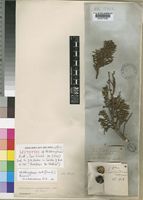
Name
Identification
Widdringtonia wallichii Endl. [family CUPRESSACEAE ] Widdringtonia nodiflora (L.) E.Powrie [family CUPRESSACEAE ] (stored under name); Verified by Farjon, A., Pachylepis unrecorded unrecorded [family CONIFERAE ] Widdringtonia juniperoides Endl. [family CUPRESSACEAE ] Verified by O. S.,
Related name
- Pachylepis unrecorded
- Widdringtonia wallichii
- Widdringtonia juniperoides
- Widdringtonia nodiflora
Flora
Entry for WIDDRINGTONIA juniperoides Endl. [family CUPRESSACEAE]
Herbarium
Royal Botanic Gardens, Kew (K)
Collection
Flora Capensis
Resource Type
Reference Sources
Entry From
Flora Capensis, Vol 5, Part 2 (Supplement), page 14, (1933) Author: (By O. STAPF.)
Names
WIDDRINGTONIA juniperoides Endl. [family CUPRESSACEAE], Syn. Conif. 32, excluding the synonymy;—Lindl. & Gord. in Journ. Hort. Soc. v. 203; Knight, Syn. Conif. 13; Pappe, Silva Cap. 30; Fl. Cap. Med. Prodr. ed. ii. 36; Carr. Trait. Conif. ed. i. 64; ed. ii. 58; Gordon, Pinet. ed. i. 334; suppl. 107; ed. ii. 418; Schlechtend. in Linnaea, xxxiii. 356, 361, tab. i. fig. 2; Henk. & Hochst. Syn. Nadelhölz. 292; Parlat. in DC. Prodr. xvi. ii. 442; Rehmann, Geo-bot. Verh. S. Afr. (in Bot. Centralbl. i. 1120, 1122); Masters in Journ. Linn. Soc. xxxiii. 268; Sim, Tree Plant. Natal, 234; For. Fl. Cape Col. 336, tab. 147 and Native Timb. S. Afr. 131, t. 27; Marloth, Fl. S. Afr. 101, 104, tab. 17 B, and 19; Dallimore & Jackson, Handb. Conif. 540; Wilson, Plant Hunt. t. 6.
WIDDRINGTONIA Wallichii Endl. [family CUPRESSACEAE], l.c. 34 (name); Lindl. & Gord. l.c.; Carr. Trait. Conif. ed. i. 68; ed. ii. 62; Gordon, Pinet. ed. i. 335; ed. ii. 419; Schlechtend. l.c. 359; Henkel & Hochst. l.c. 295; Parlat. l.c. 433; Masters, l.c. 271, 273, 274.
WIDDRINGTONIA Wallichiana Gord. [family CUPRESSACEAE], Pinet. suppl. 107 (name).
Callitris arborea Schrad. ex Drège [family CUPRESSACEAE], Zwei Pflanzengeogr. Doc. 73 (name); Hutchins in Report Conserv. For. Cape Col. 1895, 48, 49; in Trans. S. Afr. Phil. Soc. xi. 62; in Agric. Journ. Cape Good Hope, xxvi. 661, 662; Storr Lister, Rep. Chief Conserv. Fort. Cape Good Hope, figs. on p. 2.
Callitris stricta Schlecht. [family CUPRESSACEAE], (err. pro C. arborea, Schrad.) Hook. f. in Lond. Journ. Bot. iv. 141.
Callitris Ecklonii Schrad. ex Pappe [family CUPRESSACEAE], Fl. Cap. Med. Prodr. ed. i. 25.
Callitris juniperoides Durand & Schinz [family CUPRESSACEAE], Consp. Fl. Afr. v. 951; Engler, Pflanzenw. Afr. ii. 88; Marloth, Kapland, 167, fig. on p. 168.
Parolinia juniperoides Endl. ex Gord. [family CRUCIFERAE], Pinetum, Suppl. 107.
Pachylepis sp. Hook. f. [family ], l.c. 142.
Information
a tree, mostly 15–20 or occasionally up to over 60 ft. high, trunk up to 3 or 4 ft. in diam., branches horizontally spreading; ultimate ramifications of the adult plant almost cylindric, 1/2– 5/8 lin. in diam.; leaves of juvenile state unknown, of adult state decussate, squamiform; those of the older branches with an ovate acutely acuminte upwards free and somewhat spreading or appressed free blade, the free portion rarely much over 1 lin. long; those of the ultimate divisions tightly appressed, with the upper part more or less wavy, or slightly spreading so that the contour of the twigs is rarely a straight and unbroken line, rhombic-ovate to rhombic-oblong, about 1 lin. long, subacute at both ends or more obtuse at the lower, the free portion shorter than the adnate, slightly keeled on the back or rounded; male strobiles cylindric-oblong, 1 1/2–2 lin. long, ebracteate and subsessile in the cup formed by the subtending foliage leaves; scales in about 6 decussate pairs, coriaceous, subpeltate, very broadly ovate, minutely apiculate to subobtuse; pollensacs 4, covered by the scales in the strobile; female strobiles in short densely scattered or crowded spikes, 1/4– 1/3 in. long and terminating with a vegetative bud; strobiles at the time of pollination up to over 1 lin. across, exceeding the subtending squamiform broad-ovate acute bract; scales ovate, subacute or obscurely apiculate, stout with a large hump on the face, olive-green; ovules about 3 with each scale, bottle-shaped, broad, compressed, slightly unilaterally winged. Cones 1–3 in a spike, close, and if the spikes are crowded forming occasionally large compact clusters, globose, 1/2– 3/4 in. in diam., dark purplish-brown and usually covered with irregular roundish bosses from among which on each scale rises a stout conical pointed tubercle; valves ultimately slightly spreading, coarsely warty or tubercled along the margins, with a stout conical often pungent mucro (the morphological apex) from below the top, and a usually striated central area; seeds 4–8, stout more or less triquetrous-ovoid, 4 lin. long with a very narrow wing along 2 of the angles and over the tip, almost jet-black and somewhat glossy when mature or paler towards the base with a large white scar corresponding to similar scars at the base of the valves. null
Distribution
CAPE PROVINCE Clanwilliam Div.; Cedarberg Mountains, scattered singly or in small clumps over a range of 30 miles mainly between 3000 and 6500 ft., Zeyher; Drège! Wallich! Leipoldt in MacOwan, Herb. Aust. Afr. 1649! Budler in Herb. MacOwan, 3034! Herb. For. Dept. 1027! 1029! 1030! Herb. Sims! Hutchins!
Notes
Masters' statement that it also occurs at Swellendam is due to an old erroneous entry in the Kew Herbarium according to which Wallich collected it in that locality. His specimens are in fact from the Cedarberg Mts., as is shown by a in his own handwriting in the collections of the British Museum. Leipoldt's specimens have unusually smooth, small and barely mature cones with small marginal tubercles and more conspicuously, yet still narrowly, winged seeds. The cones were collected in June when the tree was in flower, and their peculiar condition may be due to delayed development. They were found in an unusually low locality (2500 ft.) and are also interesting on account of the presence of male strobiles on the female branches. The tree was certainly not known in Linnæus' time, and probably not until Zeyher and Drège collected it in 1829 and 1830 respectively. Linnæus' Cupressus juniperifolia and all the other names connected with it have therefore to be struck out of the synonymy of this species. A valuable timber tree (see particularly Sim and Hutchins, ll.cc.). The Cedar-boom or Cape Cedar of the Cape Colonists.