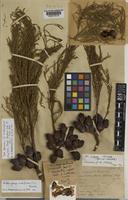
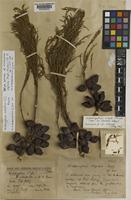
a tree of the habit of W. Whytei; juvenile state unknown; ultimate ramifications very slender, cylindric, about 1/3 lin. in diam.; leaves of the adult state decussate, squamiform; those of the long and intermediate branches distant by their own length, subappressed, lanceolate or acuminate, base adnate with parallel margins about 1 lin. long, those of the ultimate and often also of the penultimate ramifications tightly appressed, rhombic-oblong from a cuneate base, acute or subobtuse, 1 lin. long, rounded on the back, with the free portion as long or nearly as long as the adnate; male strobiles coetaneous (always?) with the mature cones, shortly cylindric, up to 2 lin. long, sessile; scales in about 6 pairs, broadly rhomboid, subacute to acute, 1/2 lin. long and wide, transversely depressed below the middle, pollen-sacs 4, protruding between the scales; female strobiles unknown in the flowering state; cones in loose racemose clusters of 3–5 with a rhachis up to over 1 in. long, borne on a stout stipe up to 3 lin. long, chestnut brown, very pruinose towards the base, when closed inversely pear-shaped, obtuse, with 4 often pungent cusps, 10 lin. long, up to 7 1/2 lin. in diameter below the middle; valves more or less unequal, two ovate-oblong, up to 5 1/2 lin. wide, two linear-oblong, up to 4 lin. wide, all usually obtuse, smooth, their cusps unequally distant from the top; seeds up to 36, dark-brown, obovate-oblong, or oblong, with a terminal, oblong, emarginate wing, 4 1/2–5 lin. long, the body of the seed ovate-lanceolate, beaked, about 3 lin. long, 1 1/2 lin. wide, the wing up to 2 1/2 lin. wide below the top. null