

Compilation
Widdringtonia dracomontana
1 Images see all
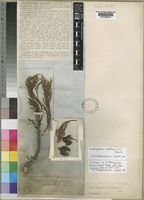
Name
Identification
Widdringtonia dracomontana Stapf. [family CUPRESSACEAE ] Verified by Farjon, A., Widdringtonia cupressoides Endl. [family CUPRESSACEAE ] Widdringtonia nodiflora (L.) E.Powrie [family CUPRESSACEAE ] (stored under name); Verified by Farjon, A.,
Related name
- Widdringtonia cupressoides
- Widdringtonia nodiflora
- Widdringtonia dracomontana
Flora
Entry for WIDDRINGTONIA dracomontana Stapf ex Dallimore & Jackson [family CUPRESSACEAE]
Herbarium
Royal Botanic Gardens, Kew (K)
Collection
Flora Capensis
Resource Type
Reference Sources
Entry From
Flora Capensis, Vol 5, Part 2 (Supplement), page 14, (1933) Author: (By O. STAPF.)
Names
WIDDRINGTONIA dracomontana Stapf ex Dallimore & Jackson [family CUPRESSACEAE], Handb. Conif. 540
WIDDRINGTONIA cupressoides Sim [family CUPRESSACEAE], Tree Plant. Natal, 234; For. Fl. Cape Col. 337 (the Drakensberg plant); Bews in Ann. Natal Mus. iii. 549; not of Endl.
Callitris cupressoides Wood [family CUPRESSACEAE], Handb. Fl. Natal, 122, and in Trans. S. Afr. Phil. Soc. xviii. 122, 224, not of Schrad.
Callitris natalensis Endl. ex Fourcade [family CUPRESSACEAE], Rep. Natal For. 1889, 161, 121.
Information
a shrub, 8–10 ft. high, rarely a tree; ultimate ramifications slender, about 1/2 lin. in diam.; leaves of the juvenile state unknown, of the adult state decussate, squamiform, those of the older branches with an ovate subacute appressed blade, the free portion not much over 1 lin. long, those of the ultimate divisions tightly appressed with the upper part more or less bulging, so that the contour of the twigs is a broken line, oblong to obovoid-oblong, hardly ever rhombic, subacute to subobtuse, with the free and adnate portions about equally long, obtusely keeled if at all, oblong, about 1 lin. long, ebracteate and subsessile in the cup formed by the subtending foliage leaves; scales in about 6 pairs, subpeltate, rhombic-ovate, obscurely acuminate, subcoriaceous, slightly keeled upwards; pollen-sacs 4, almost covered by the scales in the cone; female strobiles in short, very scanty spikes, terminating with a vegetative bud; cones at the time of pollination up to 2 lin. in diam., exceeding the subtending squamiform ovate subacute bract; scales ovate-oblong, subobtuse, stout, particularly along the median line, but without a well-marked hump on the face, olive-green, more or less bluish-pruinose on the face when dry; ovules 3 with each scale, bottle-shaped, with 2 obscure equal wings; cones 1–2 from each spike, globose to ovoid-globose, smooth with a short stout point (morphological apex) from below the top, purplish-brown with a glaucous bloom, when quite mature 9–10 lin. in diam., blackish-grey; valves wrinkled, but not or only very scantily tubercled, furrowed on the face, seed-scars obscure; seeds up to 12 (?), somewhat compressed, oblong to lanceolate- or ovate-oblong, about 3 1/2 by 1 1/2 lin., equally or subequally winged on the sides, the wings meeting at the apex in a notch, about 1 lin. wide, dark brown or the nucleus black. null
Distribution
EASTERN REGION Griqualand East; Mt. Ayliff Distr., Pole-Evans, 30004! Transkei: Baziya Mountains, Herb. For. Dept., 1375!NATAL Drakensberg Range, headwaters of the Bushman's River (Langalibalele's location), Fannin! Sanderson, 2011! Giant's Castle Game Reserve, For. Dept. Herb. 2960! 2989!; between Cathkin Peak and Mont aux Sources, forming isolated woods or clumps at high altitudes, according to Fourcade; without precise locality, Sim in Herb. For. Dept., 1044!
Notes
A coloured drawing communicated by J. Sanderson, along with a fruiting specimen, shows this species as a pyramidal tree of very regular habit with drooping branches and twigs. Sim and Bew say it is rather a shrub than a tree, but Sim also states that it has grown into a tree in the Pietermaritzburg Garden.