

Compilation
Weihea subpeltata
1 Images see all
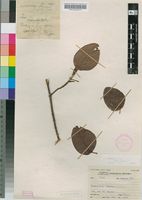
Name
Identification
Weihea subpeltata Sim [family RHIZOPHORACEAE ] Verified by Not on sheet, Androstachys johnsonii Prain [family PICRODENDRACEAE ] (stored under name); Verified by Not on sheet,
Related name
- Weihea subpeltata
- Androstachys johnsonii
Flora
Entry for Androstachys johnsonii Prain [family EUPHORBIACEAE]
Herbarium
Royal Botanic Gardens, Kew (K)
Collection
Flora Zambesiaca
Resource Type
Reference Sources
Entry From
FZ, Vol 9, Part 4, (1996) Author: A. Radcliffe-Smith
Names
Androstachys johnsonii Prain [family EUPHORBIACEAE], in Bull. Misc. Inform., Kew 1908: 439 (1908); 1909: 201–204 (1909). —Hutchinson in F.T.A. 6, 1: 741 (1912); 1049 (1913); in F.C. 5, 2: 377 (1915). —Engler, Pflanzenw. Afrikas (Veg. Erde 9) 3, 2: 38 (1921). —Pax & Hoffmann in Engler, Pflanzenr. [IV, fam. 147, xv] 81: 287 (1922); in Engler & Harms, Pflanzenfam., ed. 2, 19c: 75 (1931). —Burtt Davy, Fl. Pl. Ferns Transvaal: 298 (1932). —Hutchinson, Botanist in Southern Africa: 667 (1946). —White, F.F.N.R.: 193 (1962). —Airy Shaw in Kew Bull. 18: 251 (1965); in Adansonia, Sér. 2, 10, 4: 520 (1970). —Drummond in Kirkia 10: 251 (1975). —K. Coates Palgrave, Trees Southern Africa, ed. 2, rev.: 415 (1983). Syntypes: Mozambique, Inhambane, female fl. viii. 1883, O'Neill s.n. (K); Manica e Sofala, Beira, male fl. & fr. xi. 1908, Johnson 283 (K).
Weihea subpeltata Sim [family EUPHORBIACEAE], For. Fl. Port. E. Afr.: 66, t. 61A (1909). Type: Mozambique, Maputo, Lebombo Mts., Sim 6387 (PRE, holotype; GRA; NU).
Androstachys subpeltatus Sim Phillips [family EUPHORBIACEAE], in Mem. Bot. Surv. S. Afr. 25 (Gen. S. Afr. Fl. Pl., ed. 2): 460 (1951).
Information
A tree up to 20 m high.Bark blackish-grey, longitudinally fissured.Wood hard.Twigs grey.Young growth densely whitish-tomentose.Petioles 0.5–4 cm long.Stipular sheath 1–3.5 × 0.4–0.7 cm, oblong, rounded, detersibly tomentellous (indumentum easily detached).Leaf blades 3–9(13) × 2–7(12) cm, broadly ovate or asymmetrically hemirhombic-ovate, less often elliptic-ovate, obtuse or rounded at the apex, cuneate to rounded or truncate at the base, or peltate, entire, coriaceous, glabrous, shiny and dark green on upper surface, densely whitish-tomentose beneath, 5–7-nerved from the base; lateral nerves in 5–8 pairs.Male inflorescences up to 3 cm long, 3-flowered, with the central flower longer than the laterals.Male flowers: pedicels 5–6 mm long in lateral flowers, or 1–1.3 cm long in central flowers, pubescent; sepals 2–3 in lateral flowers, or 5 in central flowers, 4 × 0.5 mm, linear-oblanceolate, subacute, sericeous-hirsute without, glabrous within; receptacle up to 1.5 cm long in lateral flowers, or 2 cm long in central flowers; stamens up to c. 35 in lateral flowers, or to c. 50 in central flowers, filaments of lowest stamens up to 1 mm long, anthers 3 × 0.5 mm, connective sparingly sericeous-pubescent at first, later glabrescent, thecae yellow.Female flowers: pedicels 1–1.5 cm long, extending to up to 3 cm long in fruit; sepals 7–8 × 2–2.5 mm, ovate-lanceolate, obtusely acuminate or sometimes bifid at the apex, minutely crisped-puberulous on the margins and at the base, otherwise ± glabrous; ovary c. 3 mm in diameter, ovoid, densely tomentose; stylar column with styles c. 7 mm long, puberulous, stigmas minutely papillose.Fruit 8–10 × 12–13 mm, minutely crisped puberulous, bright green at first, yellowish to light brown when mature; indumentum detersible (easily detached).Seeds 6.5–7(8)× 4.5–5(6) × 2–3 mm, laterally compressed-ovoid, shallowly longitudinally striate-ridged, chestnut-brown.
Habitat
Locally common below 1000 m, in hot dry localities on well drained soils, usually gregarious on rocky hillsides and along seasonal watercourses, often forming dense shrub thickets, also in mixed deciduous woodland
Altitude range
100–900 m.
900
100
Distribution
Mozambique M Goba, Libombo Spring, fr. 8.xi.1961, Lemos & Balsinhas in Lemos 220 (BM; K; LISC; LMA; SRGH).Mozambique GI Mocodoene–Funhalouro, Xilaule Forest, st. 28.x.1947, Barbosa 614 (K; LMA).Mozambique MS Maringua, 9.5 km north of Save (Sabi) R., fr. 23.vi.1950, Chase 2439 (BM; SRGH).Zimbabwe S Masvingo Distr., Bangara Falls, Mtilikwe R., fr. 13.xii.1953, Wild 4635 (K; LISC; SRGH).Mozambique N Nampula, Mossuril, Cruce Forest, o. fr. & seed. 18.ii.1984, de Koning, Groenendijk & Dungo 9664 (K; LMU; MO).Zimbabwe E Chipinge Distr., Mangaze Native Area, 32 km SW of Chirinda, male fl. xi.1965, Goldsmith 50/65 (K; LISC; SRGH).
Distribution (external)
Swaziland
South Africa (northern and eastern Transvaal)
Madagascar
Notes
The specimen Dr. Williams (Wellcome Chemical Research Lab.) 28.x.1925, without precise locality, but said to come from NE Rhodesia, is unlikely to have been collected in Zambia (NE Rhodesia).Vernacular names as recorded in specimen data include: “cimbirre”, “simbiri” (Manjacaze, Muchopes areas); “cruce”, “crusse”, “m'crusse”, “mecrusse”, “mucrusse” (eMakhuwa, Goba area); “makruss” (Inhambane area); “mezimbite”, “m'zimbiti”, “zimbiti” (Beira area); “msumbiti” (Mewenezi area); “musimbite” (chiNdau); “simbite” (Chipinge area); “uluti” (eMakhuwa).The timber is resistant to termite attack, and is therefore of value for the construction of bridge and house piles.Although hard and heavy it can be readily sawn into planks for flooring, steps, causeways etc.It is also employed for cabinet-making.The pollen, however, produces poisonous honey.