

Compilation
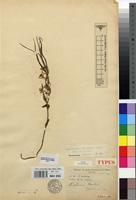
Walleria hockii
1 Images see all
Name
Identification
Walleria hockii De Wild. [family TECOPHILAEACEAE ] Verified by Not on sheet, Walleria nutans Kirk [family TECOPHILAEACEAE ] (stored under name); Verified by Carter S., 1961
Related name
- Walleria hockii
- Walleria nutans
Flora
Entry for Walleria nutans J. Kirk [family TECOPHILAEACEAE]
Herbarium
Royal Botanic Gardens, Kew (K)
Collection
Flora Zambesiaca
Resource Type
Reference Sources
Entry From
FZ, Vol 12, Part 3, page 18, (2001) Author: E. J. Cowley & R. K. Brummit
Names
Walleria nutans J. Kirk [family TECOPHILAEACEAE], in Trans. Linn. Soc., London 24: 497-498, tab. 52, fig. 1 (1864). —J.G. Baker in F.C. 6: 528 (1897); in F.T.A. 7: 568 (1898). —R.A. Dyer in Fl. Pl. Africa 34: pl. 1321 (1960). —Carter in Kew Bull. 16: 187-189 (1962). Syntypes: Malawi, Manganja Hills, from near Bishop Mackenzie’s Mission, 1864, Waller s.n. (K); Manganja Hills, Waller s.n. (K); and painting by Kirk (K).
Walleria mackenziei var. nutans J. Kirk Baker [family TECOPHILAEACEAE], in J. Linn. Soc., Bot. 17: 499 (1879).
Walleria muricata N.E. Br. [family TECOPHILAEACEAE], in Bull. Misc. Inform., Kew 1909: 145 (1909). Type: Botswana, near Palapye, i.1898, Lugard 289 (K, holotype).
Walleria baumii Dammer [family TECOPHILAEACEAE], in Bot. Jahrb. Syst. 48: 361 (1912). Type from Angola.
Walleria hockii De Wild. [family TECOPHILAEACEAE], in Bull. Jard. Bot. État 5: 8 (1915). Type: Zambia, Kafue Valley, 1911, Hock s.n. (BR, holotype).
Information
Erect perennial herb (4)10–30 cm tall. Tubers 1–5, subspherical, 1.7-2.5 × 2-3 cm, up to c. 20 cm below ground on a slender vertical underground stem. Stem leafy, simple or sometimes with up to 3 branches from axils of the lower leaves, ± flexuous, ± strongly longitudinally ribbed at least above, glabrous, scabrid, or with scattered short recurved prickles. Leaves cauline, becoming progressively larger and congested towards the stem apex, sessile, (2)7-17 × 0.2-1 cm, linear to linear-lanceolate, acute or ± gradually tapering to the apex, occasionally slightly cirrose at the tip, with recurved prickles 0.75–c. 1 mm long on the midvein beneath and/or on the leaf margin, or prickles absent; lowermost leaves 0.7-1.2 cm long, membranous. Peduncles 2-5 cm long, ascending, smooth, scabrid or with minute prickles; bracts 5-17 × 0.5-2.5 mm; pedicels deflexed. Tepalspure white to pink, mauve, purple or blue, spreading, 6-15 × 2-5 mm, ovate, acute, 5-7-veined, free to the base, ± recurved at the tips, outer segments slightly longer than the inner. Filaments 0.5-1 mm long. Anthers 4-8 × 0.75 mm, yellow with blue to purple tips, connivent and adherent at the apex; pores lateral at the anther apex, introrse, oblique. Style 7-8.5 mm long, shorter than, or slightlyexserted from the perianth segments. Capsulegreen, yellow or orange,8-17 mm in diameter, globose, slightly rugose, surrounded by the persistent perianth segments. Immature seeds 2 × 1 mm.
Habitat
Sandy soils in mixed deciduous woodland, with Brachystegia, Albizia or Combretum spp., open grassland and dry river beds, and on doloritic or granitic rocky outcrops, also in land cleared for cultivation
Altitude range
950–1700 m.
1700
950
Distribution
Botswana N Dobe, 4.iv.1964, Lee DA-39 (SRGH).Zambia C Liempe, 12 km east of Lusaka, 10.xii.1971, Korna? 635 (K); Lusaka, 8.xii.1968, Fanshawe 10482 (SRGH).Zimbabwe N Mazowe Distr., Mvurwi (Umvukwe) Range, Ruorka Ranche, 19.xii.1952, Wild 3958 (K; LISC; SRGH).Botswana SW Groot Laagte (East), 15.iii.1980, P.A. Smith 3179 (K; SRGH).Botswana SE north of Lephephe, fr. ii.1982, Snyman & Noailles 231 (PRE).Zambia S Mazabuka Distr., Magoye, 28.xii.1962, Angus 3454 (K).Zimbabwe W Bulawayo, Hillside Dam, xi.1957, Miller 4789 (K; PRE; SRGH).Zimbabwe C Harare, Waterfalls, 22.xi.1969, Linley 332 (K; SRGH).Zimbabwe E Mutare (Umtali), south east commonage, 16.xii.1954 (7.i.1954 on some duplicate specimens), Chase 5361 (BM; BR; COI; K; LISC; PRE; SRGH).
Distribution (external)
Angola
Namibia
South Africa (Transvaal)
Notes
Flowering between November and March, but usually after fires in November.Lugard reported that in Botswana the bulb is eaten raw.