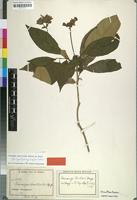
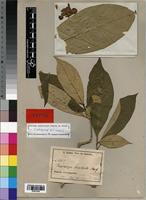
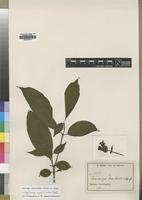
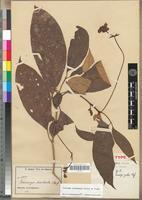
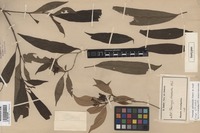
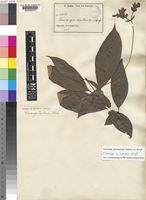
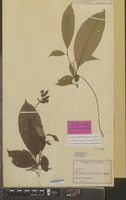
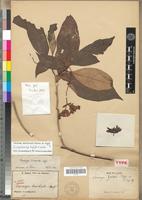
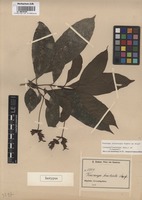
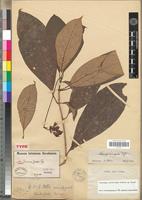
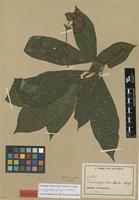
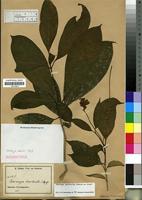
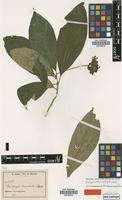
Quite glabrous; branches slender, terete, fistular, pale brown or the youngest blackish when dry.Leaves lanceolate to oblong-lanceolate, usually long and finely acuminate, acute to subcuneate at the base, 4–6 in. long, 1 1/4–2 in. broad, herbaceous, thin; secondary nerves 6–7 on each side, very oblique, gently curved; petiole slender, up to 6 lin. long. Inflorescences solitary (always?) from the young branch-forks, nodding, of 1 or 2 contracted pseudoumbels, multibracteate; peduncles very slender, up to 6 in. long; bracts broad-ovate or oblong, obtuse or subobtuse, 3–4 lin. long, crowded at the base of the pseudoumbels, subpersistent, if the pseudoumbels are paired, with 2 longer oblong bracts at the base of the dichotomy; pedicels slender, up to 4 lin. long. Calyx wide, subcampanulate, 4–5 lin. long, somewhat fleshy, with a zone of numerous small glands just above the base; lobes rotundate, porrect, slightly shorter than the tube. Corolla-tube stout, constricted at the middle and mouth, 5–5 1/2 lin. long, twisted, very delicately velvety just below the stamens, otherwise glabrous; limb rotate; lobes obovate-oblong, 4 lin. long, crisp, brown when dry. Stamens inserted above the middle of the corolla-tube; anthers 2 1/2 lin. long, tips shortly exserted, tails straight, subacute. Disc fleshy, annular, not quite half the height of the ovary. Style 3 lin. long.