JSTOR Global Plants Home
  • Home
  • Browse
  • About
  • Access
  • Account
    • Saved Items
    • Profile
  • Log in

Global Plants

Skip to Main Content
  • JSTOR Global Plants Home
  • Global Plants

    • Browse
    • About
    • Access
    • Account
      • Saved Items
      • Profile
Log in
  • Browse
  • About
  • Access
  • Account
    • Saved Items
    • Profile
Advanced Search

Compilation
Viscum subserratum

5 Images see all

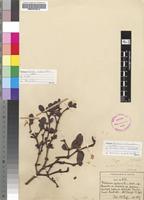
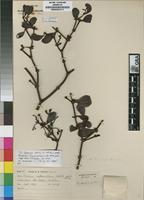
Isotype of Viscum subserratum Schltr. [family VISCACEAE]
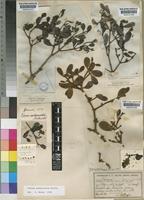
Viscum subserratum Schltr. [family VISCACEAE]
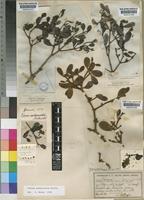
Type of Viscum subserratum Schltr. [family VISCACEAE]
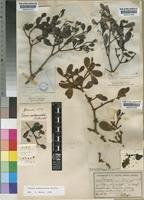
Viscum subserratum Schltr. [family VISCACEAE]
Isotype of Viscum subserratum Schltr. [family VISCACEAE]
Previous
Next

Name

Identification
Isotype of Viscum subserratum Schltr. [family VISCACEAE ] (stored under name); Verified by Not on sheet,
Related name
  • Viscum galpinianum
  • Viscum obscurum
  • Viscum subserratum
  • Viscum pauciflorum

Flora

Entry for VISCUM subserratum Schlechter [family VISCACEAE]
Herbarium
Royal Botanic Gardens, Kew (K)
Collection
Flora Capensis
Resource Type
Reference Sources
Entry From
Flora Capensis, Vol 5, Part 2, page 100, (1925) Author: (By T. A. SPRAGUE.)
Names
VISCUM subserratum Schlechter [family VISCACEAE], in Journ. Bot. 1896, 504
VISCUM galpinianum Schinz [family VISCACEAE], in Vierteljahrsschr. Nat. Ges. Zürich, xlix. 179.
Information
glabrous; branches subterete, fairly stout, about 1 3/4 lin. in diam. 6 in. below the apex; branchlets up to 4 in. long; internodes of the branchlets 1/2–1 in. long, compressed, tapering downwards, strongly 6-ribbed, the two ribs below the leaves wing-like; leaves distinctly petioled, obovate or obovate-oblong, rounded or very obtuse at the apex, subcuneate into the base, 2/3–1 1/4 in. long, 3 1/2–9 1/2 lin. broad, minutely serrulate in a dried state, thickly coriaceous, dull, 3-nerved, nerves prominent on the upper surface, less evident on the lower; petiole 1/2– 3/4 lin. long; flowers apparently diœcious; male cymules axillary, solitary or ternate, peduncled, 3-flowered; peduncle nearly 1/2 lin. long; bracteal cup boat-shaped, hardly 1 1/4 lin. long; male flowers quadrangular, fusiform, 1 1/2 lin. long; petals deltoid, 3/4 lin. long, not distinctly demarcated from the receptacle; anthers oblong, 3/4 lin. long, 1/3– 3/8 lin. broad; female inflorescence: bracteal cups axillary, solitary or geminate, peduncled, 1-flowered, strongly bilabiate, lips diverging at nearly a right angle, 1/2 lin. high, minutely glandular-ciliate; peduncle 1/2– 5/8 lin. long; flowers pedicelled; receptacle and pedicel together subcylindric, slightly tapering downwards, 7/8 lin. long; receptacle warted; petals lanceolate-oblong, 3/4 lin. long; style and stigma together 5/8 lin. long; stigma capitate; berry ovoid, truncate, coarsely and densely warted, 2 lin. long excluding the pedicel; pedicel stout, broadened into the base of the berry, 3/4 lin. long. null
Distribution
EASTERN REGION Natal; Tugela River, Gerrard & McKen, 1654! and without precise locality, Gerrard, 1650!KALAHARI REGION Transvaal; Barberton, on Cussonia sp., Galpin, 452! Shilovane, Junod, 2246!
Notes
V. subserratum is probably diœcious: Galpin, 452, and Junod, 2246, bear berries only; and Gerrard, 1650, is represented in the Kew Herbarium by two specimens, one bearing male inflorescences exclusively, the other female flowers and berries.

Related Materials

  • Terms and Conditions
  • Privacy Policy
  • Cookie Policy
  • Cookie Settings
  • Accessibility
  • Help
  • Contact Us
  • Facebook
  • Twitter
ITHAKA

JSTOR is part of ITHAKA, a not-for-profit organization helping the academic community use digital technologies to preserve the scholarly record and to advance research and teaching in sustainable ways.

©2000-2026 ITHAKA. All Rights Reserved. JSTOR®, the JSTOR logo, JPASS®, Aluka®, and ITHAKA® are registered trademarks of ITHAKA.

╳