JSTOR Global Plants Home
  • Home
  • Browse
  • About
  • Access
  • Account
    • Saved Items
    • Profile
  • Log in

Global Plants

Skip to Main Content
  • JSTOR Global Plants Home
  • Global Plants

    • Browse
    • About
    • Access
    • Account
      • Saved Items
      • Profile
Log in
  • Browse
  • About
  • Access
  • Account
    • Saved Items
    • Profile
Advanced Search

Compilation
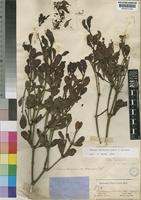
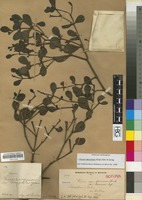
Viscum decurrens

6 Images see all

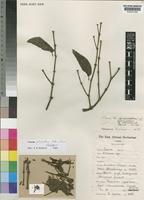
Holotype of Viscum petiolatum Polhill & Wiens [family VISCACEAE]
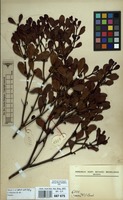
Filed as Viscum decurrens (Engl.) Baker & Sprague [family VISCACEAE]
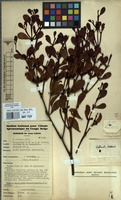
Viscum decurrens (Engl.) Baker & Sprague [family VISCACEAE]
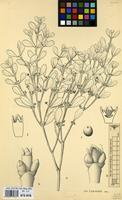
Isotype of Viscum obscurum Thunb. var. decurrens Engl. [family VISCACEAE]
Previous
Next

Name

Identification
Viscum decurrens (Engl.) Baker & Sprague [family VISCACEAE ] (stored under name); Verified by Not on sheet,
Related name
  • Viscum decurrens
  • Viscum grandifolium
  • Viscum obscurum
  • Viscum petiolatum

Flora

Entry for VISCUM decurrens Baker & Sprague [family VISCACEAE]
Herbarium
Royal Botanic Gardens, Kew (K)
Collection
Flora of Tropical Africa
Resource Type
Reference Sources
Entry From
Flora of Tropical Africa, Vol 6, Part 1, page 255, (1913) Author: (By J. G. Baker, with additions by C. H. Wright.)
Names
VISCUM decurrens Baker & Sprague [family VISCACEAE]
VISCUM obscurum Engl. var. decurrens [family VISCACEAE], in Engl. Jahrb. xx. 132; De Wild. Études Fl. Baset Moyen-Congo, i. 30, 237.
Information
Main stem terete, about 2 lin. in diam. 9–15 in. below the apex of the branchlets; branches two-angled, more or less compressed; branchlets much compressed, with linear internodes, tapering slightly from apex to base; internodes 1–2 1/4 in. long. Leaves subsessile, narrowly obovate or obovate-oblong to oblanceolate, rounded at the apex, narrowly cuneate into the base, 3/4–2 in. long, 4–10 lin. broad, coriaceous, glabrous, distinctly 3- or 5-nerved, finely reticulate, slightly glossy; petiole up to 1 lin. long. Cymules axillary and terminal, solitary or ternate, peduncled, 3-flowered, flowers monœcious, tetramerous, all of one sex in the same cyme. Male cymule: Peduncle about 1 3/4 lin. long or less, produced nearly 1/4 lin. beyond the bracteal cup. Bracteal cup boat-shaped, 1 1/4 lin. long, subapiculate at both ends. Flower-bud ellipsoid, 3/4 lin. long. Flower 7/8 lin. long, solid base 1/6 lin. long. Receptacular tube about 1/6 lin. long. Petals ovate, about 1/2 lin. long, 3/8– 1/2 lin. broad. Anthers suborbicular, 1/4 lin. in diam., or elliptic, 3/8 lin. long, 1/4 lin. broad. Female cymule: Peduncle 2–3 lin. long, more or less produced above the bracteal cup. Bracteal cup minutely ciliate, acute at both ends, finally becoming crescent-shaped. Receptacle subcylindric, slightly narrowed into the base, 3/4 lin. long, hardly 1/2 lin. in diam., or compressed, 1/2 lin. broad, 3/8 lin. deep, smooth. Petals ovate-oblong or deltoid-ovate, 1/3 lin. long, 1/4– 1/3 lin. broad. Stigma projecting 1/8– 1/7 lin. above the insertion of the petals. Young berry oblong-ellipsoid.
Distribution
Gaboon Lower Guinea Munda; Sibange Farm, Dinklage, 574! by the Gaboon River, on Symphonia globulifera, Linn. f., Mann, 984!Congo Lower Guinea near Leopoldville, Gillet!Lagos Upper Guinea Eppah, on Guttiferæ, Barter, 3314!Nigeria Upper Guinea by the Old Calabar River, on Symphonia globulifera, Linn. f., Mann, 2278!
Notes
V. decurrens has been hitherto regarded as a variety of V. obscurum, Thunb. (a native of South Africa), with which it has little in common. V. obscurum has a sessile inflorescence and long-pedicelled berries.

Related Materials

  • Terms and Conditions
  • Privacy Policy
  • Cookie Policy
  • Cookie Settings
  • Accessibility
  • Help
  • Contact Us
  • Facebook
  • Twitter
ITHAKA

JSTOR is part of ITHAKA, a not-for-profit organization helping the academic community use digital technologies to preserve the scholarly record and to advance research and teaching in sustainable ways.

©2000-2026 ITHAKA. All Rights Reserved. JSTOR®, the JSTOR logo, JPASS®, Aluka®, and ITHAKA® are registered trademarks of ITHAKA.

╳