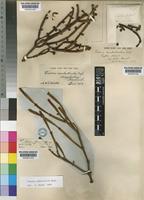
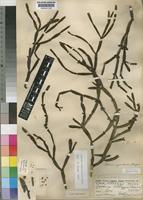
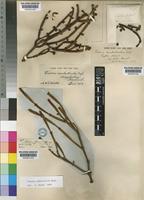
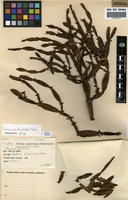
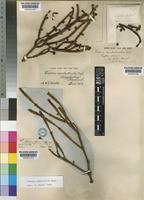
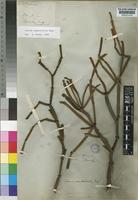
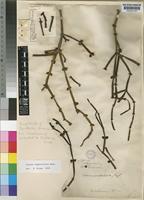
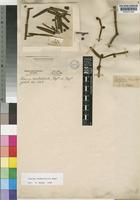
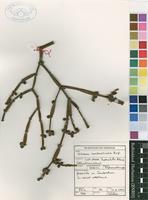
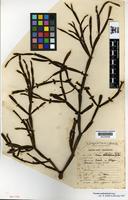
a much-branched shrub, 1–1 1/2 ft. high; stem terete, 3 1/2–4 lin. in diam. at the base, brown and slightly glossy in a dried state; branches and branchlets conspicuously flattened, ribbed in a dried state; internodes broadly linear, tape-like, broadest in their upper part, slightly contracted at the apex, slightly tapering into the base, 2/3–2 3/4 in. long, 1 1/2–3 1/2 lin. broad, those of the main branches much thickened along the middle; leaves scale-like, inconspicuous; flowers diœcious, tetramerous; male inflorescences axillary, composed of 1–5 3-flowered cymules, each of which is borne by a bracteal cup; bracteal cup subtended by a pair of scale-leaves at the base, sessile, boat-shaped, 1 3/4 lin. long; lobes ascending, rounded or obtuse, 1 lin. long, glandular-ciliolate; pedicel (solid base of flower) hardly 1/2 lin. long; receptacular tube 3/8 lin. long; petals alternately deltoid and deltoid-ovate, 3/4 lin. long, about 3/4 lin. broad; anthers trigonous with a convex outer surface, elliptic in outline, 5/8– 3/4 lin. long, nearly 1/2 lin. broad; female inflorescences axillary, composed of 1 or 3 flowers, each of which is borne by a bracteal cup; bracteal cup conspicuously 2-lobed, 1 lin. high; lobes 5/8 lin. long, rounded, glandular-ciliolate, exceeding the receptacle at the time of expansion of the flower; receptacle shortly and broadly obovoid, 5/8 lin. long; petals triangular, over 1/2 lin. long, 7/16– 1/2 lin. broad, deciduous; style broadly conical, 1/5 lin. long; stigma projecting 1/3 lin. above the insertion of the petals; berry ellipsoid, 2 1/2 lin. long, red, smooth or slightly warted. null