

Compilation
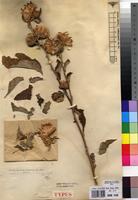
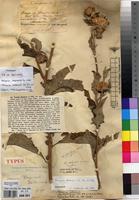
Vernonia bequaertii
2 Images see all
Name
Identification
Vernonia bequaertii De Wild. [family ASTERACEAE ] Verified by Not on sheet, Vernonia adoensis Sch.Bip. ex Walp. [family ASTERACEAE ] (stored under name); Verified by Not on sheet,
Related name
- Vernonia adoensis
- Vernonia bequaertii
Flora
Entry for Vernonia adoensis Walp. [family COMPOSITAE]
Herbarium
Royal Botanic Gardens, Kew (K)
Collection
Flora of Tropical East Africa
Resource Type
Reference Sources
Entry From
Flora of Tropical East Africa, Part 1, page 1, (2000) Author: H. J. Beentje, M.Sc., Ph.D., F.L.S.
Names
Vernonia adoensis Walp. [family COMPOSITAE], Repert. Bot. Syst. 2: 946 (1843); Oliv. & Hiern in F.T.A. 3: 291 (1877); Maquet in Fl. Rwanda 3: 554 (1985); C. Jeffrey in K.B. 43: 240 (1988); G.V. Pope in F.Z. 6: 124 (1992); K.T.S.L.: 565 (1994); U.K.W.F. ed. 2: 201 (1994); Kalanda & Lisowski in Fragm. Flor. Geobot. 40 (2): 587 (1995). Type: Ethiopia, Scholoda, Schimper 318 (BM!, BR!, K!, P!, iso.)
Vernonia kotschyana Walp. [family COMPOSITAE], Repert. Bot. Syst. 2: 947 (1843); Oliv. & Hiern in F.T.A. 3: 289 (1877); F.P.S. 3: 61 (1956); C.D. Adams in F.W.T.A. ed. 2, 2: 277 (1963). Type: Sudan, Kordofan, Milleet, Kotschy 290 (BM!, BR!, K!, P!, iso.)
Ascaricidia adoensis (Walp.) Steetz [family ], in Peters, Reise Mossamb., Bot. 1: 358 (1864)
Vernonia grantii Oliv. [family COMPOSITAE], in Trans. Linn. Soc., London 29: 92, t. 67 (1873); Oliv. & Hiern in F.T.A. 3: 291 (1877); T.T.C.L.: 161 (1949). Type: Uganda, Bunyoro [Unyoro], Grant (K!, holo.)
Vernonia shirensis Oliv. & Hiern [family COMPOSITAE], in F.T.A. 3: 291 (1877). Type: Malawi, Shire, Meller (K!, holo.)
Vernonia tigrensis Oliv. & Hiern [family COMPOSITAE], in F.T.A. 3: 290 (1877). Type: Ethiopia, Amha, Schimper 817 (K!, holo., BM!, iso.)
Vernonia whyteana Britten [family COMPOSITAE], in Trans. Linn. Soc., Bot. 4: 17 (1894). Type: Malawi, Zomba, Whyte (K!, holo.)
Vernonia leptolepis Baker [family COMPOSITAE], in K.B. 1898: 147 (1898), non O. Hoffm. (1895). Type: Malawi, between Kondowe and Karonga, Whyte (K!, holo.)
Vernonia woodii O. Hoffm. [family COMPOSITAE], in E.J. 38: 198 (1906); S. Moore in J.L.S. 40: 106 (1911). Syntypes: South Africa, Durban, Wood 1022 & 8155 (both K!, syn.)
Vernonia goetzei Muschl. [family COMPOSITAE], in E.J. 46: 73 (1911). Type: Tanzania, Njombe District, Ukinga [Kinga] Mts & Rufiji source area, Goetze 666 (B†, holo.)
Vernonia bequaertii De Wild. [family COMPOSITAE], in F.R. 13: 206 (1914). Type: Congo (Kinshasa), Katanga, Shinsenda, Bequaert 491 (BR!, holo.)
Vernonia integra S. Moore [family COMPOSITAE], in J.B. 46: 39 (1918). Type: Zimbabwe, Mazowe (Mazoe), Eyles 277 (BM!, holo., SRGH, iso.)
Vernonia fulviseta S. Moore [family COMPOSITAE], in J.L.S. 47: 266 (1925). Type: Malawi, Buchanan 1297 (BM!, holo.)
Vernonia adoensis (Walp.) G.V. Pope var. kotschyana [family COMPOSITAE], in K.B. 43: 285 (1988); G.V. Pope in F.Z. 6: 125, t. 22/11 (1992)
Baccharoides adoensis (Walp.) H. Rob. [family COMPOSITAE], in Proc. Biol. Soc. Wash. 103(1): 250 (1990)
Information
Woody herb or shrub 0.6–4 m tall, with woody rootstock; stems at first thickly pubescent to tomentose, when older developing a grey bark, sometimes purple. Leaves ovate to elliptic, rarely oblanceolate, 3–25 cm long, 1–8.5 cm wide, base cuneate or attenuate into a petioloid base, margins serrate or coarsely so, apex shortly acuminate, densely finely pubescent to scattered-hispid and often ± glabrescent above, densely grey-tomentose to thinly pubescent beneath. Capitula rather few in terminal corymbiform cymes; involucre hemispherical to globose, 18–33 mm long; phyllaries 5–6-seriate, pale green, lanceolate, the longest 13–27 mm long, ± tomentose; appendages lanceolate to ovate, 3–20 mm long, 1–11 mm wide, 0.9–13.6 times as long as wide, green to white (rarely pale lilac), ± curving or recurving on the outer and middle, standing out in a series of frills, erect on the inner, densely shortly pubescent to glabrous, acute to subtruncate or attenuate. Corolla white, pale mauve or lilac, 12.5–19 mm long, lobes 1.2–2.5 mm long. Achenes 3.2–5.5 mm long, densely ascending-pubescent; pappus yellowish white or tan, outer of short scales, inner 8–13.5 mm long. Fig. 48, fig. 38/10 (capitulum), p.168
Range
DISTR. U 1–4; K 2, 3, 5, 6; T 1, 2, 4–8 tropical Africa from Senegal to Sudan and Ethiopia and northern South Africa
Altitude range
(450–)800–2200(–2750) m
Distribution
KENYA Trans-Nzoia District Elgon, Nov. 1957, Symes 239!KENYA Nakuru District Hyrax Hill, Aug. 1967, Mwangangi 174!KENYA Masai District Trans Mara, Abossi Hill, Aug. 1961, Glover et al. 2336!TANZANIA Mbulu District Hanang, Basuto, June 1969, Carmichael 1677!TANZANIA Kigoma District Kasangazi, July 1958, Mahinde 75!TANZANIA Songea District Mbinga, Uzena, Apr. 1991, Ruffo & Kisena 3290!UGANDA Karamoja District Moroto, Feb. 1936, Eggeling 2860!UGANDA Teso District Soroti Rock, May 1970, Lye & Katende 5384!UGANDA Mubende District Watuba, Apr. 1970, Katende 96!
Notes
G.V. Pope in K.B. 43: 285 and F.Z. 6: 125 distinguishes three varieties of which two, var. adoensis and var. kotschyana (Walp.) G.V. Pope, occur in East Africa. They occur in the same kind of habitat, and have the same general African distribution. The differences reside in the width of the phyllary appendage: as narrow as the phyllary lamina in var. adoensis, broader (4–12 mm wide) in var. kotschyana .