

Compilation
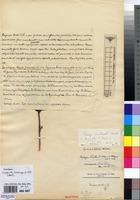
Vangueria tristis
1 Images see all
Name
Identification
Vangueria tristis K.Schum. [family RUBIACEAE ] Verified by [K.Schum.], Fadogia cienkowskii Schweinf. [family RUBIACEAE ] (stored under name); Verified by Verdcourt B., 1960
Related name
- Vangueria tristis
- Fadogia cienkowskii
Flora
Entry for Fadogia cienkowskii var. cienkowskii [family RUBIACEAE]
Herbarium
Royal Botanic Gardens, Kew (K)
Collection
Flora Zambesiaca
Resource Type
Reference Sources
Entry From
FZ, Vol 5, Part 2, (1998) Author: D. Bridson
Names
Fadogia cienkowskii var. cienkowskii [family RUBIACEAE], —Verdcourt in F.T.E.A., Rubiaceae: 789 (1991).
Fadogia katangensis De Wild. [family RUBIACEAE], in Repert. Spec. Nov. Regni Veg. 12: 295 (1913). —Robyns in Bull. Jard. Bot. État 11: 77 (1928). Type from Zaire (Dem. Rep. Congo).
Vangueria tristis K. Schum. [family RUBIACEAE], in De Wildeman, Études Fl. Katanga [Ann. Mus. Congo, Sér. IV, Bot.] 1: 227 (1903); Contrib. Fl. Katanga: 211 (1921). Type from Zaire (Dem. Rep. Congo).
Fadogia tristis K. Schum. Robyns [family RUBIACEAE], in Bull. Jard. Bot. État 11: 76 (1928).
Canthium cienkowskii Schweinf. Roberty [family RUBIACEAE], in Bull. Inst. Fondam. Afrique Noire, Sér. A., Sci. Nat. 16: 61 (1954).
Information
Leaf blades up to 4.5 cm wide, mostly densely velvety beneath.
Habitat
Grassland and grassland with scattered trees, also in deciduous woodlands including; Brachystegia–Julbernardia–Uapaca woodland, Cryptosepalum woodland, Albizia–Marquesia–Anisophyllea woodland and Combretum–Acacia woodlands, often by dambos and on rock outcrops, and in cultivated land
Range
From Mali to Nigeria in West Africa
Altitude range
600–1740 m.
1740
600
Distribution
Malawi C Lilongwe Distr., Chisepo, fl. 20.xi.1963, Salubeni 152 (K; SRGH).Zimbabwe E Chimanimani Distr., Glencoe Forest Reserve, fr. 22.xi.1955, Drummond 4948 (K; SRGH).Zambia S Mumbwa Distr., Nambala Mission, fl. 16.ix.1947, Greenway & Brenan 8101 (EA; K; PRE).Zambia C near Chilanga, Mt. Makulu Research Station, fl. 8.x.1957, Angus 1763 (FHO; K; PRE).Zambia W Mwinilunga, slope east of R. Lunga, fl. 24.xi.1937, Milne-Redhead 3374 (BM; K).Malawi N Mzimba Distr., Viphya, 61 km SW of Mzuzu, fl. 9.ix.1969, Pawek 2981 (K).Zimbabwe N Mazowe Distr., Mvurwi (Umvukwes), Ruorka Ranch, fr. 16.xii.1952, Wild 3921 (K; SRGH).Zambia B c. 51 km NE of Mongu, fl. 10.xi.1959, Drummond & Cookson 6317 (K; SRGH).
Distribution (external)
Cameroon
Cabinda
Zaire (Dem. Rep. Congo)
Sudan
Ethiopia
Uganda
Kenya
Tanzania
Angola
Notes
Fadogia fragrans links F.homblei with F. cienkowskii which are nevertheless retained here as species. It has been usual to maintain F. katangensis distinct from F. cienkowskii, and on the whole the southern material does have more tapering leaves with less tendency to be slightly bullate on drying, but occasional specimens are indistinguishable from those of northern populations. Johnson 46 (Manica, Choa Valley, fl. 24.xi.1906) was annotated and cited by Robyns as Fadogia fragrans Robyns, a species occurring in South Africa (North Prov., Gauteng, and Swaziland). It is undoubtably intermediate between F. cienkowskii and F. fragrans. Some extreme variants occur, e.g. Fanshawe 5337 [Zambia, Mufulira 6.i.1960] which had been named F. tetraquetra, but the leaf blades have very sparse hairs and papillae beneath, appearing glabrous to the naked eye. It could be of hybrid origin. Similar variants occur in West Africa. Var. lanceolata K. Schum. ex Robyns, from Cameroon, Zaire (Dem. Rep. Congo) and Tanzania, has narrow leaf blades up to 10 mm wide.