

Compilation
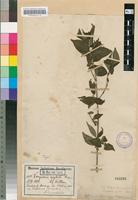
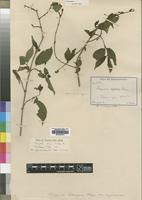
Vangueria neglecta
2 Images see all
Name
Identification
Rytigynia schumanii Robyns [family RUBIACEAE ] (stored under name); Vangueria neglecta Hiern [family RUBIACEAE ]
Related name
- Vangueria neglecta
- Rytigynia uhligii
- Rytigynia schumanii
Flora
Entry for Rytigynia uhligii K. Schum. & K. Krause Verdc. [family RUBIACEAE]
Herbarium
Royal Botanic Gardens, Kew (K)
Collection
Flora Zambesiaca
Resource Type
Reference Sources
Entry From
FZ, Vol 5, Part 2, (1998) Author: D. Bridson
Names
Rytigynia uhligii K. Schum. & K. Krause Verdc. [family RUBIACEAE], in Kew Bull. 42: 165, fig. 1F, 1G, 5F & 8D (1987); in F.T.E.A., Rubiaceae: 818, fig. 132/11 (1991). —Beentje, Kenya Trees, Shrubs Lianas: 544 (1994). Type from Tanzania.
Vangueria neglecta [family RUBIACEAE], sensu K. Schum. in Engler, Pflanzenw. Ost-Afrikas C: 384 (1895) non Hiern.
Vangueria uhligii K. Schum. & K. Krause [family RUBIACEAE], in Bot. Jahrb. Syst. 39: 534 (1907). —De Wildeman in Bull. Jard. Bot. État 8: 65 (1922).
Plectronia kidaria K. Schum. & K. Krause [family RUBIACEAE], in Bot. Jahrb. Syst. 39: 539 (1907). Type from Tanzania.
Rytigynia euclioides Robyns [family RUBIACEAE], in Bull. Jard. Bot. État 11: 146 (1928). —Brenan, Check-list For. Trees Shrubs Tang. Terr.: 529 (1949). —Dale & Greenway, Kenya Trees & Shrubs: 472 (1961). Type from Tanzania.
Rytigynia schumannii Robyns [family RUBIACEAE], in Bull. Jard. Bot. État 11: 158 (1928). —Brenan, Check-list For. Trees Shrubs Tang. Terr.: 530 (1949). —Dale & Greenway, Kenya Trees & Shrubs: 473 (1961). —Drummond in Kirkia 10: 276 (1975). —K. Coates Palgrave, Trees Southern Africa, ed. 3, rev.: 875 (1988). Type from Tanzania.
Rytigynia schumannii var. uhligii K. Schum. & K. Krause Robyns [family RUBIACEAE], in Bull. Jard. Bot. État 11: 159 (1928).
Rytigynia lenticellata Robyns [family RUBIACEAE], in Bull. Jard. Bot. État 11: 181 (1928). —Brenan, Check-list For. Trees Shrubs Tang. Terr.: 530 (1949). Type from Tanzania.
Rytigynia kidaria K. Schum. & K. Krause Bullock [family RUBIACEAE], in Bull. Misc. Inform., Kew 1932: 389 (1932). —Brenan, Check-list For. Trees Shrubs Tang. Terr.: 529 (1949).
Canthium sarogliae Chiov. [family RUBIACEAE], Racc. Bot. Miss. Consolata Kenya: 55 (1935). Types from Kenya.
Rytigynia murifolia Gilli [family RUBIACEAE], in Ann. Naturhist. Mus. Wien 77: 26, abb. 4 (1973). Type from Tanzania.
Rytigynia undulata Robyns [family RUBIACEAE], in Bull. Jard. Bot. État 11: 159 (1928). —Brenan, Check-list For. Trees Shrubs Tang. Terr.: 530 (1949). Type from Tanzania.
Information
Shrub or tree 0.9–9 m tall, rarely scandent(?), laxly branched; bark smooth, pale brown to blackish-grey.Stems pale chestnut-brown or purplish, longitudinally ridged, lenticellate, glabrous, the epidermis or bark wearing off to reveal pale undersurface.Leaves mostly not fully developed at flowering time, 1.5–11 × 0.5–4.8(5.2) cm, elliptic to ovate, narrowly or abruptly acuminate at the apex, the tip usually rounded, cuneate, rounded or ± truncate at the base, glabrous save for obvious tufted domatia, or rarely sparsely pubescent, ± thin, not or only slightly discolorous; petiole 2–6 mm long; stipule bases 3–5 mm long, triangular or ovate, joined, densely pilose within, with a ± spreading often compressed subulate appendage 1–4.5 mm long, decurrent or sometimes completely lacking.Inflorescences 1–2-flowered, rarely more; peduncle either ± suppressed or up to 6(10) mm long particularly in fruit; pedicels (2)6–12 mm long, often 15–23(30) mm long in fruit; bracts up to 1.5 mm long.Calyx tube 1.2–1.5 mm long, the limb a rim about 0.2 mm long with obsolete or very small teeth.Corolla oblong, very obtuse in bud, the limb part characteristically much shorter than the tube; white to greenish-yellow; the limb usually remains ± closed; tube 4.5–5.5 mm long, mostly subglobose or urceolate-campanulate or sometimes ± cylindrical, with a ring of deflexed hairs inside; lobes mostly green, 2 × 1.5 mm, ovate, acute but not appendaged.Ovary (2)3–5-locular.Style swollen at the base; pollen presenter just exserted or exserted up to 2.5 mm, 2–5-lobed.Fruit blue-black, (7)9–10(?13 in life) mm in diameter, globose, containing 1–5 pyrenes; pyrenes 6–7 × 3–4 mm.
Habitat
Evergreen forest understorey or sub-canopy
Altitude range
(700)900–2000 m.
2000
900
Distribution
Malawi S Mulanje Mt., Litchenya (Lichenya) Crater, sterile 4.ix.1970, Müller 1541 (K; SRGH).Mozambique Z Serra do Gurué, Namuli, R. Malema, fl. 6.xi.1967, Torre & Correia 15973 (C; COI; K; LMU).Malawi N Nyika Plateau, Nyamkowa (Nyamkhowa) Forest, fl. 14.xii.1982, Dowsett-Lemaire 534 (K).Zimbabwe E Chimanimani Distr., Mutsangazi R., west of Mt. Peni, fl. 14.xii.1972, Müller & Goldsmith 2068 (K; SRGH).
Distribution (external)
Kenya
Tanzania
Notes
Rytigynia uhligii occurs very widely in upland forest in East Africa and in common with so many forest species is well distributed there. It has its southern limit in E Zimbabwe. In East Africa it is distinct from Rytigynia adenodonta, in fact typical material is not remotely similar. In Malawi and Mozambique, however, there is difficulty separating it from Rytigynia adenodonta var. reticulata which usually has smaller thicker less acuminate leaves, a more nodular stem and slightly apiculate buds. Unfortunately, well collected material is lacking from some key areas. Several sterile specimens may belong to R. uhligii. Some inadequate material from Malawi may represent hairy forms of this species. J.D. & E.G. Chapman 9091 [Mt. Mulanje, Michesi Mt., Nandiwo Valley, fr. 27.v.1988] has the fruits described as flattened-spherical, c. 35 × 30 mm. One dry fruit on the specimen is 16 mm in diameter. If the Mulanje population proves to be uniformly large-fruited it must be at least a distinct subspecies.