

Compilation
Vangueria junodii
3 Images see all
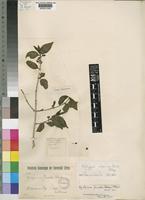
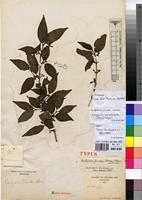
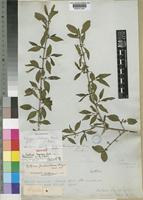
Name
Identification
Isotype of Vangueria junodii Schinz [family RUBIACEAE ] Verified by Not on sheet, Rytigynia umbellulata (Hiern) Robyns [family RUBIACEAE ] (stored under name); Verified by Not on sheet,
Related name
- Vangueria junodii
- Rytigynia junodii
- Rytigynia umbellulata
Flora
Entry for Rytigynia umbellulata Hiern Robyns [family RUBIACEAE]
Herbarium
Royal Botanic Gardens, Kew (K)
Collection
Flora Zambesiaca
Resource Type
Reference Sources
Entry From
FZ, Vol 5, Part 2, (1998) Author: D. Bridson
Names
Rytigynia umbellulata Hiern Robyns [family RUBIACEAE], in Bull. Jard. Bot. État 11: 184 (1928). —F. White, F.F.N.R.: 420 (1962). —Hepper in F.W.T.A. ed. 2, 2: 186 (1963). —A.E. Gonçalves in Garcia de Orta, Sér. Bot. 5: 206 (1982). —Verdcourt in Kew Bull. 42: 152, fig. 1E, 8C (1987); in F.T.E.A., Rubiaceae: 808 (1991). Type from Ghana.
Vangueria umbellulata Hiern [family RUBIACEAE], in F.T.A. 3: 150 (1877); Cat. Afr. Pl. Welw. 1: 480 (1898).
Vangueria concolor Hiern [family RUBIACEAE], in F.T.A. 3: 150 (1877). —De Wildeman in Bull. Jard. Bot. État 8: 50 (1922). Type from Princes Island.
Canthium lagoense Baill. [family RUBIACEAE], in Adansonia 12: 190 (1878). Type: Mozambique, Delagoa Bay, Forbes (K; P*, holotype).
Vangueria junodii Schinz [family RUBIACEAE], in Mém. Herb. Boissier, No. 10: 68 (1900). —De Wildeman in Bull. Jard. Bot. État 8: 57 (1922). Type: Mozambique, Delagoa Bay, Junod 220 (BR; G; K; Z, holotype).
Vangueria euonymoides [family RUBIACEAE], sensu Burtt Davy in Bull. Misc. Inform., Kew 1908: 173 (1908); Sim, For. Fl. Port. E. Africa: 75 (1909) non Hiern (1877).
Vangueria sparsifolia S. Moore [family RUBIACEAE], in J. Linn. Soc., Bot. 40: 92 (1911). —De Wildeman in Bull. Jard. Bot. État 8: 64 (1922). Type: Mozambique, Gazaland, Madanda Forest, Swynnerton 551 (BM, holotype; K).
Vangueria ituriensis De Wild. [family RUBIACEAE], in Bull. Jard. Bot. État 8: 56 (1922); Pl. Bequaert. 2: 275 (1923). Type from Zaire (Dem. Rep. Congo).
Rytigynia concolor Hiern Robyns [family RUBIACEAE], in Bull. Jard. Bot. État 11: 190 (1928).
Rytigynia junodii Schinz Robyns [family RUBIACEAE], in Bull. Jard. Bot. État 11: 179 (1928).
Rytigynia sparsifolia S. Moore Robyns [family RUBIACEAE], in Bull. Jard. Bot. État 11: 180 (1928).
Rytigynia welwitschii Robyns [family RUBIACEAE], in Bull. Jard. Bot. État 11: 193 (1928). —J.G. Garcia in Mem. Junta Invest. Ultramar 6 (sér. 2): 28 (1959) [Contrib. Conhec. Fl. Moçamb. IV (1959)]. Type from Angola.
Rytigynia perlucidula Robyns [family RUBIACEAE], in Bull. Jard. Bot. État 11: 175 (1928). Type from Zaire (Dem. Rep. Congo).
Information
Scrambling or erect shrub or small tree 1–5(9) m tall, often deciduous, the branches usually slender; bark grey-black; branchlets grey to purple-brown, with or without lenticels, glabrous or pubescent, or setulose on young parts.Leaves 1.8–11 × 0.7–5 cm, oblong-elliptic to ovate or lanceolate, acuminate at the apex with the tip ± rounded, broadly cuneate to rounded at the base, glabrous save for barbellate domatia, or sparsely to fairly densely appressed pilose or setulose, particularly on the midrib, usually distinctly thin; petiole 2–7 mm long; stipules ± connate at the base, 1.5–3 mm long, with triangular-truncate bases, scarious but sometimes becoming woody, ± villous inside, with a subulate appendage 2–8 mm long or rarely lacking.Cymes umbel-like, 2–8-flowered, often produced together with young leaves; peduncle 0.5–4 mm long, or ± obsolete; pedicels 2–10(15) mm long; bracteoles 1–2 mm long, connate to form a scarious involucre.Calyx tube 1–1.5 mm long, the limb 0.3 mm long, truncate or obscurely toothed, scarious.Corolla rounded to sub-apiculate at the apex in bud; creamy, yellow or greenish-white; tube 2.5–4 mm long, with a ring of deflexed hairs within; lobes 1.8–3 mm long, triangular or oblong, subapiculate.Style 4–4.5 mm long.Stigma described as yellow below, green in middle and blue on top, coroniform, 5-lobed.Ovary (4)5–locular.Fruit black, 6–9 mm in diameter, subglobose, with (2)4–5 pyrenes; pedicels 7–12 (15) mm long.Pyrenes usually pitted.
Habitat
Deciduous forest and woodlands, and in riverine thicket and forest. Woodland types include: Brachystegia–Julbernardia, Cryptosepalum–Copaifera, Maerua–Pteleopsis–Cassipourea–Entandrophragma caudatum, and also Baikaea–Fagara–Friesodielsia–Baphia on Kalahari Sand, and Afzelia–Garcinia–Bridelia–Albizia on maritime sand dunes, sometimes in rocky places and on termite mounds
Range
West Africa from Guinea Bissau to Cameroon
Altitude range
10–1350 m.
1350
10
Distribution
Mozambique M Maputo, Costa do Sol, fr. 14.xi.1963, Balsinhas 678 (K; LISC; LMA; PRE).Mozambique GI Inhambane, Inharrime (Nhacongo), fl. 25.x.1947, Barbosa 532 (LISC; LMA).Mozambique MS southern foothills of Chimanimani Mts., Makurupini Falls, fl. 25.xi.1967, Simon & Ngoni 1314 (K; LISC; SRGH).Mozambique T Mágoè, Serra de Songo near Cahora-Bassa, about 10 km on descent to Estima, fr. ii.1970, Torre & Correia 17853 (C; LISC; LMA; LMU; MO; WAG).Mozambique Z Quelimane, Lugela–Mocuba, Namagoa Estate, fl. & fr. Oct., Faulkner in PRE 323 (BR; EA; K; PRE).Zambia S Mapanza, Choma, fl. 24.x.1953, E.A.Robinson 352 (K).Zambia C 64 km west of Lusaka, Mukulaikwa Agric. Station, fr. 6.i.1963, Angus 3477 (FHO; LISC; K).Zambia N Lake Kashiba, fr. 27.x.1957, Fanshawe 3784 (K).Zambia W Ndola, Chichele Botanical Reserve, fl. 7.xii.1952, White 3826 (FHO; K).Mozambique N Nampula, Monapo, Mr Wolf's forest, fr. 13.ii.1984, de Koning et al. 9640 (LMU).Malawi S Liwonde National Park, Namelembo Thicket, fl. 31.xii.1983, Dudley 831 (K).Zimbabwe E Chimanimani Distr., Haroni Forest, east of Haroni River, fl. bud 18.xi.1994, P. van Wyk BSA 2843 (K; PRE).Zambia B 14.4 km ESE of Kaoma (Mankoya), near Luena R., fl. 21.xi.1959, Drummond & Cookson 6696 (K; SRGH).Botswana N Kwando R., island at 18°03'S, 23°19'E, fr. 29.i.1978, P.A. Smith 2306 (GAB; SRGH).Caprivi Strip along northern border, about 67 km west of Katima Mulilo, fr. 17.ii.1969, de Winter 9214 (K; PRE).
Distribution (external)
Angola
Zaire (Dem. Rep. Congo)
Uganda
Tanzania
Notes
As interpreted here Rytigynia umbellulata is very variable, but further work is needed to confirm my circumscription. Robyns recognised many species which are not separable, but possibly I have gone too far and have not recognised enough. The lowland Mozambique material is always glabrous and varies considerably in the peduncle length – if this is to be treated separately then Baillon's epithet lagoensis would be the earliest name. Some material from Zambia varies from glabrous to quite densely pubescent and corresponds with welwitschii. The pitting of the pyrenes varies considerably and needs investigation in the field. The specimen de Koning et al. 9759 (BR; K; LMU) [Mozambique, N: Nampula, Mossuril, Serra de Mesa, fr. 19.ii.1984] differs in its slightly larger fruits with a more obvious persistent calyx limb, longer more slender pedicels, much longer peduncles and more finely reticulate leaves. Patel & Seyani 1330 (K; BR; MAL) [Malawi, S: Mulanje, Mpinda, Chingoa Hill, fl. 6.xi.1983] has yellowish-brown, almost shiny, shoots, the epidermis peeling to reveal a pale undersurface (stem described as cream-coloured in life). Both may prove to be distinct taxa when more material is available.