JSTOR Global Plants Home
  • Home
  • Browse
  • About
  • Access
  • Account
    • Saved Items
    • Profile
  • Log in

Global Plants

Skip to Main Content
  • JSTOR Global Plants Home
  • Global Plants

    • Browse
    • About
    • Access
    • Account
      • Saved Items
      • Profile
Log in
  • Browse
  • About
  • Access
  • Account
    • Saved Items
    • Profile
Advanced Search

Compilation
Vangueria esculenta

8 Images see all

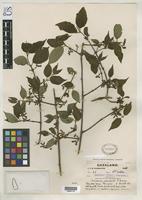
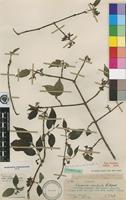
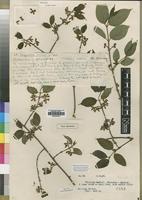
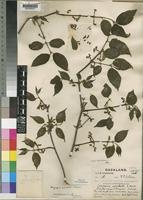
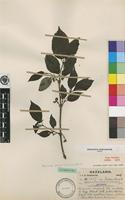
Isotype of Vangueria esculenta Moore, S. 1911. [family RUBIACEAE]
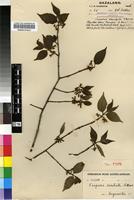
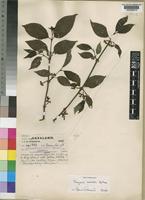
Isotype of Vangueria esculenta S.Moore [family RUBIACEAE]
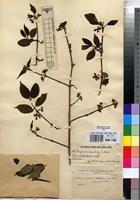
Type of Vangueria esculenta S.Moore [family RUBIACEAE]
Previous
Next

Name

Identification
Vangueria esculenta S.Moore [family RUBIACEAE ] (stored under name);
Related name
  • Vangueria esculenta

Flora

Entry for Vangueria esculenta S. Moore [family RUBIACEAE]
Herbarium
Royal Botanic Gardens, Kew (K)
Collection
Flora Zambesiaca
Resource Type
Reference Sources
Entry From
FZ, Vol 5, Part 2, (1998) Author: D. Bridson
Names
Vangueria esculenta S. Moore [family RUBIACEAE], in J. Linn. Soc., Bot. 40: 91 (1911). —De Wildeman in Bull. Jard. Bot. État 8: 52 (1922). —Robyns in Bull. Jard. Bot. État 11: 292 (1928). —Drummond in Kirkia 10: 276 (1975). —K. Coates Palgrave, Trees Southern Africa, ed. 3, rev.: 872 (1988), pro parte. Type: Zimbabwe, Chirinda Forest, Swynnerton 65 (holotype BM; K).
Vangueria esculenta var. glabra S. Moore [family RUBIACEAE], in J. Linn. Soc., Bot. 40: 91 (1911). —Robyns in Bull. Jard. Bot. État 11: 293 (1928). Type: Zimbabwe, Chirinda Forest, Swynnerton 1307 (BM, holotype; K).
Information
Small tree or shrub 1.8–6(12) m tall, with smooth bark; branchlets slender, at first covered with spreading yellowish-brown hairs, later ± glabrous, dull purplish, with finely ridged bark which flakes off in small pieces.Leaves membranous to thinly papery, 2–11 × 0.6–4.8 cm, elliptic or ovate-elliptic to elliptic-oblong, acuminate at the apex, rounded at the base, almost glabrous to densely pubescent above and on the nervation beneath, never velvety and the surface never obscured; lateral nerves in 6(7) main pairs; tertiary nerves moderately finely reticulate; petiole 5–9(15) mm long, spreading pubescent; stipules joined at base to form a cylindrical sheath 2 mm long with decurrent pubescent subulate appendage 5–7 mm long.Inflorescences pubescent, sweet-scented, often at leafless nodes, 1–2 cm long, usually of 7-flowered short dichasial cymes; peduncle 0.9–1.5 cm long with involucre of small brownish bracts at apex and another about one third the length below it or midway, presumably a true peduncle with a secondary axis but lateral branchlets suppressed; true secondary branches c. 2 mm long; pedicels 0–2 mm long.Calyx pubescent; tube c. 1 mm long, campanulate; lobes c. 1.5 mm long, triangular.Corolla rounded or ± acute in bud, distinctly contracted around the limb/tube junction in the dry state; white, yellow or pale green, glabrous or with a very few scattered hairs or with limb part pubescent outside, tube 4–5 mm long; lobes 3–3.5 × 1.5–1.8 mm, oblong-triangular, acute but not apiculate, strongly reflexed.Style exserted 1.5–2 mm; pollen presenter 0.7 mm long, ± cylindrical.Fruits deep yellow, 18–22 mm wide; pyrenes 3–5, each 18 × 8 mm with a conspicuous almost central notch.
Habitat
Evergreen forest subcanopy
Range
Not known outside the Flora Zambesiaca area
Altitude range
(200)1110–1800 m.
1800
1110
Distribution
Mozambique Z Serra Morrumbala, young fr. 13.xii.1971, Müller & Pope 2021 (K; LISC; SRGH).Mozambique MS 25 km SW of Lacerdónia, fl. 6.xii.1971, Müller & Pope 1908 (K; LISC; SRGH).Malawi S Blantyre Distr., Bangwe Hill, 4 km east of Limbe, 23.xi.1977, Brummitt et al. 15161 (K).Zimbabwe E Chirinda Forest, fl. 28.x.1947, Wild 2247 (K; SRGH).
Notes
The specimens cited from Malawi S and Mozambique Z are the only specimens known from outside Chirinda and adjacent areas. While they seem to be representative of V. esculenta more material is needed for critical study. In South Africa the name V. esculenta has been confused with V. madagascariensis and/or V. randii subsp. chartacea (e.g. Palmer & Pitman, Trees Southern Africa 3: 2083 (1973) and Moll, Trees of Natal: 250 & 251 (1981)). The ‘Chirinda Medlar’.

Related Materials

  • Terms and Conditions
  • Privacy Policy
  • Cookie Policy
  • Cookie Settings
  • Accessibility
  • Help
  • Contact Us
  • Facebook
  • Twitter
ITHAKA

JSTOR is part of ITHAKA, a not-for-profit organization helping the academic community use digital technologies to preserve the scholarly record and to advance research and teaching in sustainable ways.

©2000-2026 ITHAKA. All Rights Reserved. JSTOR®, the JSTOR logo, JPASS®, Aluka®, and ITHAKA® are registered trademarks of ITHAKA.

╳