JSTOR Global Plants Home
  • Home
  • Browse
  • About
  • Access
  • Account
    • Saved Items
    • Profile
  • Log in

Global Plants

Skip to Main Content
  • JSTOR Global Plants Home
  • Global Plants

    • Browse
    • About
    • Access
    • Account
      • Saved Items
      • Profile
Log in
  • Browse
  • About
  • Access
  • Account
    • Saved Items
    • Profile
Advanced Search

Compilation
Vangueria apiculata

19 Images see all

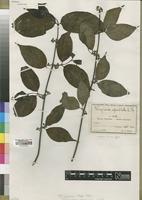
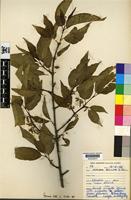
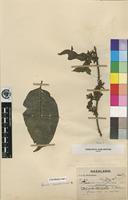
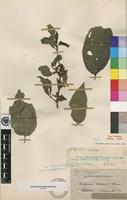
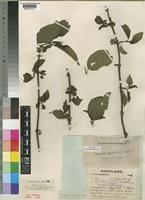
Type of Vangueria apiculata K.Schum. [family RUBIACEAE]
Vangueria apiculata
Filed as Vangueria apiculata K. Schum. [family RUBIACEAE]
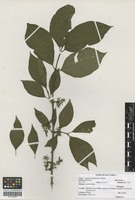
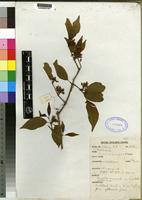
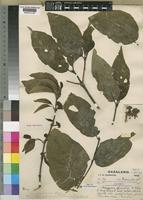
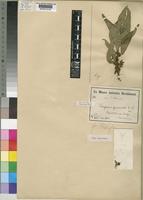
Type? of Vangueria apiculata K.Schum. [family RUBIACEAE]
Vangueria apiculata
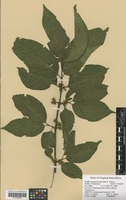
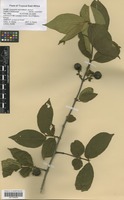
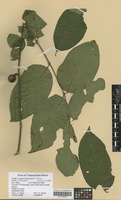
Isotype of Vangueria apiculata K.Schum. [family RUBIACEAE]
Filed as Vangueria apiculata K. Schum. [family RUBIACEAE]
Vangueria apiculata
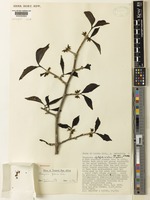
Type of Vangueria apiculata K.Schum. [family RUBIACEAE]
Vangueria apiculata K.Schum. [family RUBIACEAE]
Vangueria apiculata
Type of Vangueria apiculata K.Schum. [family RUBIACEAE]
Vangueria apiculata
Filed as Vangueria apiculata K. Schum. [family RUBIACEAE]
Holotype of Vangueria praecox Verdc. [family RUBIACEAE]
Vangueria apiculata K.Schum. [family RUBIACEAE]
Vangueria apiculata
Type of Vangueria apiculata K.Schum. [family RUBIACEAE]
Previous
Next

Name

Identification
Rytigynia stolzii Robyns [family RUBIACEAE ] (stored under name); Vangueria apiculata K.Schum. [family RUBIACEAE ]
Related name
  • Vangueria longicalyx
  • Rytigynia stolzii
  • Vangueria apiculata
  • Fadogia unrecorded

Flora

Entry for Vangueria apiculata K. Schum. [family RUBIACEAE]
Herbarium
Royal Botanic Gardens, Kew (K)
Collection
Flora Zambesiaca
Resource Type
Reference Sources
Entry From
FZ, Vol 5, Part 2, (1998) Author: D. Bridson
Names
Vangueria apiculata K. Schum. [family RUBIACEAE], in Engler, Pflanzenw. Ost-Afrikas C: 385 (1895). —Mildbraed, Wiss. Ergebn. Deutsch. Zentr.-Afrika Exped., Bot., part 4: 326 (1911). —Robyns in Bull. Jard. Bot. État 11: 283 (1928). —Brenan, Check-list For. Trees Shrubs Tang. Terr.: 537 (1949). —Cufodontis in Phyton (Horn) 1: 145 (1949). —Dale & Eggeling, Indig. Trees Uganda, ed. 2: 358 (1952). —F.W. Andrews, Fl. Pl. Anglo-Egypt. Sudan 2: 466 (1952). —J.G. Garcia in Mem. Junta Invest. Ultramar 6 (sér. 2): 32 (1959) [Contrib. Conhec. Fl. Moçamb. IV (1959)]. —Dale & Greenway, Kenya Trees & Shrubs: 478 (1961). —Drummond in Kirkia 10: 276 (1975). —Bridson & Troupin in Fl. Pl. Lign. Rwanda: 610, fig. 207.1 (1982); in Fl. Rwanda 3: 230, fig. 73.1 (1985). —K. Coates Palgrave, Trees Southern Africa, ed. 3, rev.: 872 (1988). —Verdcourt in Kew Bull. 36: 550 (1981); in F.T.E.A., Rubiaceae: 853 (1991). —Beentje, Kenya Trees, Shrubs Lianas: 550 (1994). Type from Kenya.
Vangueria longicalyx Robyns [family RUBIACEAE], in Bull. Jard. Bot. État 11: 278 (1928). —Pardy in Rhodesia Agric. J. 52: 237 (1955). —J.G. Garcia in Mem. Junta Invest. Ultramar 6 (sér. 2): 32 (1959) [Contrib. Conhec. Fl. Moçamb. IV (1959)]. Type: Zimbabwe, Chirinda outskirts, Swynnerton 64 (K, holotype and isotype; BM).
Vangueria sp. near randii [family RUBIACEAE], —Brenan, Check-list For. Trees Shrubs Tang. Terr.: 537 (1949).
Information
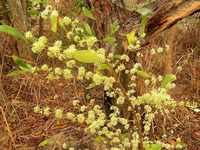
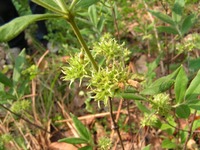
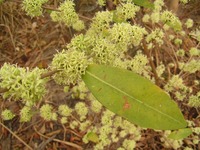
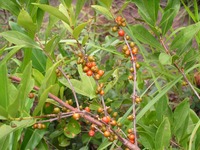
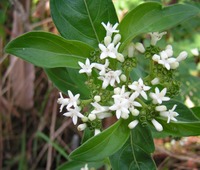
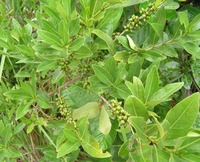
Shrub, subscandent shrub or small spreading tree 1.8–15 m tall.Stems sometimes several, virgate with branching often horizontal; bark grey, brown or red-brown, more or less smooth or finely ridged; young shoots mostly dark plum-coloured and lenticellate, quite glabrous.Leaves 3–15(17) × 1.5–6(8) cm, elliptic, oblong, ovate or ovate-lanceolate to lanceolate, distinctly acuminate at the apex, rounded to cuneate or occasionally subcordate at the base, often discolorous and venose beneath when dry, quite glabrous or rarely slightly pubescent beneath; lateral nerves in (6)7–8 main pairs; tertiary nerves finely reticulate; petiole 7–10(14) mm long; stipules with filiform part 3–9.5 mm long from a short broad base 1.5–2 mm long.Inflorescences typically short, 1–3.5 cm long including peduncle, fairly lax to very condensed, the rhachis pedicels and calyx tube almost glabrous to usually pubescent or densely shortly hairy; peduncle 5–10 mm long, similarly hairy, with paired bracts near the apex 3 × 2 mm long; pedicels 2–4 mm long, pubescent.Calyx tube 1.5 mm in diameter, subglobose, glabrescent to densely shortly hairy; lobes (1.2)3–7 mm long, oblong to linear, sometimes slightly spathulate, glabrous or ciliolate.Corolla distinctly apiculate at the apex but not tailed in bud; glabrous outside, greenish-white, or green to yellow; tube 4–5 mm long with a conspicuous tuft of hairs projecting from the throat; lobes 4–4.5 ´ 2 mm.Style 6–8 mm long; pollen presenter 1.2 mm long.Fruit turning brown, 1.7–2.2 × 1.4–2.2 cm, subglobose, or sometimes irregularly ellipsoid where only one pyrene has developed, glabrous; pyrenes 3–5, 9–17 × 4–6 mm.
Habitat
Riverine thicket and evergreen forest, and in mixed woodland, sometimes in rocky places, exposed hillsides and termite mounds
Altitude range
(850)960–2050 m.
2050
960
Distribution
Mozambique MS Manica, Mt. Vumba, fr. 29.iv.1963, Gomes e Sousa 4799 (COI; K; PRE).Malawi S Ntcheu Distr., Chirobwe Forest, fl. 18.xii.1962, Banda 478 (K; SRGH).Zimbabwe S Bikita Distr., Old Bikita, Danga, fl. 16.xii.1953, Wild 4397 (K; SRGH).Zimbabwe E Chimanimani (Melsetter), fl. 30.xi.1962, West 4346 (K; LISC; SRGH).Zimbabwe C Makoni, fl. 20.xii.1940, Hopkins in GHS 7851 (K; SRGH).Zambia W just S of Matonchi Farm, young fr. 2.i.1938, Milne-Redhead 3920 (K).Mozambique Z Milange, Serra do Chiperone (Chiparene) subida pelo Chefe Marrega vertente Voltada a NW, fr. 1.ii.1972, Correia & Marques 2472 (BR; LMU).Malawi C Dedza Mt., fr. 24.iv.1970, Brummitt 10103 (K).Zimbabwe N Mazowe Distr., Mvurwi (Umvukwes), fl. 16.xii.1952, Wild 3920 (K; SRGH).Zambia N Mbala Distr., Lake Chila, fl. 6.xi.1952, R.G. Robertson 221 (K; PRE) (see note).
Distribution (external)
Zaire (Dem. Rep. Congo)
Rwanda
Sudan
Ethiopia
Uganda
Kenya
Tanzania
Notes
Specimens from northern Zambia: R.G.Robertson 221 (Mbala, Lake Chila); Dowsett-Lemaire 73 (edge of Chowo Forest, Nyika Plateau); and Nkhoma et al. 137 (Nsumbu National Park) have shorter calyx lobes, but otherwise are a good match for V. apiculata. Similar specimens are known from the Ufipa and Iringa Districts of Tanzania. In many respects this material resembles the more northerly forms of V. madagascariensis and could equally well be classified with that species. The 'small wild medlar'.

Related Materials

  • Terms and Conditions
  • Privacy Policy
  • Cookie Policy
  • Cookie Settings
  • Accessibility
  • Help
  • Contact Us
  • Facebook
  • Twitter
ITHAKA

JSTOR is part of ITHAKA, a not-for-profit organization helping the academic community use digital technologies to preserve the scholarly record and to advance research and teaching in sustainable ways.

©2000-2026 ITHAKA. All Rights Reserved. JSTOR®, the JSTOR logo, JPASS®, Aluka®, and ITHAKA® are registered trademarks of ITHAKA.

╳