JSTOR Global Plants Home
  • Home
  • Browse
  • About
  • Access
  • Account
    • Saved Items
    • Profile
  • Log in

Global Plants

Skip to Main Content
  • JSTOR Global Plants Home
  • Global Plants

    • Browse
    • About
    • Access
    • Account
      • Saved Items
      • Profile
Log in
  • Browse
  • About
  • Access
  • Account
    • Saved Items
    • Profile
Advanced Search

Compilation
Vismianthus punctatus

9 Images see all

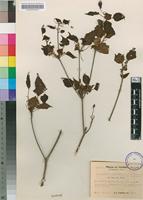
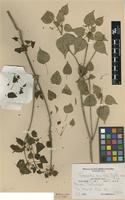
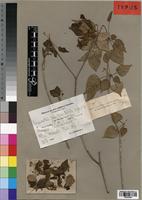
Isotype of Vismianthus punctatus Mildbr. [family CONNARACEAE]
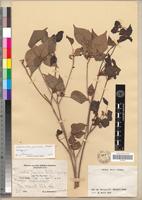
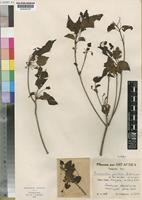
Type of Vismianthus punctatus Mildbr. [family CONNARACEAE]
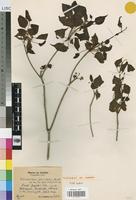
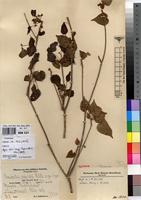
Isotype of Vismianthus punctatus Mildbr. [family CONNARACEAE]
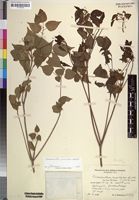
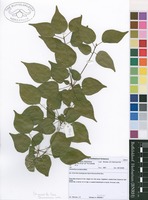
Filed as Vismianthus punctatus Mildbr. [family CONNARACEAE]
Type of Vismianthus punctatus Mildbr. [family CONNARACEAE]
Previous
Next

Name

Identification
Isotype of Vismianthus punctatus Mildbr. [family CONNARACEAE ] (stored under name); Verified by Not on sheet,
Related name
  • Vismianthus punctatus

Flora

Entry for VISMIANTHUS punctatus Mildbr. [family CONNARACEAE]
Herbarium
Royal Botanic Gardens, Kew (K)
Collection
Flora of Tropical East Africa
Resource Type
Reference Sources
Entry From
Flora of Tropical East Africa, page 1, (1956) Author: J. H. Hemsley
Names
VISMIANTHUS punctatus Mildbr. [family CONNARACEAE], in N.B.G.B. 12: 706 (1935); E.P. IV. 127: 98, fig. 15 (1938); T.T.C.L. 169 (1949). Type: Tanganyika, Lindi District, Mlinguru, about 20 km. S. of Lindi, Schlieben 5757 (B, holo. †, BM, iso.!)
Information
Much branched shrub to 5 m. high, young branches pubescent, later becoming glabrous with pale brown smooth bark and inconspicuous transverse ringing. Petiole slender, about half length of leaf blade, puberulous; lamina broadly ovate, to 8 cm. long, 5 cm. wide, apex long and narrowly acuminate, base slightly cordate, chartaceous; upper surface sparsely puberulous when young, later glabrescent; lower surface with scattered bifurcate hairs, denser on midrib and main lateral nerves, thickly beset with small dark glandular dots; lateral nerves 4–6, arcuate, ascending. Inflorescence raceme-like, with about 5 flowers; rhachis 1.5–5 cm. long, puberulous. Sepals green with dark red glandular dots and streaks, narrowly elliptic and deeply concave, to 3.5 mm. long, 1.5 mm. wide, ± glabrous. Petals white with lines of dark red glandular dots and streaks, obovate to elliptic-oblong, to 5 mm. long, 2.3 mm. wide, glabrous. Five episepalous stamens to 3.5 mm. long, 5 epipetalous to 2.5 mm. long. Ovary ovoid, to 1 mm. long, densely covered with long pale brown hairs, style ± 2 mm. long. Fruit (not fully mature) to 1.7 cm. long, 8 mm. diam., apex narrowed to a slender rostrum; dehiscence probably by ventral suture; outer layer of pericarp thin and brittle when dry, puberulous when young, later glabrescent, with prominent raised nerves and scattered dark raised gland-dots. Seed solitary, with thickened attachment to ventral placenta. Fig. 3.
Range
DISTR. T8 not known elsewhere
Altitude range
800 m.
Distribution
TANGANYIKA Lindi District Rondo Plateau, Mchinjiri, Nov. 1951 (fl.), Eggeling 6402! & Feb. 1952 (fr.), Semsei 647!;TANGANYIKA Newala District Kitangari, Gillman 1315!
Notes
This monotypic genus, known only from the Southern Province, Tanganyika, appears to be frequent on the Rondo and Makonde plateaux. Ripe fruits and mature seeds have not yet been obtained but the immature seed shows the presence of a very interesting basal structure. This takes the form of a series of branched processes, arising apparently from the testa, which are suggestive of a suspensor mechanism comparable with that found in Schellenbergia sterculiifolia (Prain) Parkinson, a monotypic Malayan genus. The basal processes although appearing to be quite separate from the hilum seem to be of arillar derivation. Observations on the method of fruit dehiscence and collections to include mature fruit and seeds are required to supplement the very sparse herbarium material available of this plant.

Related Materials

  • Terms and Conditions
  • Privacy Policy
  • Cookie Policy
  • Cookie Settings
  • Accessibility
  • Help
  • Contact Us
  • Facebook
  • Twitter
ITHAKA

JSTOR is part of ITHAKA, a not-for-profit organization helping the academic community use digital technologies to preserve the scholarly record and to advance research and teaching in sustainable ways.

©2000-2026 ITHAKA. All Rights Reserved. JSTOR®, the JSTOR logo, JPASS®, Aluka®, and ITHAKA® are registered trademarks of ITHAKA.

╳