JSTOR Global Plants Home
  • Home
  • Browse
  • About
  • Access
  • Account
    • Saved Items
    • Profile
  • Log in

Global Plants

Skip to Main Content
  • JSTOR Global Plants Home
  • Global Plants

    • Browse
    • About
    • Access
    • Account
      • Saved Items
      • Profile
Log in
  • Browse
  • About
  • Access
  • Account
    • Saved Items
    • Profile
Advanced Search

Compilation
Viscum shirense

5 Images see all

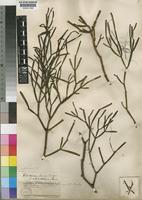
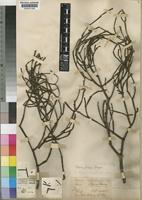
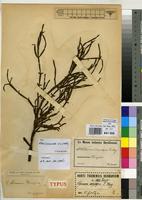
Viscum shirense Sprague [family VISCACEAE]
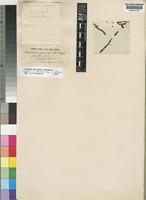
Isotype of Viscum junodii Engl. [family VISCACEAE]
Isotype of Viscum junodii (Tiegh.) Engl. [family VISCACEAE]
Viscum shirense Sprague [family VISCACEAE]
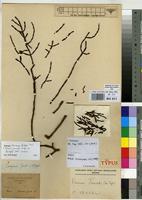
Type? of Viscum shirense Sprague [family VISCACEAE]
Previous
Next

Name

Identification
Isotype of Viscum junodii (Tiegh.) Engl. [family VISCACEAE ] Verified by Not on sheet, Viscum shirense Sprague [family VISCACEAE ] (stored under name); Verified by Polhill R.M., 1997
Related name
  • Aspidixia junodii
  • Viscum articulatum
  • Viscum shirense
  • Viscum junodii
  • Viscum dichotomum

Flora

Entry for VISCUM shirense Sprague [family VISCACEAE]
Herbarium
Royal Botanic Gardens, Kew (K)
Collection
Flora of Tropical Africa
Resource Type
Reference Sources
Entry From
Flora of Tropical Africa, Vol 6, Part 1, page 255, (1913) Author: (By J. G. Baker, with additions by C. H. Wright.)
Names
VISCUM shirense Sprague [family VISCACEAE]
VISCUM anceps Engl. [family VISCACEAE], in Engl. Jahrb. xxx. 305, not of E. Meyer.
Information
A much-branched shrub. Stem terete, about 2 1/2 lin. in diam. 1 1/2 ft. below the apex of the branchlets. Branches and branchlets conspicuously flattened, ribbed in a dried state; internodes broadly linear or oblanceolate-linear, more rarely oblong, tape-like, broadest in their upper part, little or not at all contracted at the apex, more or less tapering into the base, 1/2–1 1/2 in. long, 1–2 1/4 lin. broad, those of the main branches much thickened along the middle. Flowers diœcious, tetramerous. Male inflorescence: Flowers solitary, sessile. Bud ellipsoid, 1 1/4 lin. long, solid base 1/4 lin. long. Receptacular tube 3/8– 1/2 lin. long. Petals deltoid-ovate, 1/2– 5/8 lin. long. Anthers obtusely trigonous, elliptic in outline, 1/2– 5/8 lin. long, 3/8 lin. broad. Female inflorescences consisting of 1 or 3 flowers, which are usually unprovided with bracteal cups. Bracteal cup, when present, embracing only the base of the receptacle at the time of expansion of the flower, sessile, bilobed, 1/2– 5/8 lin. high, 5/8 lin. long; lobes ascending, very obtuse, 3/8 lin. long. Receptacle and pedicel together obovoid-oblong, 7/8–1 lin. long, 5/8 lin. broad. Petals yellowish-green, oblong-ovate, 5/8– 3/4 lin. long, 3/8– 1/2 lin. broad, deciduous. Style distinct, short, thick, compressed-quadrangular; stigma projecting 3/8– 1/2 lin. above the insertion of the petals. Young berry pedicelled, orange-red, ovoid.
Distribution
German East Africa Mozamb. Dist. Unyika; near Manyames Dorf, 5000 ft., Goetze, 1441!Nyasaland Mozamb. Dist. Mount Malosa, 4000–6000 ft., Whyte! near Mambane, 4000 ft., Kirk!Portuguese East Africa Mozamb. Dist. Gazaland; Mossurize District, Mafusi, 3500 ft., Johnson, 166! Mount Maruma, 3500 ft., on Albizzia, &c., Swynnerton, 1085!
Notes
V. anceps, E. Meyer, bears a strong resemblance to V. shirense, from which it may be distinguished by the shorter internodes, distinctly contracted at the apex, and the warted berries, each of which is borne by a bracteal cup.

Related Materials

  • Terms and Conditions
  • Privacy Policy
  • Cookie Policy
  • Cookie Settings
  • Accessibility
  • Help
  • Contact Us
  • Facebook
  • Twitter
ITHAKA

JSTOR is part of ITHAKA, a not-for-profit organization helping the academic community use digital technologies to preserve the scholarly record and to advance research and teaching in sustainable ways.

©2000-2026 ITHAKA. All Rights Reserved. JSTOR®, the JSTOR logo, JPASS®, Aluka®, and ITHAKA® are registered trademarks of ITHAKA.

╳