

Compilation
Uvaria pycnophylla
1 Images see all
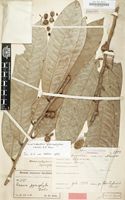
Name
Identification
Uvaria pycnophylla Diels [family ANNONACEAE ] Verified by Not on sheet., Uvariodendron pycnophyllum (Diels) R.E.Fr. [family ANNONACEAE ] (stored under name); Verified by Not on sheet.,
Related name
- Uvaria pycnophylla
- Uvariodendron pycnophyllum
Flora
Entry for UVARIODENDRON pycnophyllum (Diels) R. E. Fries [family ANNONACEAE]
Herbarium
Royal Botanic Gardens, Kew (K)
Collection
Flora of Tropical East Africa
Resource Type
Reference Sources
Entry From
Flora of Tropical East Africa, page 1, (1971) Author: B. Verdcourt
Names
UVARIODENDRON pycnophyllum (Diels) R. E. Fries [family ANNONACEAE], in Acta Horti Berg. 10: 58 (1930); T.T.C.L.: 46 (1949); Verdc. in K.B. 23: 515 (1969). Type: Tanganyika, W. Usambara Mts., Bungu, Langheinrich in F.H. Dar es Salaam 2889 (B, syn.) & E. Usambara Mts., Sigi valley near Amani, Brönnle in Herb. Amani 1876 (B, syn., FHO, isosyn. !)
Uvaria pycnophylla Diels [family ANNONACEAE], in E.J. 53: 434 (1915)
Information
Tree; bark flaking off in membranous plates; branchlets graceful, glabrous below (but no apical portions have been seen), ridged and lenticellate; buds silvery silky (fide Fries, presumably leaf-buds). Leaf-blades oblong-oblanceolate or oblanceolate, 15–28 cm. long, 2.5–6.5 cm. wide, distinctly acuminate at the apex, cuneate at the base, rather thick, glabrous and somewhat shining above, at first silvery silky beneath in young leaves, but soon hairs becoming sparse and lower surface at length almost glabrous; midrib impressed above, very prominent beneath; lateral nerves 15–20, prominent beneath; petiole 7–10 mm. long, thick. Flowers axillary, solitary, subsessile, borne on the leafy branchlets; peduncle attaining 1 cm. after flowering; bracts 6, imbricate below the calyx, biseriate, rounded, up to ± 1 cm. long, silky outside, glabrous inside. Sepals joined at the base, broadly ovate, much shorter than the petals, silvery silky outside. Petals thick,outer ovate-elliptic, ± 2 cm. long, 1.6 cm. wide, apiculate, inner oblong-elliptic, about the same length but narrower, narrowed at the base, all silvery silky outside, glabrous inside save for some sparse tomentum towards the apex. Stamens linear, 3 mm. long. Monocarp (only one seen) oblong, 2.7 cm. long, 1.6 cm. wide, rounded at both ends, ferruginous tomentose.
Range
DISTR. T3 not known elsewhere
Altitude range
840–1100 m.
Distribution
TANGANYIKA Lushoto District W. Usambara Mts., Bungu, July 1912, Langheinrich in F.H. Dar es Salaam 2889 & E. Usambara Mts., Sigi valley near Amani, 20 July 1908, Brönnle in Herb. Amani 1876!
Notes
The above description is based almost entirely on that given by Fries, which is curiously very much fuller than that given by Diels, which describes only the petiole and leaf-blades. The sheet at FHO which I have seen bears the number 1876 but the collector is stated to be Braun. T.T.C.L. gives both Braun 1876 and Brönnle 1876, but it is highly improbable that there are two such gatherings. I am certain the writer of the duplicate label at Berlin made a slip. The old herbarium book preserved in Nairobi gives 1876 as having been collected by Br. which could mean either.